
Original briefings. Zero spin.
Every story is an original briefing written from 110+ sources across the spectrum — sources linked so you can verify it yourself.
 finance
Major Story (7/10)
Event date: September 3, 2026
finance
Major Story (7/10)
Event date: September 3, 2026
Shein Shares Fall 21.5% in First Week of Hong Kong Trading, Company Discloses FTC Probe
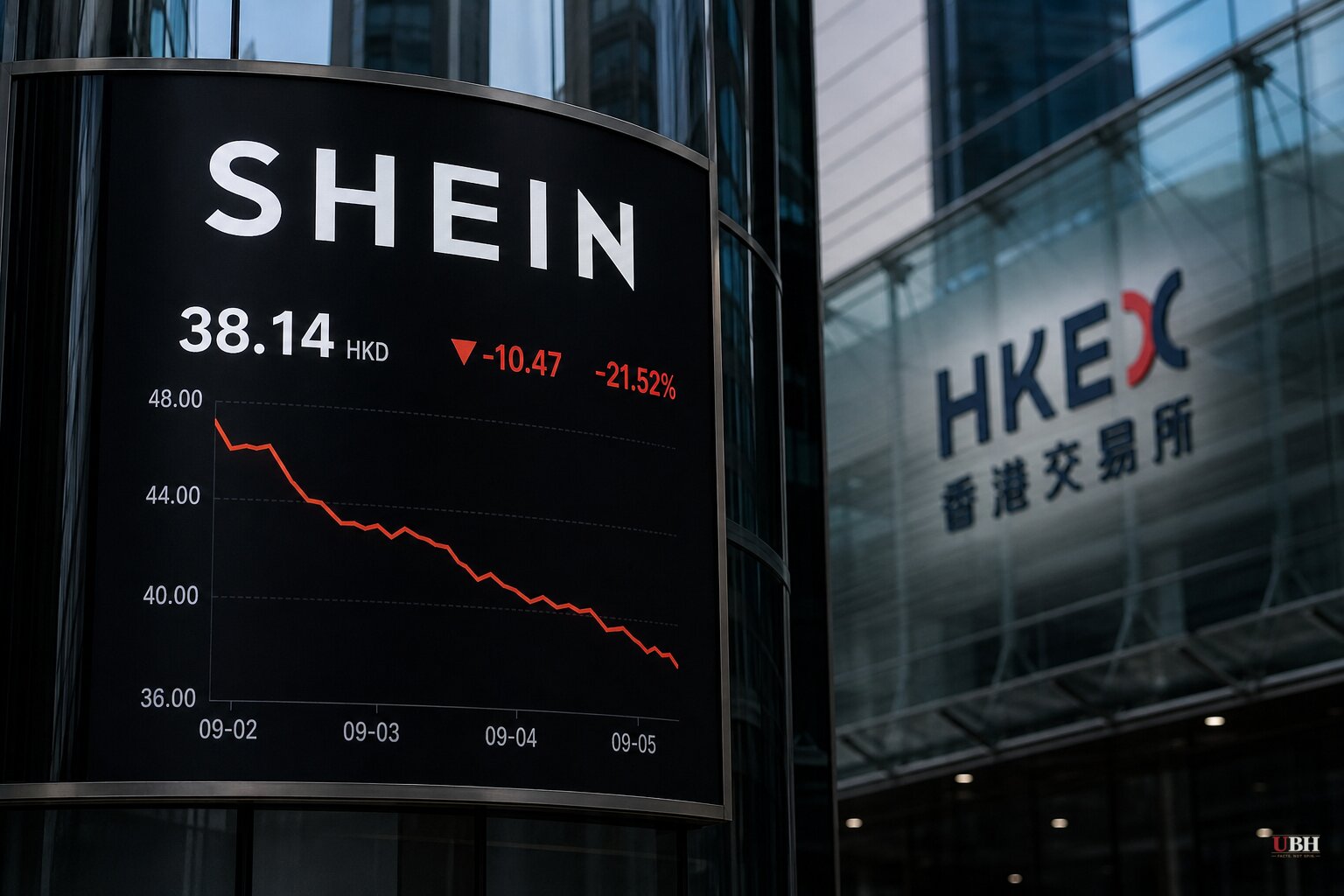
Since Shein began trading on the Hong Kong Stock Exchange on Tuesday, September 1, its stock has dropped in every single session. It closed Friday, September 4, at HK$38.14 ($4.86), down 21.5% from its HK$48.56 ($6.19) IPO price, according to The Epoch Times.
The sequence was ugly from the start. Shares fell as much as 10% on opening day, then kept sliding: HK$46.00 on September 2, HK$42.00 on September 3, HK$38.14 on September 4. Shein never closed above its offer price once in four days of trading.
The IPO itself already represented a massive comedown. Shein raised roughly $1.7 billion and was valued at around $26.5 billion, according to CNN Business, down more than 70% from its 2022 peak of $98.2 billion. FX Empire pegged the post-slide valuation at roughly $22.7 billion by Thursday's close.
Beyond the daily stock drops, Shein disclosed to The Epoch Times that its U.S. sales fell 14%, which it attributes in part to the end of duty-free "de minimis" treatment for low-value Chinese shipments. Shein also confirmed it is under investigation by the Federal Trade Commission. FTC deputy director of public affairs Juliana Gruenwald Henderson declined to detail the probe, telling The Epoch Times: "FTC investigations are nonpublic, so we generally do not comment on them."
Separately, the Committee on Foreign Investment in the United States is reviewing Shein's acquisition of U.S. retailer Everlane, according to an August Bloomberg report cited by The Epoch Times. Everlane CEO Alfred Chang confirmed the deal in May, saying the brand would stay independent under Shein while gaining more financial stability. Neither Shein, Everlane, nor the Treasury Department responded to The Epoch Times' request for comment.
France also began enforcing its ultra-fast-fashion penalty law on September 1, the same day Shein started trading. Under the law, penalties on qualifying products can reach €12 (about $14) per item this year, capped at 50% of the item's pre-tax price, rising to €19.50 by 2030. Starting January 1, 2027, paid or unpaid influencer promotion of ultra-fast-fashion brands will be banned in France, with fines up to €116,000 for violations.
Sources disagree on emphasis, not facts. Breitbart frames the collapse around President Trump's trade policy, quoting Reuters' description that Shein was "humbled by tariff and duty changes in the U.S. and Europe." Saxo's chief investment strategist Charu Chanana told Reuters the stock still looks overpriced given "weak growth visibility and significant regulatory and trade risks."
CNN's reporting broadens the picture: the EU scrapped its own de minimis exemption in July, adding pressure alongside the U.S. change. CNN also reports Shein's net income plunged 39% last year even as revenue grew, and losses swelled to $99 million in the first quarter of this year, according to its IPO prospectus.
Euronews emphasizes an ESG angle, quoting sustainability consultant Ildiko Almasi Simsic's argument that "capital markets aren't acting out of pure altruism: they're reacting to material financial risk," and that Shein's model of forced-labor allegations and hazardous-chemical findings (Greenpeace Germany flagged seven of 47 tested products in 2022) has become a "central business risk." That's a real factor sources cite, but it's one of several, not the sole explanation Euronews implies.
Jin Lu of The Asia Group consultancy told CNN Shein "absolutely missed the best timing for an IPO," while GlobalData's Louise Deglise-Favre noted competitors have only intensified pressure. Dartmouth's Ken Pucker told Marketplace it remains "unclear" whether Shein's underlying labor and environmental issues were ever actually resolved, versus the company simply finding "a more permissible place to IPO" in Hong Kong after New York and London rejected it.
Shein still has real scale: a global customer base, a supply chain that disrupted Zara and H&M, and, per its own prospectus, roughly 4,700 new apparel styles offered daily in the first quarter alone. FX Empire's Carolane De Palmas argues the rough debut "does not necessarily mean that Shein's growth story is over," and China's state-run Global Times has argued the company's supply-chain advantages remain distinctive. A four-day stock slide is not proof the business model is finished, only proof that Hong Kong investors are pricing in more risk than Shein's private backers once did.
CFIUS has not announced a timeline or outcome for its Everlane review. The FTC has not disclosed the scope, subject matter, or expected duration of its investigation. Whether Shein raises prices further in Europe to offset the new French penalties, as it has already done in the U.S. after the de minimis change, will be the next concrete signal of how much pricing power the company still has left.
Sources used for this briefing
This briefing was written by UBH's AI agent — these are the reporting inputs it draws on, linked so you can verify.


