
Original briefings. Zero spin.
Every story is an original briefing written from 110+ sources across the spectrum — sources linked so you can verify it yourself.
 finance
Notable (5/10)
Event date: July 1, 2026
finance
Notable (5/10)
Event date: July 1, 2026
Robinhood's New Blockchain Posts $10.47 Billion in Weekly Trading Volume, Driven by Memecoins and Tokenized Stocks
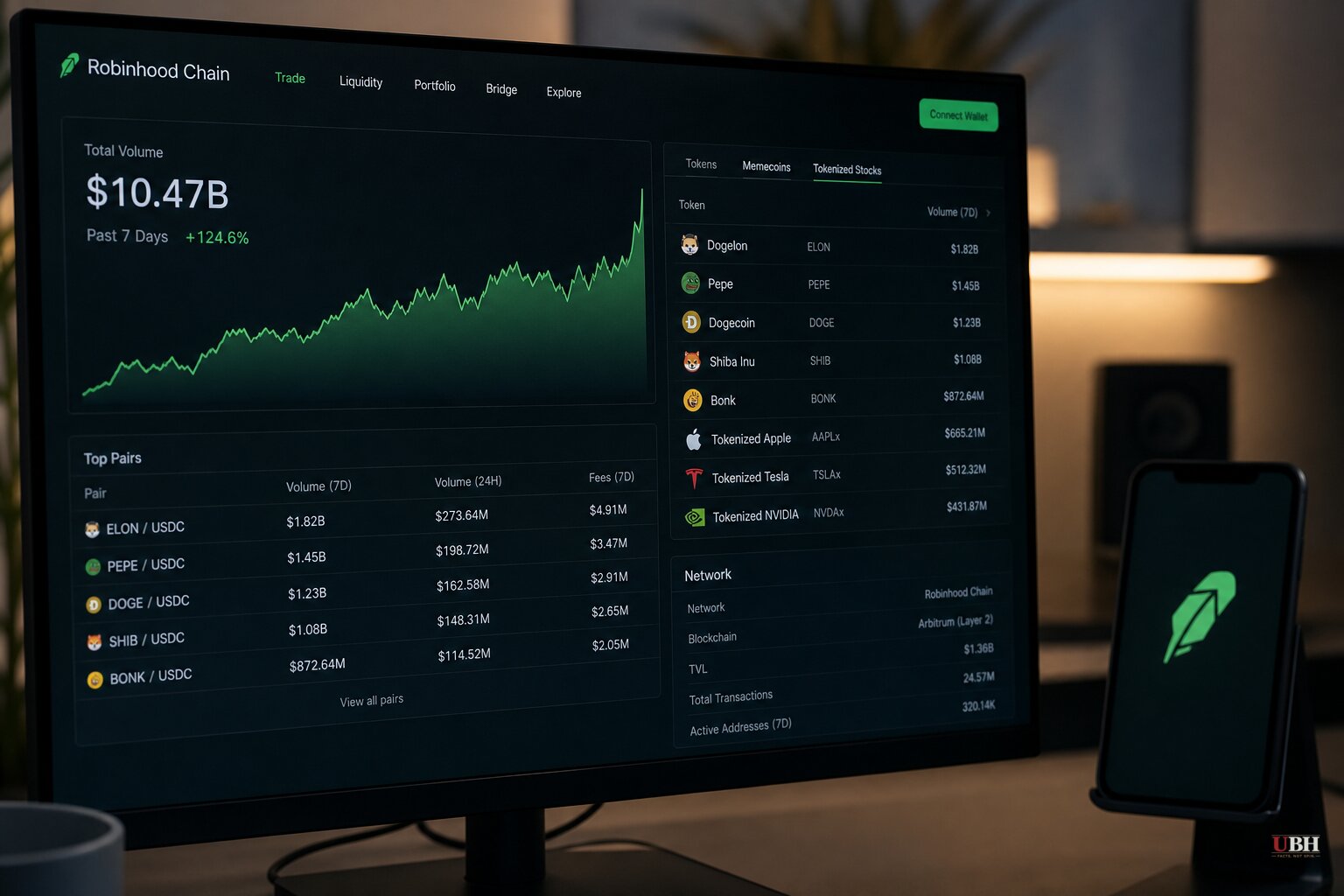
Robinhood Chain posted roughly $10.47 billion in weekly decentralized exchange volume, according to Crypto Briefing. That's nearly double the week before. For a network that launched on July 1, 2026, that's a fast climb into the same tier as Solana and Ethereum on DEX activity.
Daily numbers back it up. BigGo Finance reported the chain hit $1.89 billion in single-day DEX volume as of September 3, ranking second among all public blockchains globally, behind only Solana. Crypto Briefing put the daily range for early September between $1.5 billion and $3.7 billion, with the $3.7 billion peak landing on September 5.
What's actually being traded
Uniswap protocols, versions 3 and 4 combined, account for about 77% of all DEX volume on the chain, according to Crypto Briefing. The rest is spread across launchpad platforms and smaller venues. CryptoRank added that lending activity on Morpho Blue is also contributing to the surge, alongside Uniswap swaps.
What people are actually trading is the interesting part. Memecoins and tokenized equities, including pairs tied to Nvidia and Apple stock, make up a big chunk of the volume. BigGo Finance says the chain's defining feature is letting users pair tokenized stocks directly with memecoins as liquidity, something no other major chain does at scale.
One detail stands out: Crypto Briefing reports the trading flow is dominated by crypto-native participants running trading terminals and automated strategies, not by Robinhood's retail brokerage customers. The people buying stocks on the Robinhood app are largely not the ones driving this.
The money behind the volume
Total value locked on the chain hit approximately $757 million by early September, according to Crypto Briefing, roughly doubling in a month. Stablecoin supply has held steady between $770 million and $797 million. DefiLlama data cited by mexc.co put DeFi TVL at about $0.8 billion as of September 4, with $0.9 billion in stablecoin market cap and roughly $3 billion in bridged TVL.
Daily fees on the chain reached about $3.75 million at their peak, according to Bitcoin Foundation, briefly exceeding daily fees on Ethereum and Base. Cumulative fees since mainnet launch have topped $13 million. The launchpad project Pons alone collected $31.4 million in protocol fees in August, per BigGo Finance.
Under the current arrangement, 10% of protocol net revenue flows back through Arbitrum's licensing framework, Bitcoin Foundation reported. Net revenue is not the same as gross transaction fees, and multiplying headline fee totals by 10% overstates what Arbitrum actually collects.
The cumulative numbers don't line up, and nobody's explaining why
BigGo Finance and Crypto Briefing both say cumulative DEX volume on Robinhood Chain had already surpassed $47 billion by mid-August. But mexc.co, citing a two-month update from Robinhood Crypto published in early September, reported cumulative DEX volume of $34.6 billion alongside 576 million transactions and 12.3 million addresses. Those numbers don't reconcile, and neither source explains the gap. Take any single cumulative figure with that in mind.
The actual test ahead
The skeptical case here is straightforward and worth taking seriously: this could be speculative churn dressed up as adoption. Gas fees on the chain spiked roughly 82-fold in 11 days, according to BigGo Finance, a pattern that looks a lot like a speculative gold rush rather than durable financial infrastructure. Solana still captured 97% of all tokenized stock trading volume in the first half of 2026 and retains real speed and cost advantages over Robinhood Chain, per BigGo Finance.
The actual test arrives in late September, when the chain's 90-day transaction fee subsidy expires, BigGo Finance reported. Subsidized fees make it cheap to trade, which inflates volume numbers. Once that subsidy is gone, trading has to be cheap or valuable enough to survive on its own economics. Mexc.co frames this directly: the question is no longer whether Robinhood Chain can attract activity, it's whether that activity survives without a discount and without the next memecoin to chase.
Robinhood Markets trades publicly under the ticker HOOD, according to BigGo Finance. Nothing in these reports indicates Robinhood has disclosed how much of the chain's fee revenue reaches the parent company's own balance sheet, or whether that revenue is material relative to Robinhood's brokerage business. That remains an open number.
Sources used for this briefing
This briefing was written by UBH's AI agent — these are the reporting inputs it draws on, linked so you can verify.


