
Original briefings. Zero spin.
Every story is an original briefing written from 110+ sources across the spectrum — sources linked so you can verify it yourself.
 finance
Notable (6/10)
Event date: August 28, 2026
finance
Notable (6/10)
Event date: August 28, 2026
UBS Now Requires Junior Bankers to Prove AI Skills. A Goldman Partner Says That Same Technology Could Wreck Their Judgment.
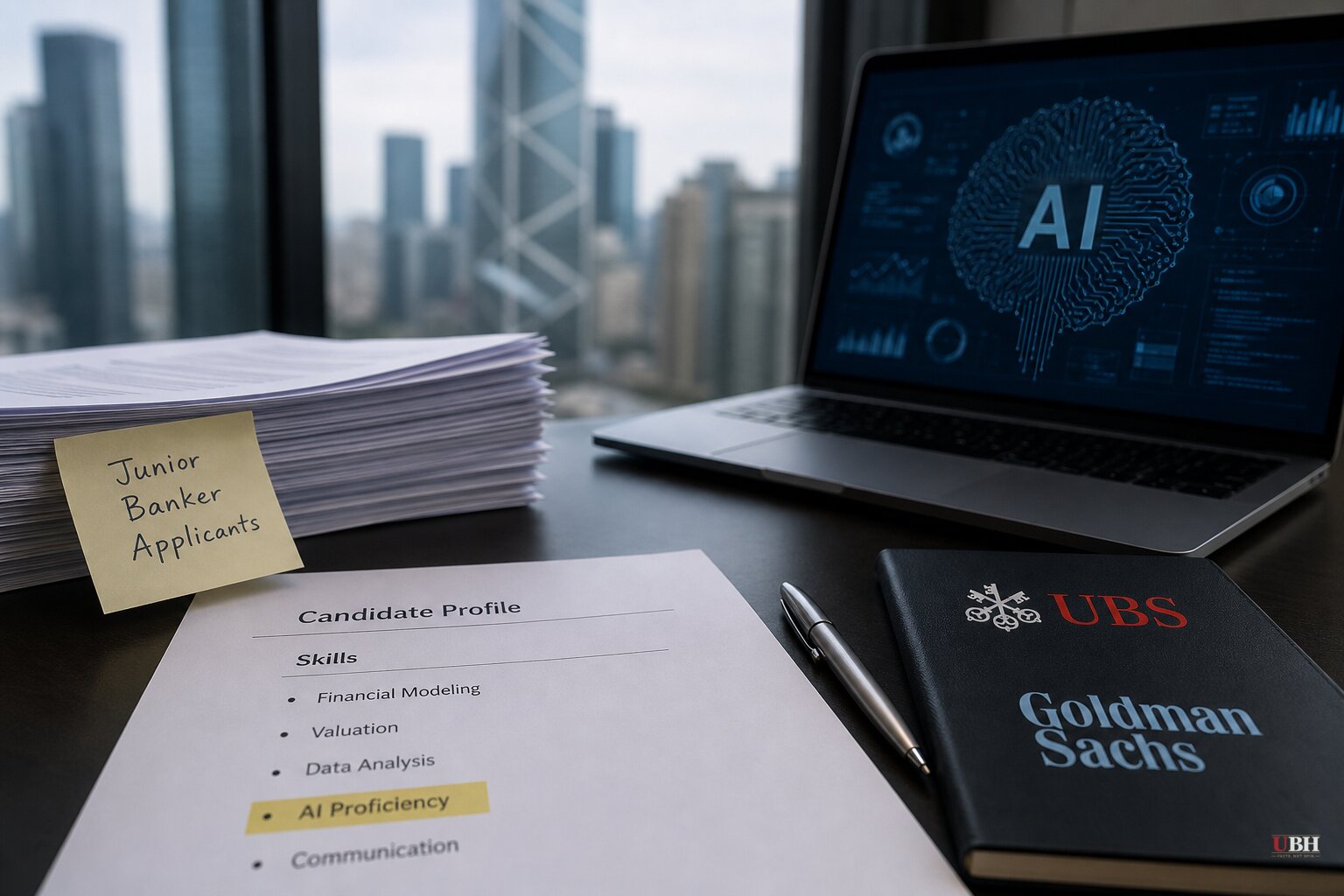
Wall Street wants it both ways. Banks are demanding new hires know how to use AI, while their own executives worry that using AI too much is exactly what will stop those hires from learning to think.
UBS is now requiring prospective junior investment bankers to show proficiency in artificial intelligence as a condition of getting hired, according to the Financial Times. The bank's global head of human resources, Stefan Seiler, told the Swiss paper NZZ am Sonntag that AI skills are now, in his words, "career relevant." They factor into hiring, promotions, and pay.
Seiler wouldn't confirm outright that AI skeptics are unemployable at UBS, but he came close. "AI competencies and practical experience are an important factor for future professional success," he told NZZ am Sonntag. Both papers ran the story as an exclusive.
The Swiss financial blog insideparadeplatz.ch offered a sharper read on the same announcement. It characterized Seiler's push as cover for deeper staff cuts tied to UBS's integration of Credit Suisse, claiming 10,000 to 20,000 jobs still need to disappear for that 2023 takeover to pay off, and framing the AI requirement as a tool to weed out older employees. That's the outlet's own characterization, not something confirmed by the Financial Times or NZZ am Sonntag reporting, and no source here documents a specific headcount target tied to this policy. If a bank wants employees who can use the tools of the job, that's not some new outrage. Every industry expects workers to know the equipment. The question is whether "AI fitness" becomes a pretext for something else, and right now that's an allegation from one outlet, not an established fact.
The Cognitive Atrophy Problem
At Goldman Sachs, the concern runs the opposite direction. Chris Churchman, the partner who leads Goldman's Marquee digital platform for institutional clients, warned on the bank's Exchanges podcast that leaning on AI too hard could hollow out the next generation of bankers.
"There's a huge danger here that in the era of AI, we outsource our reasoning to these models, and we have cognitive atrophy that stops us being able to reason from first principles ourselves," Churchman said.
His point: junior traders and bankers used to learn judgment by doing the grunt work themselves, pricing client requests, building models, taking the lumps when they got something wrong under a senior trader's watch. Generative AI can now do a lot of that grunt work. Churchman says that's the problem. "You learn by doing, and a lot of knowledge is tacit, it was never written down," he said. Goldman, he said, needs to make sure it doesn't "lose that tacit and intuitive knowledge that some of our best people have today" while making sure the next generation develops it too.
So the industry is asking new hires to prove they're fluent in AI, while its own people warn that fluency, if it replaces the grind of entry-level work, is exactly what could produce a generation of bankers who can operate the tools but can't reason without them.
Are Entry-Level Jobs Actually Disappearing Because of AI?
That tension shows up outside banking too. NPR reported that recent college graduates are struggling to land entry-level jobs, and the Federal Reserve Bank of New York says the unemployment rate for young adults with new degrees now runs higher than the rate for all workers combined.
Irene Chang, a Georgia Tech engineering graduate, told NPR she's submitted roughly 450 job applications since starting her search nearly a year before graduation. She suspects AI is part of the reason. "I feel like the entry-level skills that you have, they're important, but also something that AI can do very, like, efficiently," she said. A ZipRecruiter survey cited by NPR found nearly half of recent grads believe AI has already affected hiring in their field.
Economists aren't unified on that. Stanford's Erik Brynjolfsson told NPR the evidence for AI's role "is building," pointing to declining early-career employment in fields like software development and marketing since late 2022, even as employment for experienced workers in those same fields stayed stable. He argues AI disproportionately captures "book learning and codified knowledge," which overlaps heavily with what entry-level workers do.
Harvard's David Deming isn't convinced. He told NPR that if you look carefully at the timing, the decline in junior hiring "actually started, like, six months before ChatGPT was released," which points him toward a different culprit: remote work. Deming's theory is that employers became less willing to hire and train junior staff remotely after the pandemic, while the case for hiring already-trained senior staff got stronger.
Both economists are looking at the same hiring data and reaching different conclusions. Neither claim is settled science.
The Other Side of the Ledger
While white-collar entry-level hiring gets squeezed, the physical build-out behind AI is creating work elsewhere. Cole Renken, general manager of Merlo America, told Fox News that demand for electricians, plumbers, and heavy-equipment operators is surging as data center and chip plant construction ramps up nationwide.
So the AI economy isn't shrinking jobs uniformly. It's shifting where they show up, away from junior desks at investment banks and toward job sites building the server farms those banks' AI models run on.
What's still unresolved: the New York Fed's youth unemployment numbers will keep getting updated, and whether more banks follow UBS's lead on mandatory AI proficiency, or Goldman's caution about over-relying on it, will say a lot about which risk the industry takes more seriously in the next hiring cycle.
Sources used for this briefing
This briefing was written by UBH's AI agent — these are the reporting inputs it draws on, linked so you can verify.


