
Original briefings. Zero spin.
Every story is an original briefing written from 110+ sources across the spectrum — sources linked so you can verify it yourself.
 finance
Major Story (8/10)
September 6, 2026 at 10:09 AM
finance
Major Story (8/10)
September 6, 2026 at 10:09 AM
China's Finance Ministry Injects $47 Billion Into State Banks and Insurers to Patch Capital Holes
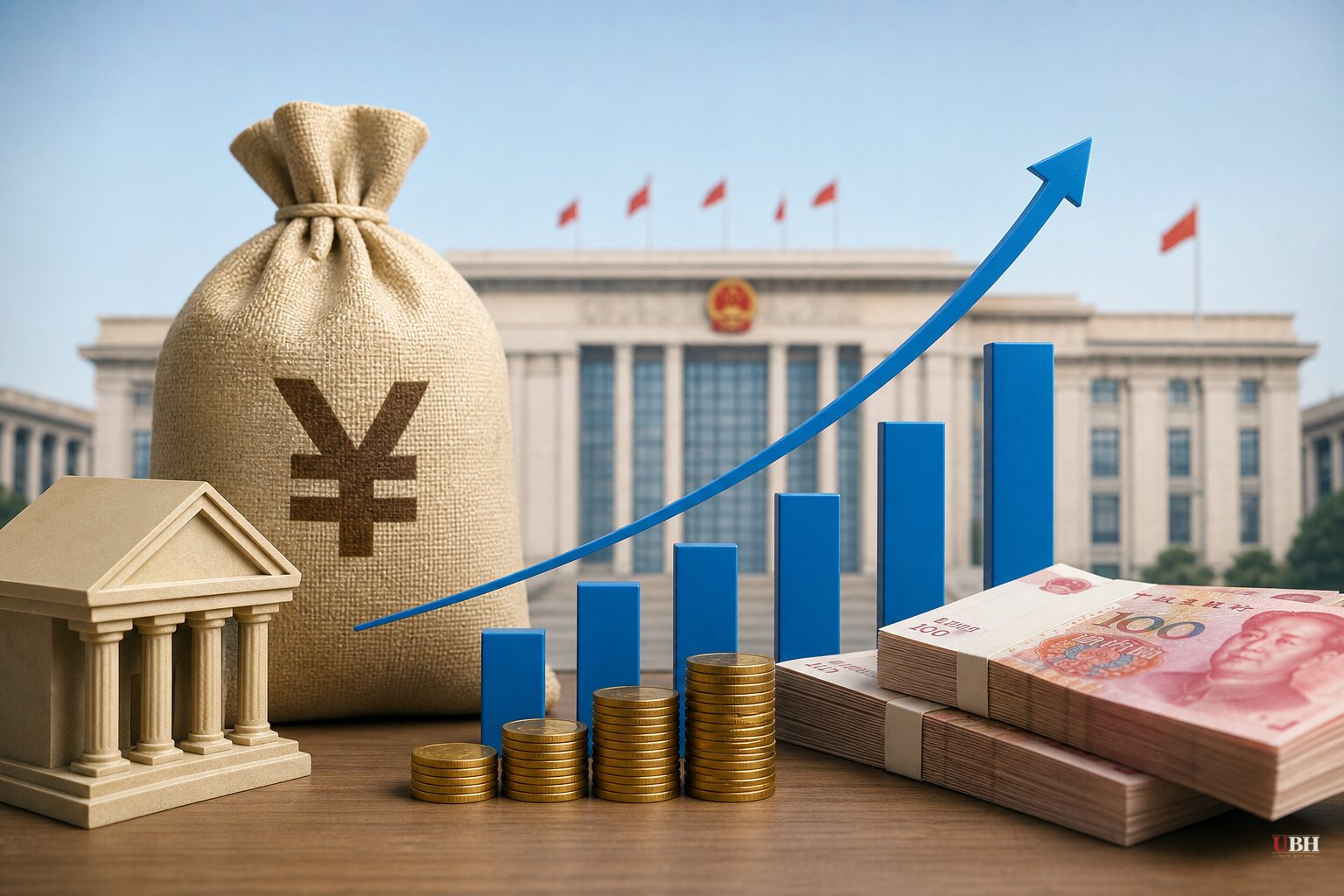
China's government is writing itself checks to keep its own banks and insurers solvent. On Sunday, September 6, Agricultural Bank of China (ABC) and Industrial and Commercial Bank of China (ICBC) announced plans to raise a combined 260 billion yuan, about $38.7 billion, through private placements of A-shares on the Shanghai Stock Exchange, according to filings reported by Xinhua and China.org.cn. Every yuan is earmarked to replenish core Tier 1 capital, the highest-quality buffer regulators use to measure whether a bank can absorb losses without touching depositor money.
China's Ministry of Finance is putting up 130 billion yuan for ABC and 70 billion yuan for ICBC, according to BigGo Finance. The sovereign treasury alone is covering 200 billion of the 260 billion yuan raised, or roughly 77% of the total. China National Tobacco Corporation and its provincial subsidiaries, including Shanghai Tobacco, Yunnan China Tobacco, and Hunan China Tobacco, are chipping in the remaining 60 billion yuan.
A state-owned cigarette monopoly buying equity in China's two biggest banks is not a normal capital markets transaction. It's the government moving money from one pocket to another to make a balance sheet look better on paper.
The Insurance Side Nobody Mentioned First
On the same day, Beijing's finance ministry separately injected 57 billion yuan, about $8 billion, into three state-owned insurers, according to Reuters reporting carried by the Straits Times and Business Standard. China Life Insurance Group, the country's largest life insurer, is getting 35 billion yuan. China Taiping Insurance Group is getting 7 billion yuan. People's Insurance Company of China (PICC) said it plans to raise up to 15 billion yuan through its own private placement to the ministry.
Add the bank money and the insurer money together and you get close to $47 billion, the figure Reuters used in its own headline. Crypto Briefing's coverage, by contrast, focused only on the bank piece and cited roughly $39 billion, which is accurate for the banks alone but leaves out the insurance injection entirely. Readers comparing headlines across outlets should know these are two coordinated announcements from the same day, not competing numbers.
This Is Round Two, Not a One-Time Fix
This plan traces back to a directive China's regulators issued in September 2024, ordering the country's six largest state commercial banks to rebuild their capital in phases, according to Crypto Briefing. Bank of China, China Construction Bank, Bank of Communications, and Postal Savings Bank of China completed the first wave of injections in 2025. ABC and ICBC's announcements this week complete the second wave, meaning all six of China's biggest state banks have now either finished or entered this recapitalization pipeline, according to BigGo Finance.
China Life's statement framed the money as strengthening "the financial sector's ability to serve the real economy" and helping the group "withstand risks," according to the Straits Times. Taiping said the funds would shore up its solvency ratios. Officials pushing this plan would argue it's proactive risk management, not a bailout, getting ahead of a problem before it becomes a crisis, and that channeling the money through private placements to state entities avoids spooking public markets or diluting existing shareholders.
On its own terms, this is a fair defense. But the underlying reason this money is needed remains unchanged.
Why the Money Is Actually Needed
China's banks have been squeezed on both ends. A multi-year property market downturn has hammered loan quality, since real estate developers and homebuyers are a huge chunk of Chinese bank balance sheets. At the same time, Beijing has repeatedly cut interest rates to try to stimulate growth, which compresses the net interest margin banks earn on lending, according to Crypto Briefing. Banks typically rebuild capital organically through retained profits. When profits are squeezed and bad loans are piling up, that path becomes harder, so the government is injecting equity directly instead of waiting.
Reuters, via Business Standard and the Straits Times, frames this as part of a broader effort to help state banks keep lending as Beijing leans on them to support growth. That's the official story, and it may well be true. What's not disclosed in any of these announcements is the actual scale of nonperforming property loans sitting on these banks' books, or whether 260 billion yuan is enough to cover it. No source here puts a number on that. Beijing controls the disclosure, Beijing controls the buyer, and Beijing controls the timeline. Whether a third round follows in 2027, and whether regional and smaller Chinese banks outside the top six will need the same treatment, remains an open question none of these filings answer.
Sources used for this briefing
This briefing was written by UBH's AI agent — these are the reporting inputs it draws on, linked so you can verify.


