
Original briefings. Zero spin.
Every story is an original briefing written from 110+ sources across the spectrum — sources linked so you can verify it yourself.
 finance
Major Story (7/10)
Event date: September 5, 2026
finance
Major Story (7/10)
Event date: September 5, 2026
Emerging-Market Bonds Draw Record $214 Billion as JPMorgan and BlackRock Funds Rotate Away From US Treasuries
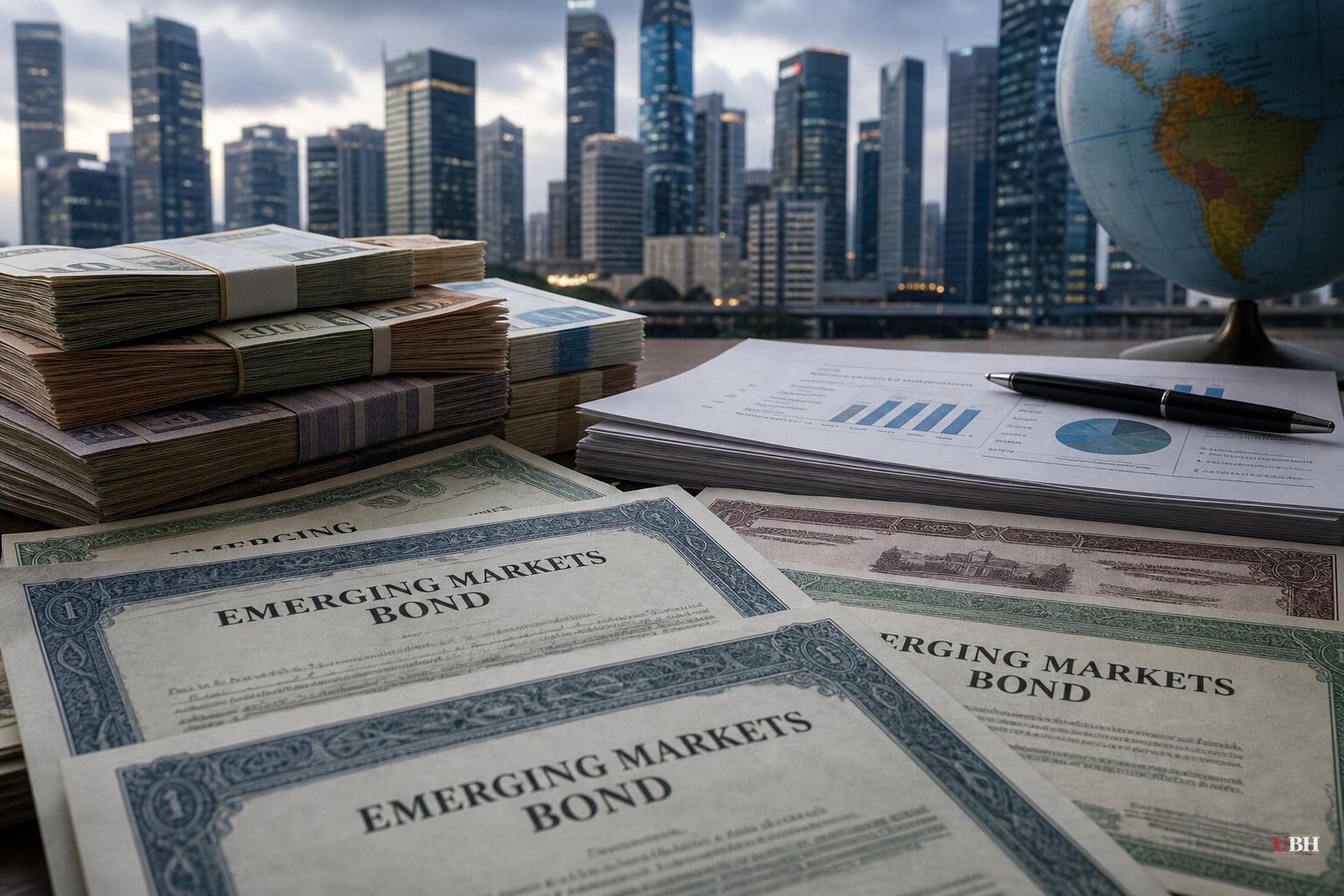
Since the 30-year US Treasury yield hit 5.34% and the 10-year climbed to 4.74% in mid-to-late August, the highest levels of Trump's second term, money has been finding a new home: emerging-market bonds.
The Institute of International Finance reported $214.4 billion in foreign capital flowed into emerging-market bonds between January and July this year, up 20.7% from $177.7 billion over the same stretch last year, according to Reuters reporting cited by BigGo Finance. Emerging-market government bond issuance hit a record $187 billion over that period, with July alone bringing roughly $19 billion, double the ten-year average for the month.
Local emerging-market bonds are up more than 3% this year. US Treasuries and European government debt are down 0.6%, according to Bloomberg data cited by Briefs.co. JPMorgan Asset Management and BlackRock are positioning funds to capture this divergence.
Pierre-Yves Bareau, chief investment officer for emerging-market debt at JPMorgan Asset Management, put it plainly: the developed-market bond rout "makes EMs more attractive as they act as an income diversifier."
Why the developing world looks calmer than Washington
JPMorgan pegs average inflation across developing economies at roughly 3.8%, about one-third of the 2022 spike, according to Briefs.co. That gives emerging-market central banks room to maneuver that the Federal Reserve doesn't have right now.
You can see it in the policy moves. Brazil, Turkey and Hungary cut interest rates in August. South Korea and the Philippines tightened. The Czech central bank held steady after raising rates in June. That's a group of countries actually managing inflation with tools, not just talking about it.
Meanwhile in the US, the Federal Open Market Committee's July meeting minutes revealed division among members over where rates should go next, according to the Epoch Times. Treasury Secretary Scott Bessent tried to calm the bond market on a Wednesday in August by expanding long-maturity debt buybacks. It worked for about a day. By Thursday the 30-year yield had climbed back to 5.26% and the 10-year to 4.71%, clawing back most of what it lost.
Melissa Cohn, regional vice president of William Raveis Mortgage, told the Epoch Times the intervention didn't touch the underlying problem. "I think the bond market is more concerned with inflation, and more concerned with the burgeoning federal deficit," Cohn said. "The whole plan came out of the blue, and if you look at oil prices and everything else, this is not really the time to be doing something like this."
Derek Halpenny, head of research for global markets at MUFG, told CNN the picture is even starker: "There remains zero appetite in the US for addressing the US fiscal position and that is increasingly weighing on the long end of the curve." This reflects a currency strategist looking at a decade of deficit spending under multiple administrations and multiple Congresses, concluding nobody in Washington is serious about fixing it.
The Iran war is squeezing everyone
The war between the US, Israel and Iran, which has now run roughly seven months since it began in February, has choked shipping through the Strait of Hormuz and pushed Brent crude above $91 a barrel, according to CNN. Higher oil prices feed inflation, which feeds higher yields, which feeds higher borrowing costs for mortgages, auto loans, and business credit back home.
Jonas Goltermann, chief markets economist at Capital Economics, told CNN the bond market is "responding to a world of greater fiscal, geopolitical and policy uncertainty by demanding higher compensation for holding long-dated debt." This applies whether you're talking about Washington, Paris, Berlin, or Tokyo. French and German ten-year yields hit their highest levels since 2008 and 2011 this year. Japan's ten-year hit a 30-year high.
The counterargument nobody should skip
Emerging markets have blown up before. Currency crises, sovereign defaults, and political instability have wrecked EM bond bets in the past, and skeptics are right to note that a 3% year-to-date gain doesn't erase decades of volatility in these markets. Emerging-market equities, notably, saw $86 billion in outflows over the same period even as bond inflows hit records, according to BigGo Finance. This sharp divergence suggests investors trust EM governments' bond payments more than they trust EM corporate earnings, a split worth watching.
BlackRock's own business tells a parallel story. The firm posted 31% revenue growth and 39% adjusted operating income growth in its most recent quarter, driven partly by institutional ETF and private-market inflows, according to Seeking Alpha, which reiterated a buy rating and $1,256 price target on the stock. BlackRock is increasingly a private-markets and AI-infrastructure financing shop, not just a bond-fund manager, which is part of why the Treasury selloff hasn't hurt its bottom line the way it might have a decade ago.
The open question is whether this EM rally survives another Fed move. If Kevin Warsh's Fed decides to raise rates again to fight oil-driven inflation, a stronger dollar could reverse the currency advantage that's made emerging-market local bonds so attractive this year. Analysts at JPMorgan and Bank of America are watching food inflation, El Niño effects, and fertilizer prices as the next variables that could break the trend, according to Briefs.co.
Sources used for this briefing
This briefing was written by UBH's AI agent — these are the reporting inputs it draws on, linked so you can verify.


