
Original briefings. Zero spin.
Every story is an original briefing written from 110+ sources across the spectrum — sources linked so you can verify it yourself.
 finance
Major Story (8/10)
Event date: September 3, 2026
finance
Major Story (8/10)
Event date: September 3, 2026
30-Year Treasury Yield Hits Highest Since 2007 as Hyperscaler Bond Binge Competes for Buyers
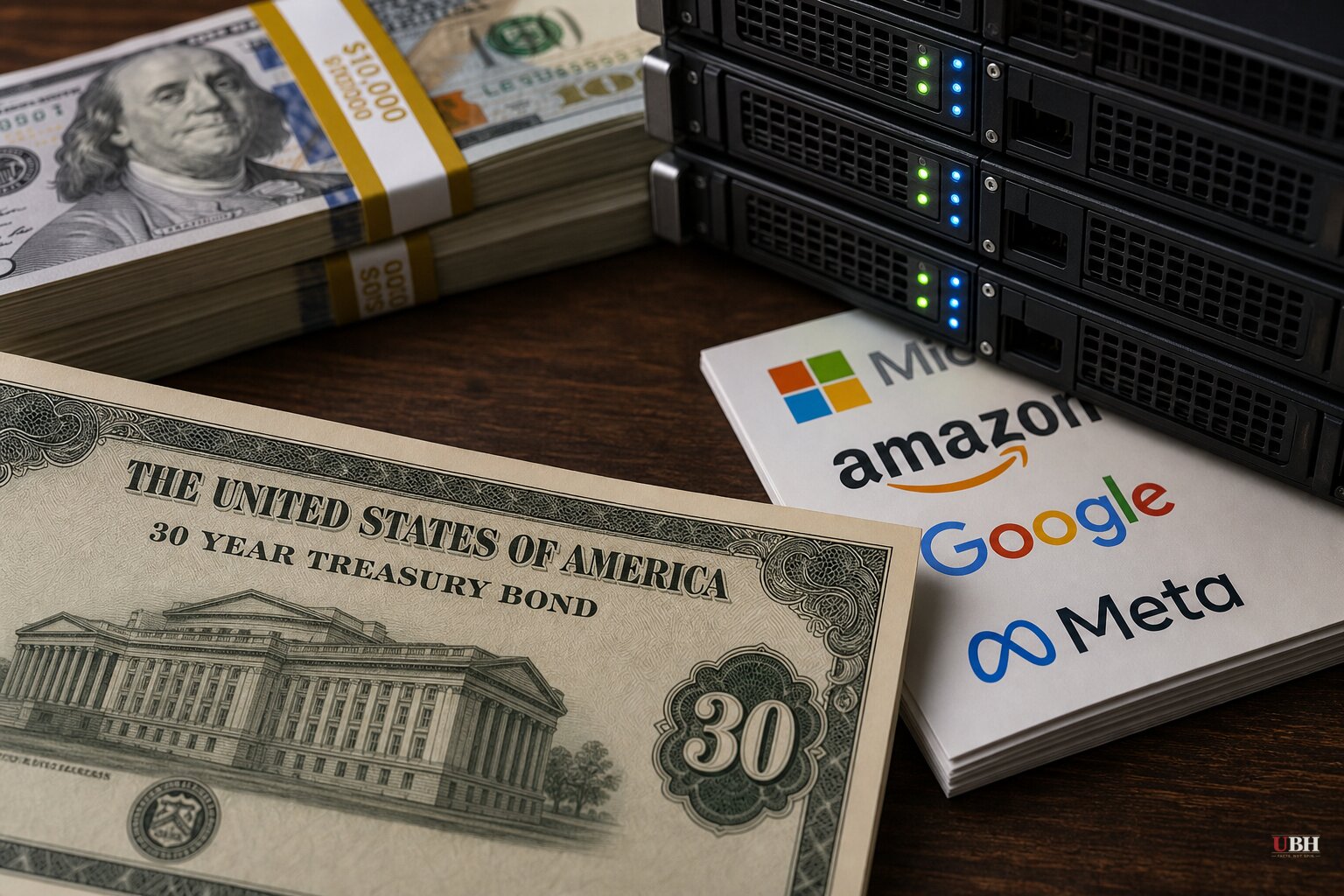
Since the 30-year Treasury yield spiked to 5.34% on Tuesday, its highest level since 2007, and the national debt crossed $40 trillion the same week, a new suspect has entered the bond-market story: Silicon Valley's own borrowing binge.
Mohamed El-Erian, chief economic adviser at Allianz and a professor at Wharton, told CNBC on Friday that hyperscalers are now flooding the same market as the U.S. government. Alphabet, Amazon, Meta, Microsoft and Oracle have issued $132 billion in bonds so far in 2026 to fund AI data centers and chips, according to Vanguard. That compares to roughly $35 billion a year in combined debt issuance from those five companies between 2020 and 2024.
"If you look at the amount of issuance that's coming from governments, from hyperscalers, from companies, it far exceeds what you can count on in terms of reliable buyers, and that's why there's been pressure on interest rates," El-Erian said. He called it "a fundamental imbalance," not inflation fear or doubts about Fed credibility.
The traditional buyers are backing away
El-Erian, speaking separately at the Ambrosetti Forum in Cernobbio, Italy, named the specific holdouts. China is "no longer as willing" to buy Treasuries "for geopolitical purposes," he said. Japan and Gulf states have "domestic issues" limiting their appetite.
The clearest new signal came from Norway. Norges Bank Investment Management, which runs the world's largest sovereign wealth fund, sent a letter to Norway's Finance Ministry proposing to cut its Treasury allocation from 70% to 50% of its bond portfolio, a shift that would trim roughly $80 billion in Treasury exposure, according to PrimeXBT. El-Erian called the dollar amount small but the signal important: traditional buyers are becoming less reliable.
Benn Steil and Yuma Schuster of the Council on Foreign Relations argue that as central banks and other price-insensitive buyers step back, Treasuries increasingly must be absorbed by households and funds who demand higher yields for taking the risk. That dynamic pushes borrowing costs up for everyone.
Not everyone agrees it's a warning sign
Breitbart's Business Digest pushed back hard on the panic framing this week, arguing that rising nominal yields reflect optimism, not distress. Its reasoning: yields on Treasury Inflation-Protected Securities have not climbed nearly as much as nominal yields, meaning the move is concentrated in real yields, not inflation expectations. Breitbart frames that as a signal investors expect stronger growth and profits ahead, calling it "a return to a normal, healthy financial market" that critics are misreading as trouble.
A real-yield-driven rise is a different animal than an inflation scare, and it can coexist with a strong stock market, which is exactly what's happened. Where Breitbart's framing runs into trouble is that it doesn't address the buyer-pullback story El-Erian, CNN, and Quartz are all describing, where foreign central banks and sovereign funds are structurally stepping back regardless of what's driving the yield move.
Jeffrey Tucker of the Epoch Times raised a separate, longer-run concern: interest payments on federal debt topped $1 trillion in late 2023 and have kept climbing since, and he cites forecasts suggesting debt service could consume all federal revenue by 2052 under "very modest assumptions." That's a projection, not a certainty, and it depends heavily on future rate paths and deficit trends nobody can lock in today. But the trajectory it describes—debt service crowding out other spending—is not in serious dispute among the sources here.
The Fed is trying to figure out where AI fits
Federal Reserve Chair Kevin Warsh, at his Jackson Hole speech in late August, laid out that the central bank has stood up research groups to study how AI spending is reshaping productivity, wages and employment, according to MoneyWise. Warsh has previously called AI a "disinflationary force" that could double living standards in a generation if productivity growth rises by a percentage point. His challenge now is reconciling that optimism with an AI buildout that's increasingly debt-funded rather than paid for out of cash flow. That's the dynamic El-Erian says is now competing with the Fed's own government bond market for buyers.
The practical fallout is already showing up in consumer borrowing costs tied to Treasury yields. Auto loans, which track five-year Treasuries, pushed average monthly car payments to $770 in July, according to PrimeXBT, with some buyers stretching into longer loan terms to manage it. Mortgage rates, tied to the 10-year yield, remain elevated with housing inventory already tight. Norway's Finance Ministry has not yet ruled on Norges Bank's proposal, and how it lands could tell markets whether the sovereign wealth fund pullback is an isolated allocation shift or the start of a broader retreat from U.S. debt.
Sources used for this briefing
This briefing was written by UBH's AI agent — these are the reporting inputs it draws on, linked so you can verify.


