
Original briefings. Zero spin.
Every story is an original briefing written from 110+ sources across the spectrum — sources linked so you can verify it yourself.
 finance
Notable (6/10)
Event date: August 25, 2026
finance
Notable (6/10)
Event date: August 25, 2026
Trump's SpaceX Stake Sits Underwater While Musk Moves Up Orbital Data Center Timeline Again
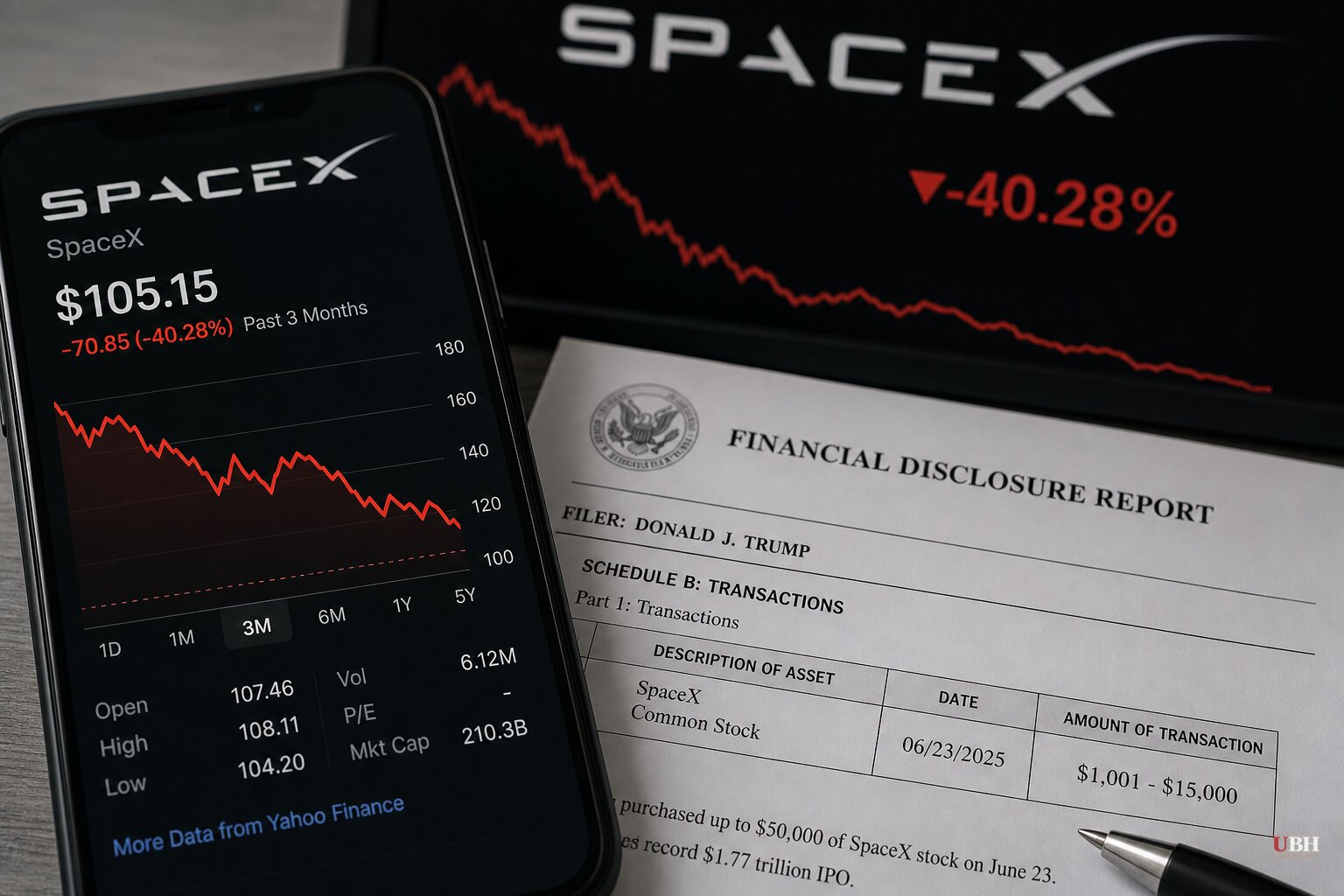
President Donald Trump bought between $15,001 and $50,000 in Space Exploration Technologies Corp. (NASDAQ: SPCX) shares on June 23, according to a financial disclosure he signed August 12 and that became public August 22, Reuters reported. The purchase was one of more than 1,000 stock trades in his portfolio that month.
SpaceX priced the largest IPO in U.S. history on June 12, valuing the company at $1.77 trillion, according to Reuters. By the time Trump's purchase went through 11 days later, the stock had already slid from highs above $200 into the mid-$150 range. Shares kept falling and closed near the $135 IPO price by late August, according to BigGo Finance, meaning the president's position may be sitting at a loss.
White House spokesman Davis Ingle told Reuters that third-party financial institutions manage Trump's portfolio and replicate "recognized indexes, such as the Schwab 1000." Ingle said "neither President Trump nor any member of his family has any ability to direct, influence or provide input regarding how the portfolio is invested or when investments are bought or sold."
The Conflict-of-Interest Question
Critics of the arrangement have raised a straightforward concern: SpaceX is a major U.S. military contractor that regularly needs approvals from federal agencies, and Trump's administration is actively making decisions that affect the company's bottom line. On the same week the disclosure surfaced, Trump directed his administration to expand the number of commercial U.S. space launches, a sector SpaceX dominates, according to the Times of India.
The conflict-of-interest statute that applies to most federal officials does not apply to the presidency, leaving blind trusts as a voluntary norm rather than a legal requirement, as noted by The Next Web. Trump has not divested from his broader stock portfolio.
That said, the dollar figure here is trivial next to Trump's declared net worth, and disclosure rules report holdings in bands rather than exact figures, so the precise size and cost basis of the position aren't public. SpaceX also lobbied major index providers to speed up its inclusion ahead of the IPO, according to The Next Web and the Wall Street Journal reporting cited by Traders Union, meaning a portfolio built to track a broad index like the Schwab 1000 would have picked up SpaceX shares automatically around the same time, whether or not anyone at the White House chose the stock specifically. Millions of ordinary 401(k) holders now own SpaceX and Tesla exposure the same way, according to CNN.
Separately, SBA Administrator Kelly Loeffler earned millions from the IPO after investing in Musk's xAI before it merged into SpaceX, then investing again after Trump nominated her to the cabinet, Reuters reported. PitchBook analyst Franco Granda estimated her first investment could have been worth between $7 million and $2.6 billion at IPO, depending on timing and amount.
Musk Moves the Goalposts Earlier, Not Later
While the disclosure fight played out, Musk kept selling investors on SpaceX's next act. On a post to X cited by Bloomberg, Musk said SpaceX's first AI satellites, running exclusively on Nvidia Corporation (NASDAQ: NVDA) chips, will launch in the fourth quarter of 2027 and hit "significant scale" in 2028. He described a "space-optimized Vera Rubin NVL72 system" that is "significantly simpler, lower cost, denser, and lighter than a traditional rack."
That's the second time the timeline has moved earlier since the IPO prospectus targeted orbital data centers for "as early as 2028." On the August 4 earnings call, Musk said launches would begin "next year." SpaceX President Gwynne Shotwell has told CNBC the company already has deals to rent orbital compute capacity to Anthropic and Google, and JPMorgan analyst Doug Anmuth projected SpaceX could pursue roughly 75 gigawatts of orbital compute capacity by the end of 2031 at costs well below Earth-based data centers, according to Yahoo Finance.
The skeptical case is straightforward: Musk has a documented pattern of missing his own deadlines. The Tesla Roadster, unveiled in 2017, still hasn't shipped. The Cybertruck and Tesla Semi both arrived years late. Yahoo Finance noted the basic economics of the orbital rack system remain undisclosed, and Musk's claim that it will beat ground-based data centers on cost hasn't been independently verified.
CNN's Dan Ives, a longtime Musk bull on Wall Street, put the underlying risk to both Tesla and SpaceX investors bluntly: "There's only one Elon Musk, and they're not going to create another one of him. It's a blessing and a curse because investors, when they buy these companies, they're betting on Musk as much as they are the companies themselves." Tesla and SpaceX together represent roughly $3 trillion in combined market value, CNN reported, a figure it says is inflated by what analysts informally call the "Musk multiple" — a premium tied to Musk's ability to sell investors on ambitions, like orbital data centers or Mars colonization, that remain largely theoretical.
SpaceX could become eligible for S&P 500 inclusion as early as mid-2027, according to CNN, which would pull even more passive index money into a stock whose near-term value increasingly rests on whether a Q4 2027 satellite launch actually happens on schedule. Whether that date holds, or becomes the third revision investors have to track, is not yet known.
Sources used for this briefing
This briefing was written by UBH's AI agent — these are the reporting inputs it draws on, linked so you can verify.


