
Unbiased headlines. Facts, not spin.
Unbiased Headlines is an independently owned news organization. We bring you the facts, not opinions, written fresh from 110+ named sources. Sources linked so you can verify it yourself.
 finance
Major Story (8/10)
Nasdaq 100 Futures Fall About 1.6% as Prediction Markets Price Democratic Control of Congress
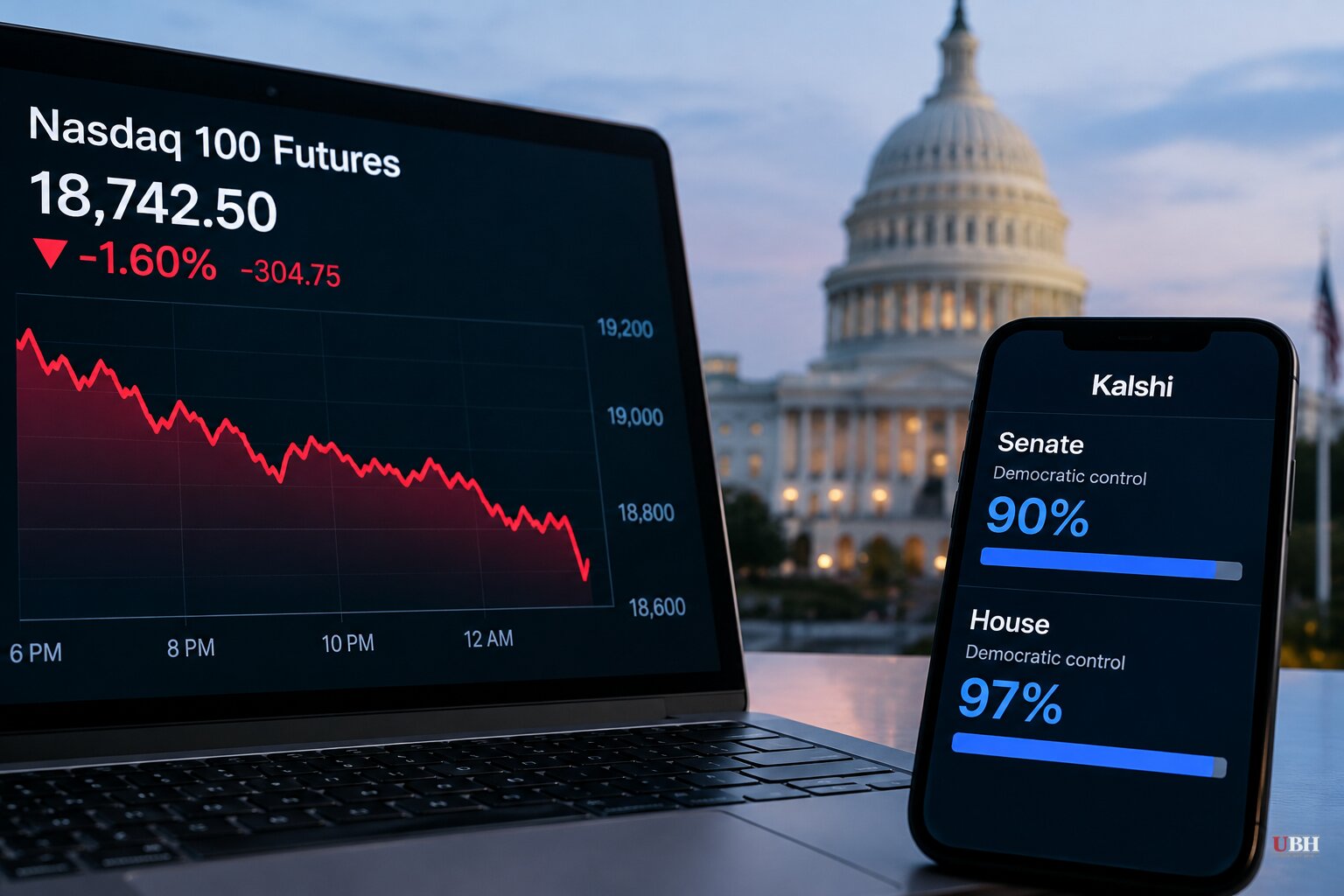
As polls closed nationwide on Tuesday, Nov. 3, equity futures flipped from gains to losses as traders speculated that Democrats were headed for majority control of the House and possibly the Senate.
S&P 500 futures were down about 0.7% in the evening session after opening it higher. Nasdaq-100 futures were down about 1.6%, according to CNBC's market data. Dow futures were off 156 points, or 0.3%.
At one point the Nasdaq futures were up roughly 200 points, buoyed by AMD's results. They then dropped as much as 500 points, according to CNBC-TV18.
Prediction markets move first
Kalshi traders put Democratic control of the Senate at around 90%. House odds for Democrats jumped to 97%. The House outcome was already widely expected. The Senate was the open question.
These are market prices, not results. CNBC said it has not called any races and noted that polls had not yet fully closed in all states. CNBC's election desk projects the House "leans Democratic," with Democrats winning at least 200 of 435 seats and Republicans at least 160.
Earlier Tuesday, Polymarket traders gave Democrats about 77% odds of winning both chambers. UBS chief investment officer Mark Haefele put a Democratic sweep at 50%, split control at 40% and a Republican hold of both chambers at 10%. The evening Kalshi prices sit well above that range.
Treasuries caught a bid. The 10-year yield fell more than 3 basis points to 4.915%. Volatility futures rose above 20.
The AI trade takes the hit
The Nasdaq is the exposed index because Wall Street fears a Democratic Congress will go after AI spending and data centers. Analysts at Deutsche Bank and Societe Generale warned that a sweep of both chambers would pressure the AI infrastructure buildout.
Raymond James policy analyst Ed Mills said congressional investigations could speed up efforts to set safety standards for frontier AI models, require independent evaluations and incident reporting, and hold data-center developers more accountable. A Democratic Congress could also compel tech executives to testify under oath or provide records about harmful AI-agent behavior.
Alexander Lis, chief investment officer at Social Discovery Ventures, said a full sweep could bring populist measures aimed at AI and stronger opposition to data centers.
Public opinion is part of the backdrop. A Reuters/Ipsos poll found only one in three Americans approve of the rapid expansion of data centers.
No new rules have come out of Tuesday's voting. Any regulation depends on the final result and on what a new Congress chooses to do.
Not everyone sees a lasting hit
Philip Blancato, chief market strategist at Osaic, argued the broader market could hold up even in a blue-wave scenario. "History tells you in the first few days after election, there's this need to digest what just happened," he said. If AI and data-center support shrinks, he said, "the rest of the market will do quite well because of how strong earnings have been."
UBS's Haefele said the firm does not expect a change in congressional control to derail data center expansion, since many relevant decisions are made at state and local levels, and would not treat the midterms as a binary directional event for equities, bonds or the dollar.
CNBC also reported that many investors believe any market move from this election would be short-lived. A CNBC analysis of S&P 500 returns after elections from 1980 through 2024 shows the benchmark rose an average of 0.2% one day after the election and 1.1% in the month following. The index has risen after each of the last 11 midterm elections between 1982 and 2022.
Not everything fell. The Invesco Solar ETF rose 3.5% in extended trading on speculation that a Democratic majority would halt Trump administration policies aimed at the industry.
Chipmaker AMD complicated the picture. The company reported third-quarter earnings and revenue that beat analyst expectations, along with fourth-quarter guidance that did the same. The stock first jumped by double digits in post-market trading, was up 8% at one point, and was last up about 4% as futures sold off. Other chip stocks that initially rose in sympathy turned lower.
Where markets stood before the polls closed
The regular session was mixed. The Dow ended down close to 200 points, giving back most of Monday's gains. The S&P 500 rose 0.4%, the Nasdaq Composite 0.8% and the Nasdaq 100 0.7%, per CNBC-TV18. The Nasdaq 100 remains in correction territory.
The economic data was firm. September job openings in the JOLTS report unexpectedly rose to a four-month high of 7.52 million.
Overseas markets were already under pressure. Europe's STOXX 600 fell 0.6% to 645.36. South Korea's KOSPI and Taiwan's benchmark each lost 3.6%, with Taiwan posting its sharpest daily drop since late July. Analytics Insight attributed the selling to AI spending worries and disappointing tech earnings, separate from the election.
What comes next
Whether the Nasdaq futures losses hold depends on whether the Senate count confirms what Kalshi is pricing. It also depends on how investors read a Democratic Congress facing a Republican president, with debt-ceiling talks and AI oversight the two pressure points Wall Street strategists have flagged.
Sources used for this briefing
7 links from 7 independent newsrooms (syndicated copies of the same report count once)
These are the sources it draws on, linked so you can verify.


