
Unbiased headlines. Facts, not spin.
Unbiased Headlines is an independently owned news organization. We bring you the facts, not opinions, written fresh from 110+ named sources. Sources linked so you can verify it yourself.
 finance
Major Story (7/10)
Event date: November 3, 2026 ·
Meta Raises $15 Billion in Five-Part Dollar Bond Sale, With Disclosed Coupons Up to 6.25%
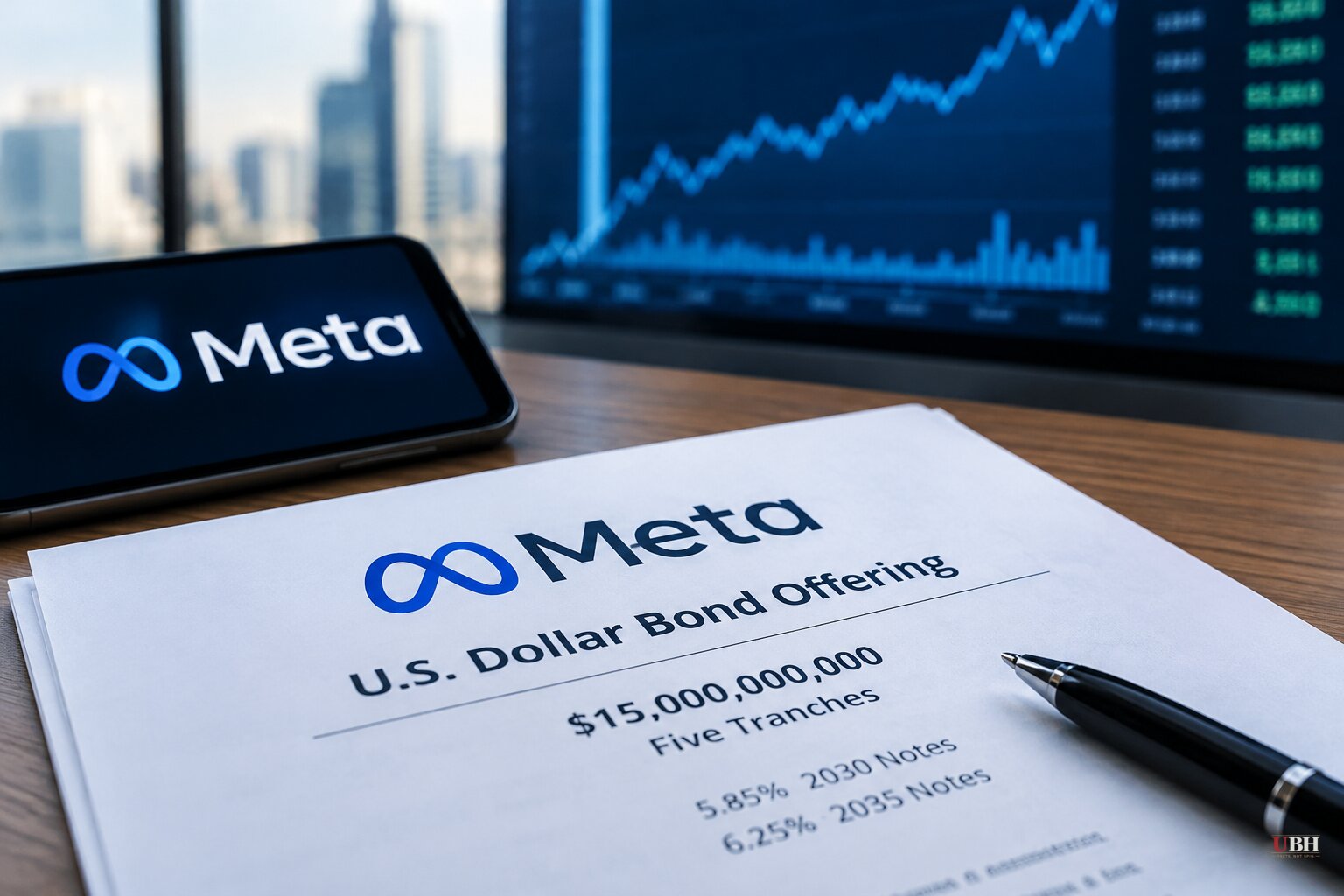
Since Meta started marketing up to $25 billion of dollar and euro bonds this week, the company has disclosed the dollar leg: $15 billion in a five-part offering, according to a regulatory filing.
Two of the five tranches are public so far. A $3.25 billion note due 2031 carries a 5.85% coupon. Another $3.25 billion note due 2033 carries 6.25%.
That is $6.5 billion of the $15 billion. The size and coupons of the other three tranches were not included in the filing details available as of Tuesday night, Nov. 3.
What the dollar tranches show
The notes are split into five tranches with maturities of five to 30 years. Early pricing guidance for the longest tranche pointed to a spread of roughly 2.5 percentage points over Treasuries, according to Bloomberg. Citigroup and Morgan Stanley are running the offering.
The broader sale was expected to be about two-thirds in dollars and one-third in euros, according to people familiar with the matter. That would be Meta's first euro bond offering. Final pricing was expected Tuesday afternoon. Meta declined to comment.
The company last sold bonds in April, a $25 billion deal. Bloomberg reported order books for that deal peaked at $96 billion. It also reported that buyers have demanded bigger concessions on AI-related offerings since then.
Meta also sold $30 billion of bonds last year. Its total debt stood at $83.67 billion as of Sept. 30, according to LSEG data. Quartz reported that long-term debt rose by about $25 billion in the first half of 2026.
Two rating agencies, two readings
Moody's assigned the new debt an Aa3 rating. It said it expects Meta to maintain conservative financial policies and a positive net cash position despite rising AI spending.
S&P Global Ratings took a more cautious view days ago. It moved Meta's outlook from AA- stable to AA- negative. S&P cited "uncertainty" about heavy capital spending and negative free cash flow. It also said Meta has fewer avenues than its competitors for earning revenue from AI.
The numbers behind S&P's concern are in Meta's own reporting. Full-year capex is guided to $135 billion to $145 billion. Free cash flow was negative $2.12 billion in the third quarter. Quartz reported that Meta's quarterly filing for the period ended Sept. 30 disclosed roughly $825 billion in lease and contract commitments, many tied to AI infrastructure.
Moody's is looking at the same company and pointing to positive net cash. The two agencies agree on the rating level and differ on how much the spending trajectory matters.
Debt on top of a huge equity raise
The bond sale is one piece of a larger funding push. On Oct. 26, Meta announced a plan to raise $95 billion through stock: $35 billion in underwritten public offerings and $60 billion through an at-the-market program. The company said proceeds would support "emerging AI opportunities," including applications, data centers and its AI agent Muse.
Last week Meta placed $22.5 billion in common stock and $12.5 billion in preferred shares. Reuters reported that Meta has since expanded the plan to what could become a $97.5 billion equity raise.
Meta shares rose 2.7% on Tuesday, according to CNBC. They had fallen in 12 of the prior 14 sessions, and October was the stock's worst month in four years.
Jay Woods, chief market strategist at Freedom Capital Markets, tied the post-earnings slide to investor worries. "Fears of a continued capex spend and free cash flow going negative outweighed any positive feelings," he told The Epoch Times.
A crowded market for AI debt
Meta is not alone. Oracle placed $10 billion in bonds on Monday. Alphabet sold €6 billion ($6.73 billion) of euro notes. Microsoft sold $25 billion last week, ending a lull of close to three months in which no major technology company had issued debt, according to Quartz, citing Bloomberg.
Nvidia CEO Jensen Huang said last week that demand is "off the charts" for neoclouds but that there is a "scarcity of capital." Elon Musk wrote on X on Oct. 25 that debt markets have closed their doors to companies without "substantial revenue independent of AI data centers."
What remains to be answered is the euro leg. Meta has not disclosed how much it sold in euros or at what pricing. The three undisclosed dollar tranches also leave the average cost of the $15 billion unknown.
The at-the-market program is the other open item. Up to $60 billion in share sales is planned through that program, and Meta has not said how fast it plans to use it.
Sources used for this briefing
7 links from 7 independent newsrooms (syndicated copies of the same report count once)
These are the sources it draws on, linked so you can verify.


