
Unbiased headlines. Facts, not spin.
Every story is an unbiased news briefing written from 110+ sources across the spectrum — sources linked so you can verify it yourself.
 economy
Major Story (7/10)
September 16, 2026 at 08:36 AM
economy
Major Story (7/10)
September 16, 2026 at 08:36 AM
UK Inflation Climbs to 3.1% in August as Petrol and Diesel Prices Jump on Middle East Oil Shock
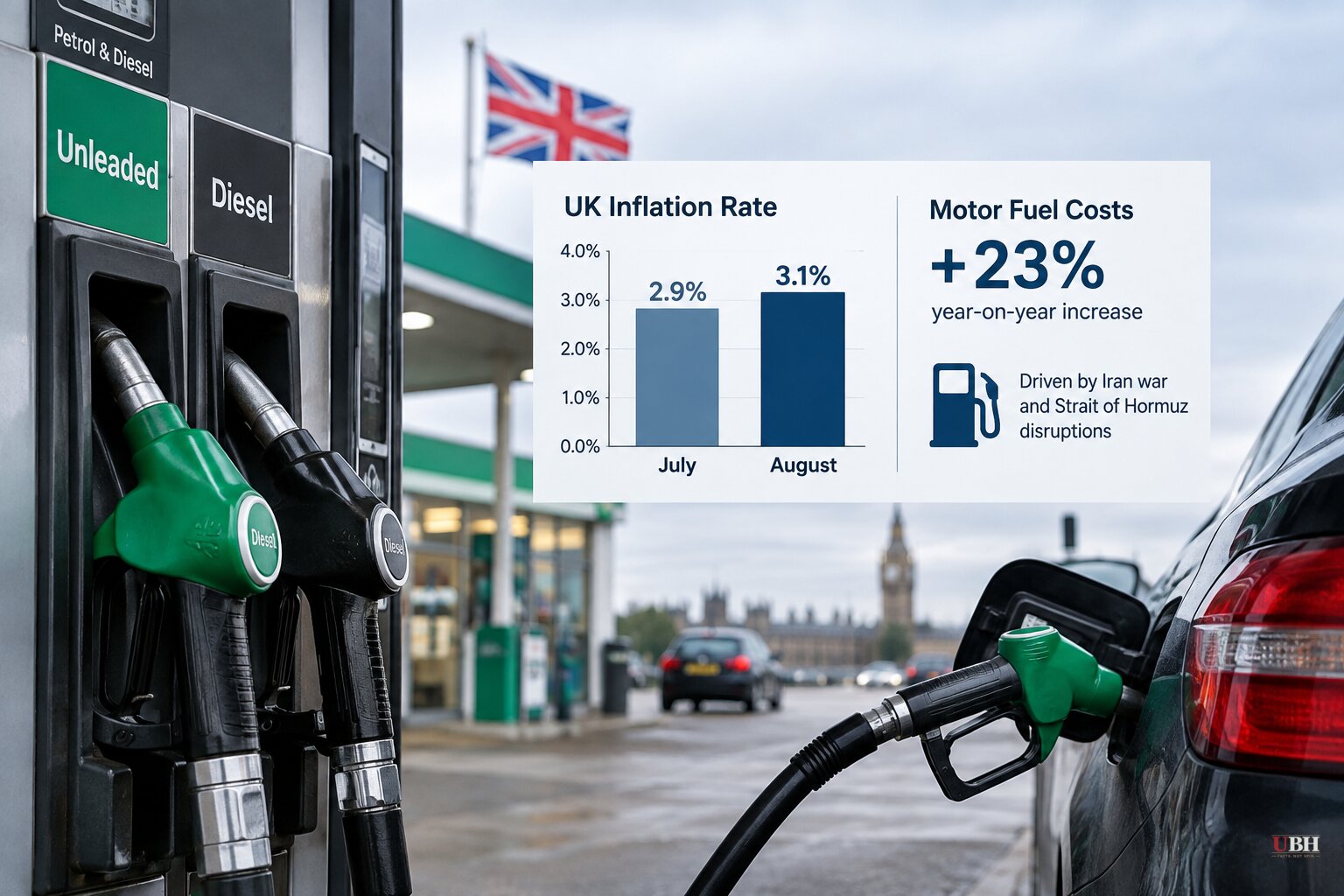
UK inflation rose to 3.1% in the 12 months to August, up from 2.9% in July, the Office for National Statistics reported Wednesday. The print matched economists' expectations, according to Morningstar's Alliance News wire, and marks the first reading above 3% since March.
Grant Fitzner, the ONS's chief economist, said "sharp price rises for petrol and diesel pushed inflation up again in August," adding that higher airfares, particularly on long-haul routes, also contributed. Average petrol prices rose 9.1 pence per liter between July and August to 161.3 pence, the highest since November 2022. Diesel climbed 14.2 pence to 181.8 pence per liter. Airfares jumped 6.2% month-on-month.
The ONS said motor fuels rose 23% year-on-year overall. That single category did most of the damage to the headline figure. Core inflation, which strips out energy, food, alcohol and tobacco, held steady at 2.6%. Services inflation was unchanged at 3.4%. Food and non-alcoholic drink inflation actually slipped to 1.1%, according to CNBC.
James Smith, a developed markets economist at ING, said there is "nothing in the latest UK inflation numbers that screams a need to hike interest rates," and that the real question is "whether the energy shock is broadening out to other parts of the inflation basket." So far, he said, there is very little sign of that.
The Iran war is the common thread
The timeline is not in dispute across any of the sources. Crude oil has traded above $100 a barrel, and Asharq Al-Awsat reported it near $108, since the breakdown of the US-Iran ceasefire in July. The Enfield Independent, republishing USA Today reporting, tied the fuel spike directly to that ceasefire collapse. British motoring group the RAC said this week that pump prices are at four-year highs.
Producer prices show the same pattern from the supply side. Alliance News reported UK input prices for manufacturers rose 6.1% year-on-year in August, with crude oil up 27% annually, the single largest contributor. Factory gate output prices rose 3.7%, with coke and refined petroleum products up 49% annually.
The pattern isn't unique to Britain. Eurozone inflation hit 3.3% in August, up from 2.9% in July, according to Eurostat's flash estimate cited by the Epoch Times. The European Central Bank said in a September 1 blog post that roughly 90% of the eurozone's inflation surge from January through May came from energy supply shocks linked to the Iran war and the Strait of Hormuz closure, not the demand-driven pressures that fueled the 2021-22 surge. The ECB said that distinction explains why its policy response this time has been "more gradual" than the aggressive hiking cycle of 2022.
What the Bank of England does next
The Bank of England's Monetary Policy Committee is scheduled to announce its rate decision Thursday, September 17. Markets are pricing in more than an 80% chance the Bank holds its benchmark rate at 3.75%, according to LSEG data cited by CNBC, with a hike anticipated at the November meeting instead. Martin Sartorius, lead economist at the Confederation of British Industry, said limited signs of domestic price pressure make a hold likely, though he noted the renewed energy price rise will keep the committee watchful.
Not everyone expects relief soon. Thomas Pugh, chief economist at RSM UK, said the August rise "is just the start of a new upward trend as higher energy, food and memory chip prices continue to make their way through supply chains," forecasting inflation could peak near 4% in early 2027 before easing back to 2% by 2028. The Bank of England itself has warned that a worsening Middle East scenario could push inflation as high as 4.5% by mid-2027, according to the Guardian.
If the war drags on, this won't be a one-month blip. A central bank holding rates while inflation climbs risks falling behind the curve. But the counterargument, backed by both ING's Smith and the ECB's own analysis, is that raising rates to fight an oil-supply shock does little to change the price of crude and mainly just slows growth further in an economy that, per multiple sources here, is already struggling.
The political pressure on Downing Street
The timing is brutal for Prime Minister Keir Starmer and Chancellor Rachel Reeves, who face an October 28 budget. Reeves has pledged fiscal discipline while also touting measures like a £2 bus fare cap, a cut to electricity bill taxes, and lower rates for pubs and music venues. Richard Carter, head of fixed interest research at Quilter Cheviot, called the inflation print "a kick in the teeth for an administration that wants to make easing the cost of living its central mission," adding that with borrowing costs climbing, the budget's room to maneuver "will be limited."
That borrowing cost problem is real and separate from the inflation print. UK 30-year gilt yields hit a 28-year high Tuesday before easing slightly to 5.907% Wednesday; the 10-year gilt sat at 5.365%. Reeves has not said whether the October 28 budget will include tax increases. Whether she can hold that line while also funding fuel-cost relief, with the Bank of England expected to keep rates on hold Thursday and a possible hike looming in November, is the open question hanging over Westminster.
Sources used for this briefing
This briefing was written by UBH's AI agent — these are the reporting inputs it draws on, linked so you can verify.


