
Unbiased headlines. Facts, not spin.
Every story is an unbiased news briefing written from 110+ sources across the spectrum — sources linked so you can verify it yourself.
 economy
Notable (6/10)
Event date: September 14, 2026
economy
Notable (6/10)
Event date: September 14, 2026
U.S. Trains 50 Nations on Forced-Labor Import Bans While Lawmakers Ask DHS Why Enforcement at Home Is Slipping
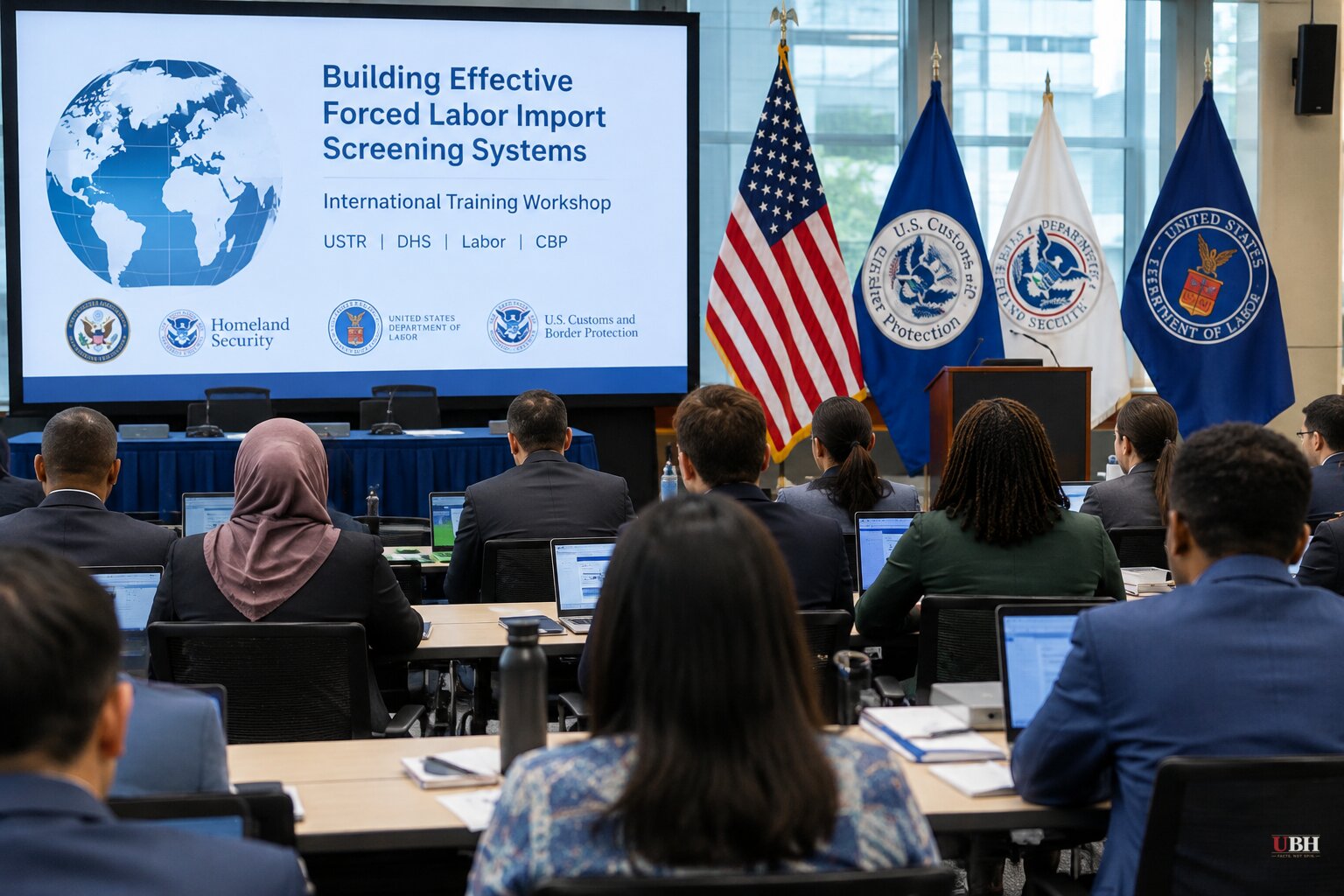
The U.S. government spent Tuesday teaching more than 50 other countries how to do something Washington has spent the past year building for itself: block imports made with forced labor.
The September 15 training session in Washington was run by the Office of the U.S. Trade Representative, alongside the Departments of Homeland Security and Labor and U.S. Customs and Border Protection, according to Tech Times. The pitch to foreign governments was simple: build a credible forced-labor import ban, enforce it, and Washington will consider easing the punitive tariffs it slapped on your exports two months ago.
How We Got Here
Those tariffs didn't come out of nowhere. USTR opened 60 separate Section 301 investigations on March 12, 2026, collecting more than 450 written comments and testimony from nearly 60 witnesses over two days of hearings in late April, per Tech Times. On June 2, USTR determined all 60 economies under review were "actionable" because they'd either never passed a law banning forced-labor imports or had one on the books and didn't enforce it.
A second round of hearings followed in July, this time drawing more than 100 witnesses. USTR finalized the action on July 23, and tariffs of 10% to 12.5% took effect at 12:01 a.m. EDT on July 24, covering imports from 60 economies that together account for roughly 99.4% of all U.S. goods imports, replacing an earlier set of Section 122 duties that expired the same moment, according to Tech Times, which cited trade analysis from Greenberg Traurig confirming the final action.
Tuesday's training is the follow-up move: a path off the tariff list for countries willing to police their own supply chains. Tech Times frames the stakes for the tech and semiconductor sector bluntly. Polysilicon for solar panels and cobalt for lithium-ion batteries routinely move through Vietnam, Bangladesh, and Cambodia before reaching U.S. buyers. If those transshipment hubs adopt the screening systems the U.S. just demonstrated, a manufacturer can no longer count on clearing a single customs chokepoint. The compliance math turns multiplicative instead of additive, screened at every stop instead of just the last one.
The Enforcement Questions Back Home
While Washington was exporting its enforcement model, a bipartisan group of lawmakers was asking whether the model works at home. Reps. John Moolenaar (R-Mich.) and Chris Smith (R-N.J.) led a September 3 letter to DHS, co-signed by Reps. Ro Khanna (D-Calif.), Jim McGovern (D-Mass.), Bennie Thompson (D-Miss.), Carlos Gimenez (R-Fla.), Young Kim (R-Calif.), and Sen. Jeff Merkley (D-Ore.), according to the Epoch Times.
The letter welcomed DHS's August 3 expansion of the Uyghur Forced Labor Prevention Act Entity List, which added 43 companies in the largest single expansion since the list was created, bringing the total to 187 entities spanning textiles, food, pharmaceuticals, aluminum, copper, lithium, and battery materials. One addition, Xinjiang Tianyun Organic Agriculture Co., was flagged over alleged participation in government-sponsored labor-transfer programs involving Uyghur, Kazakh, or Kyrgyz workers, per the Forced Labor Enforcement Task Force findings cited by the Epoch Times.
But the lawmakers also cited reports of "substantially declining detention activity" in some high-risk sectors, continued imports flowing through transshipment hubs, and what they called "hundreds more Entity List packages" stuck in the approval pipeline. They gave DHS 30 days to brief Congress on what's being stopped at the border, what's being released, and how the agency traces Chinese-origin inputs that move through third countries before reaching U.S. ports.
DHS's own 2025 UFLPA strategy update says CBP has reviewed more than 16,700 shipments worth nearly $3.7 billion since the law took effect in 2022, denying entry to more than 10,000 of them. The law creates a rebuttable presumption that goods made wholly or partly in Xinjiang, or by a listed entity, were made with forced labor and are barred unless the importer proves otherwise.
The Cost Side of the Ledger
A legitimate concern emerges from the compliance math Tech Times lays out. A screening regime that multiplies across 50-plus countries doesn't just catch bad actors, it raises costs and paperwork for legitimate importers trying to prove clean supply chains, particularly smaller manufacturers without the legal budgets of a major chipmaker. That's a real burden, not a hypothetical one, even if the underlying goal of blocking forced-labor goods commands broad support.
The administration has shown a similar tariff-first posture elsewhere this year. A Congressional Research Service report dated September 14 details how President Trump invoked Section 338 of the Tariff Act of 1930, for the first time by any president, to impose 50% tariffs on Canadian alcohol, dairy, and motor vehicles starting August 22, after a brief suspension for negotiations failed. Canada retaliated with tariffs on C$27.6 billion (roughly US$20 billion) of American goods effective September 8, and the U.S. responded September 8 with new import bans on certain Canadian goods set to take effect September 29, plus a directive barring Canadian products from federal procurement.
Whether the forced-labor tariffs achieve their stated goal, faster adoption of import bans by trading partners, will depend on how many of the 50-plus countries at Tuesday's training actually build enforceable systems, and on what DHS tells Congress when it responds to the lawmakers' letter within its 30-day window.
Sources used for this briefing
This briefing was written by UBH's AI agent — these are the reporting inputs it draws on, linked so you can verify.


