
Unbiased headlines. Facts, not spin.
Every story is an unbiased news briefing written from 110+ sources across the spectrum — sources linked so you can verify it yourself.
 economy
Major Story (7/10)
Event date: September 2, 2026
economy
Major Story (7/10)
Event date: September 2, 2026
Treasury Watchdog: IRS Audit Revenue Fell 35% After DOGE-Driven Staff Cuts
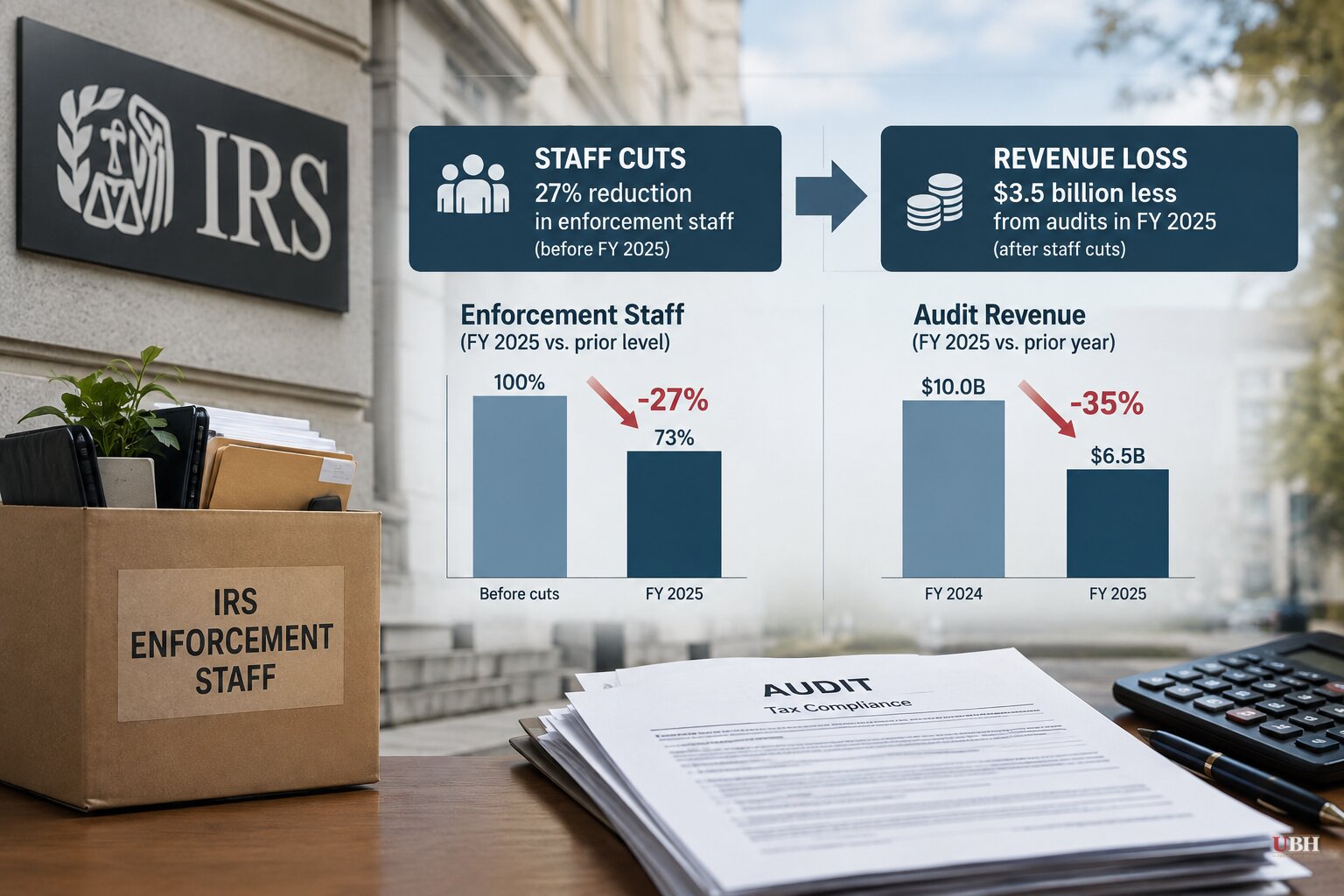
The IRS cut its enforcement staff by 27% last year as part of the Trump administration's government efficiency push led by Elon Musk. The result, according to a new report from the Treasury Inspector General for Tax Administration (TIGTA), was a 35% drop in revenue collected from audits in fiscal year 2025.
Audits brought in $10 billion in fiscal 2024. In fiscal 2025, that number fell to $6.5 billion, according to the TIGTA report cited by NPR. The Inspector General warned that "the downstream effects of these reductions are likely to become more apparent over time."
More than 25,000 IRS employees were laid off or took early retirement in 2025, including roughly 3,600 tax examiners, NPR reported. Staffing kept falling through the first four months of the current fiscal year, and the Trump administration has proposed additional IRS funding cuts for 2027.
The IRS had ramped up its auditing ranks under the Biden administration to chase after some of the estimated $696 billion in taxes that go unpaid every year, mostly from individuals and businesses under-reporting income. That buildup paid off: audit-related revenue rose 41% in fiscal 2024. Last year's staff cuts largely wiped that gain out.
Natasha Sarin, who served as a tax policy counselor to former Treasury Secretary Janet Yellen and is now a law professor at Yale, told NPR the numbers speak for themselves. "Defunding the IRS is not a money-saving proposition because you have fewer employees," Sarin said. "It is a money-losing one, because you do a less good job of collecting taxes."
Sarin argues the cost extends beyond the audit-revenue drop, because audits deter cheating in the first place. "You're less likely to speed when you know that there's a cop on the beat," she told NPR.
The cuts hit hardest at the top of the income scale. Audits of partnerships, a favored structure for high-income filers and private-equity arrangements, fell 76% between 2023 and 2025. Sarin says the top 1% of earners account for roughly a third of the total tax gap, meaning that's exactly where enforcement dollars generate the most return.
IRS Leadership Pushes Back
IRS Commissioner Frank Bisignano defended the agency's enforcement record before lawmakers earlier this year, according to NPR, arguing the IRS is using technology to target audits more efficiently with fewer staff. If better data and algorithms let a smaller workforce flag the same high-risk returns, the staffing reduction might not produce a net loss. The TIGTA numbers so far show audit revenue went down, not sideways.
There's also a legitimate conservative case against a bigger IRS enforcement apparatus that has nothing to do with cost-cutting theater: audits are burdensome, intrusive, and can be misapplied to lower and middle-income filers who make simple mistakes rather than the wealthy tax cheats the increased Biden-era staffing was supposedly targeting. That concern is worth taking seriously on its own terms. But this report documents a specific staffing cut producing a specific revenue loss that TIGTA measured directly. The audit declines landed disproportionately on partnerships and high earners, not average filers.
A Missing Number
One complication for anyone trying to track this going forward: the IRS has not published its usual annual estimate of the total tax gap, the figure that shows how much in owed taxes goes uncollected nationwide each year. Without that update, it's harder to know whether the shortfall documented in the TIGTA audit-revenue numbers reflects a broader, growing problem across the whole tax system or is concentrated in the specific audit categories TIGTA reviewed.
The open question now is what happens next. The Trump administration wants further IRS funding cuts in 2027, even as TIGTA's own report shows last year's reductions likely cost the Treasury more in lost audit revenue than they saved in payroll. Whether the agency's tech-driven approach that Bisignano described actually closes that gap, or whether the numbers keep sliding, will show up in next year's TIGTA report.
Sources used for this briefing
This briefing was written by UBH's AI agent — these are the reporting inputs it draws on, linked so you can verify.


