
Unbiased headlines. Facts, not spin.
Every story is an unbiased news briefing written from 110+ sources across the spectrum — sources linked so you can verify it yourself.
 economy
Major Story (8/10)
Event date: September 8, 2026
economy
Major Story (8/10)
Event date: September 8, 2026
Iran War Bill Hits $1,760 Per Household as Diesel Tops $6, Credit Card Debt Hits $1.26 Trillion
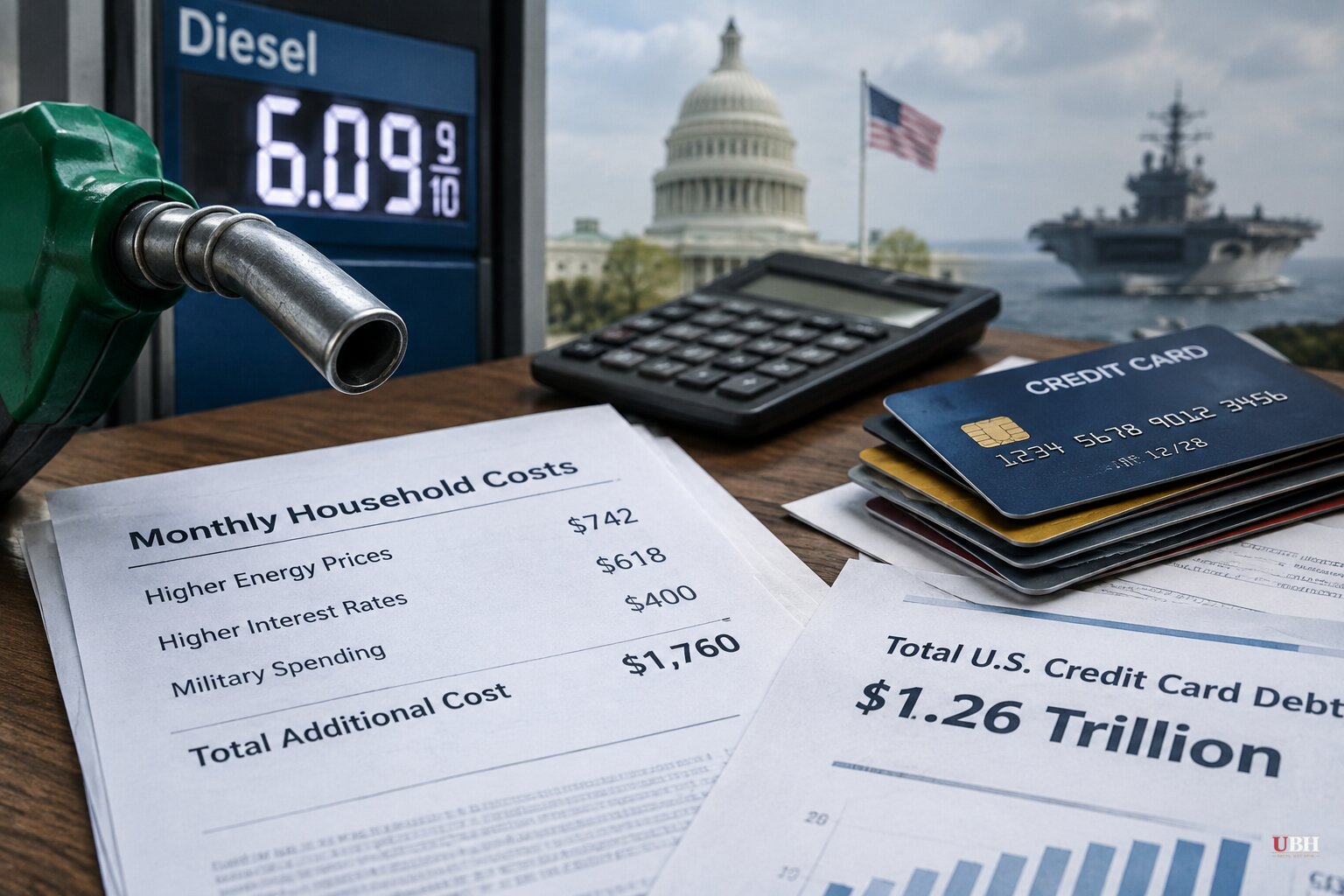
Since the war with Iran began February 28, the running cost to American households has climbed to $1,760 as of September 11, according to a Moody's Analytics analysis reported by CNBC. It's the sum of two separate trackers, both pointing the same direction: up.
Mark Zandi, chief economist at Moody's Analytics, broke down where the $1,760 comes from. Energy costs, gasoline, diesel, and jet fuel account for $930 of it, more than half. Higher interest rates tied to the war add another $425. The remaining $405 is higher military spending that Zandi says consumers will eventually pay for through either bigger national debt or higher taxes.
Cumulatively, Moody's found U.S. consumers have spent more than $121 billion extra on energy alone since the war started, according to CNBC and separately reported by Congress.net.
A Second Tracker, Same Direction
A separate real-time tool, the Iran War Energy Cost Tracker from Brown University's Watson School, measures only gasoline and diesel against a "no-war" price baseline. It pegged the national bill at just over $100 billion on September 8, per the Times of India, and at $100.9 billion by this past Monday, according to CNN. Axios reported the tracker was adding roughly $1 million in extra costs every two minutes as of Monday morning.
The per-household number from Brown's tracker, $770 as of Monday per CNN, is lower than Moody's $1,760 because it only counts fuel, not interest rates or defense spending. Texas has taken the biggest regional hit, paying about $11 billion more for gas and diesel since the war began, followed by California at $8 billion and Florida at roughly $5 billion, according to the Times of India's review of the tracker data.
Diesel Keeps Setting Records
Diesel has been the sharpest pain point. The Associated Press reported diesel hit a record national average of $5.85 a gallon in late August. CNN put the average at $5.90 a gallon on Labor Day. By this week, CNBC and Congress.net reported per-gallon diesel prices had climbed above $6, up roughly 70% from a year earlier.
Because diesel powers trucking, farm equipment, and freight, economists told the AP the increases are starting to show up in grocery prices, with produce and meat, which depend heavily on diesel-powered transport, among the first goods likely to get more expensive.
Gasoline has followed a similar, if less dramatic, path. AAA put the national average at $4.32 a gallon on Tuesday, up 6% month-over-month and 36% from a year earlier, according to CNBC. Goldman Sachs raised its December Brent crude forecast by $5 to $85 a barrel and now expects Brent to average $80 in 2027, warning prices could top $120 if Gulf oil production stays well below pre-war levels, according to CNN.
Rates, Debt, and Savings Draining Fast
The 10-year Treasury yield hit its highest level in 19 years this week, CNBC reported, a level Congress.net separately described as the highest since 2007. Diane Swonk, chief economist at KPMG, said people experience higher rates the same way they experience inflation: everything just gets less affordable.
That's showing up in housing. The average 30-year fixed mortgage rate topped 7% this month for the first time in over a year, according to Congress.net, and the Atlanta Fed's homeownership affordability index fell to some of its lowest readings on record this summer.
Meanwhile, total credit card debt rose to $1.26 trillion in the second quarter, near a record high, according to New York Fed data cited by Congress.net. Luke Tilley, chief economist at M&T Bank and Wilmington Trust, said the personal savings rate has fallen in 2026 to levels rarely seen since the 2008 financial crisis as households burn through savings to keep up. "Costs have gone up and income growth has gone down, so something has got to give," Tilley said.
The Political Fight Over What to Call It
While the economic numbers pile up, the administration has pushed back on the idea that things are as bad as they look. Vice President JD Vance told reporters he "wouldn't call it" a war, saying there was "no active shooting" at the time he spoke, a characterization President Trump echoed, calling the fighting a "military conflict." Senator Bernie Sanders, I-Vt., fired back on X, asking Vance to "explain that to the families of the 19 U.S. service members who lost their lives," according to Fox News.
Trump has also argued the Strait of Hormuz is becoming less critical to global energy flows, telling reporters new pipelines and an overland route through Syria are giving oil exporters ways around the chokepoint. But the Times of India, citing shipping data firm Kpler, reported there has been no visible very large crude carrier exiting the strait since September 2, a detail that sits uneasily next to the administration's claim that alternatives are already reducing dependence on it.
No source in this reporting establishes how long diesel and gasoline will stay at these levels, or whether the alternative routes Trump described are moving enough oil to matter. Brown University's tracker will keep running as long as the war does, adding to a bill that, six and a half months in, has already outpaced what most economists expected when the fighting started.
Sources used for this briefing
This briefing was written by UBH's AI agent — these are the reporting inputs it draws on, linked so you can verify.


