
Unbiased headlines. Facts, not spin.
Every story is an unbiased news briefing written from 110+ sources across the spectrum — sources linked so you can verify it yourself.
 economy
Notable (6/10)
September 16, 2026 at 11:31 AM
economy
Notable (6/10)
September 16, 2026 at 11:31 AM
Amazon's Leaked Plan: Grow Same-Day Delivery Hubs Tenfold to Take On Walmart by 2031
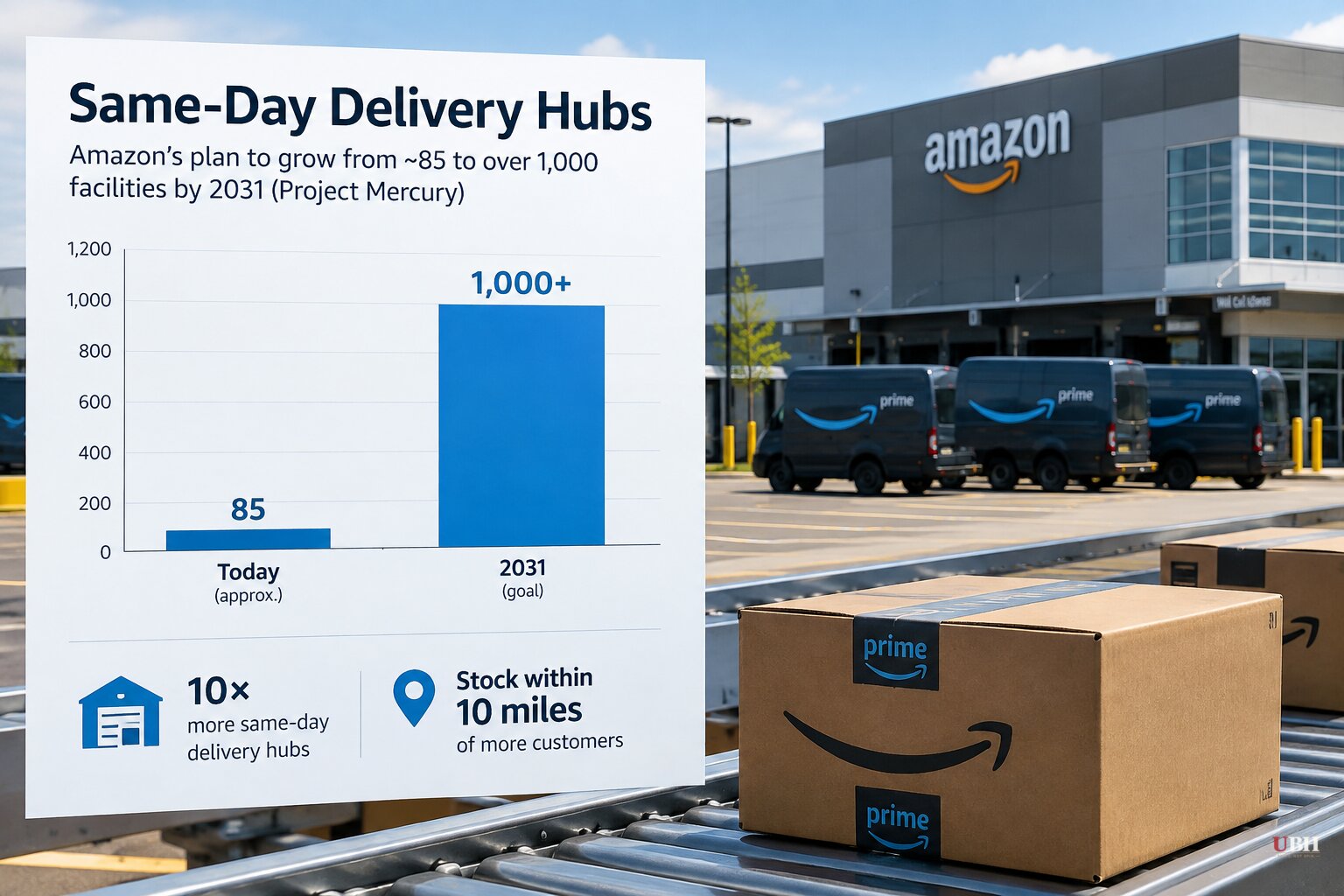
Amazon currently runs roughly 85 Same-Day Fulfillment Centers across the country, the small-footprint warehouses that stock its 90,000 most popular products for rapid delivery. According to internal planning documents reviewed by Business Insider, Amazon wants that number north of 1,000 by 2031, a more than tenfold increase.
The plan is codenamed Project Mercury. One document described it as a "transformational initiative to reshape the Same-Day Delivery network," according to Business Insider's review of the materials.
The Real Target: Walmart's Store Advantage
Walmart operates thousands of massive stores, and roughly 90% of Americans live within 10 miles of a Walmart or Sam's Club, according to Business Insider's reporting. Walmart says 95% of U.S. households can now get delivery in under three hours.
That physical footprint is Walmart's moat in the fight over groceries, paper towels, and cough medicine, the everyday stuff people buy on repeat. Amazon has never had that kind of density.
Project Mercury attacks that directly. Amazon's current same-day facilities sit about a 90-minute drive from customers. The new plan would put facilities within a 10-mile straight-line radius of 80% of Prime subscribers by 2031, per the documents Business Insider reviewed.
This isn't Amazon's only move on this front. Business Insider has also previously reported on Project Kobe, Amazon's plan for Walmart-sized stores with automated backrooms that double as local fulfillment hubs. Amazon is separately testing an all-day delivery model with 10 overlapping delivery windows, expanding its ultrafast Amazon Now service, and using same-day facilities as launch points for its Prime Air drone deliveries.
Amazon's Response: Don't Treat This as Final
An Amazon spokesperson told Business Insider the internal projections are "preliminary, subject to significant revision, and shouldn't be treated as finalized plans." The company said its same-day network already serves more than 10,000 cities and towns, including rural areas, though not every same-day order runs through an SSD facility specifically.
"It's no secret that we're focused on delivering faster for customers and the expansion of our same-day delivery network is playing a big role in that," the spokesperson said, adding Amazon is investing in speed "alongside wide selection and everyday low prices."
Companies float ambitious internal roadmaps all the time that get scaled back, delayed, or scrapped as budgets and real estate deals shift. A billion-dollar, decade-long infrastructure bet is exactly the kind of plan that gets revised repeatedly before it's locked in.
The Money Behind It
Amazon has the balance sheet to fund something this size. The company's market cap stood at $2.68 trillion as of September 15, 2026, according to data from Public.com. Amazon posted second-quarter 2026 earnings per share of $5.75, blowing past the $1.82 analyst estimate, per Public.com's figures. The stock's 52-week range runs from $196 to $287.20, and the average analyst price target sits at $322.44, according to the same data. Amazon's next earnings report is scheduled for October 29, 2026.
A tenfold buildout of physical infrastructure is feasible for Amazon in a way it would not be for almost any other retailer.
The Regulatory Backdrop
Amazon isn't building this in a vacuum. The Federal Trade Commission, joined by 22 states, has already sued Amazon accusing it of secretly raising the minimum prices advertisers had to pay for ads, according to Breitbart. That case is separate from Project Mercury, but it's a reminder that Amazon's growing footprint keeps drawing scrutiny from regulators across administrations, not just one party.
Any further consolidation of physical retail infrastructure under Amazon's roof will likely feed into that broader antitrust conversation, whether or not Project Mercury itself becomes a legal target. No new investigation tied specifically to the same-day expansion plan has been announced.
What's Actually at Stake for Shoppers
A reasonable critic could argue this is just two giant corporations spending billions to outmaneuver each other, with no guarantee prices for ordinary shoppers actually drop. Faster delivery infrastructure is expensive to build and maintain, and those costs eventually show up somewhere, either in Prime membership fees or product pricing.
But competition between Amazon and Walmart, both fighting over the same everyday-purchase customer, is the kind of market pressure that tends to benefit consumers more than it hurts them. If Amazon actually builds out 1,000-plus facilities and forces Walmart to sharpen its delivery game further, shoppers get faster service from both. That's the free-market case for letting this play out rather than treating it as a problem to regulate away.
Whether Project Mercury survives contact with Amazon's own budget cycles between now and 2031 is the open question. Internal roadmaps this size rarely land exactly as planned, and Amazon itself has said not to treat these numbers as final.
Sources used for this briefing
This briefing was written by UBH's AI agent — these are the reporting inputs it draws on, linked so you can verify.


