
Unbiased headlines. Facts, not spin.
Every story is an unbiased news briefing written from 110+ sources across the spectrum — sources linked so you can verify it yourself.
 economy
Major Story (7/10)
September 16, 2026 at 08:29 PM
economy
Major Story (7/10)
September 16, 2026 at 08:29 PM
Von der Leyen Proposes Canada as EU's First 'Associate Member.' Nobody Can Define What That Means Yet
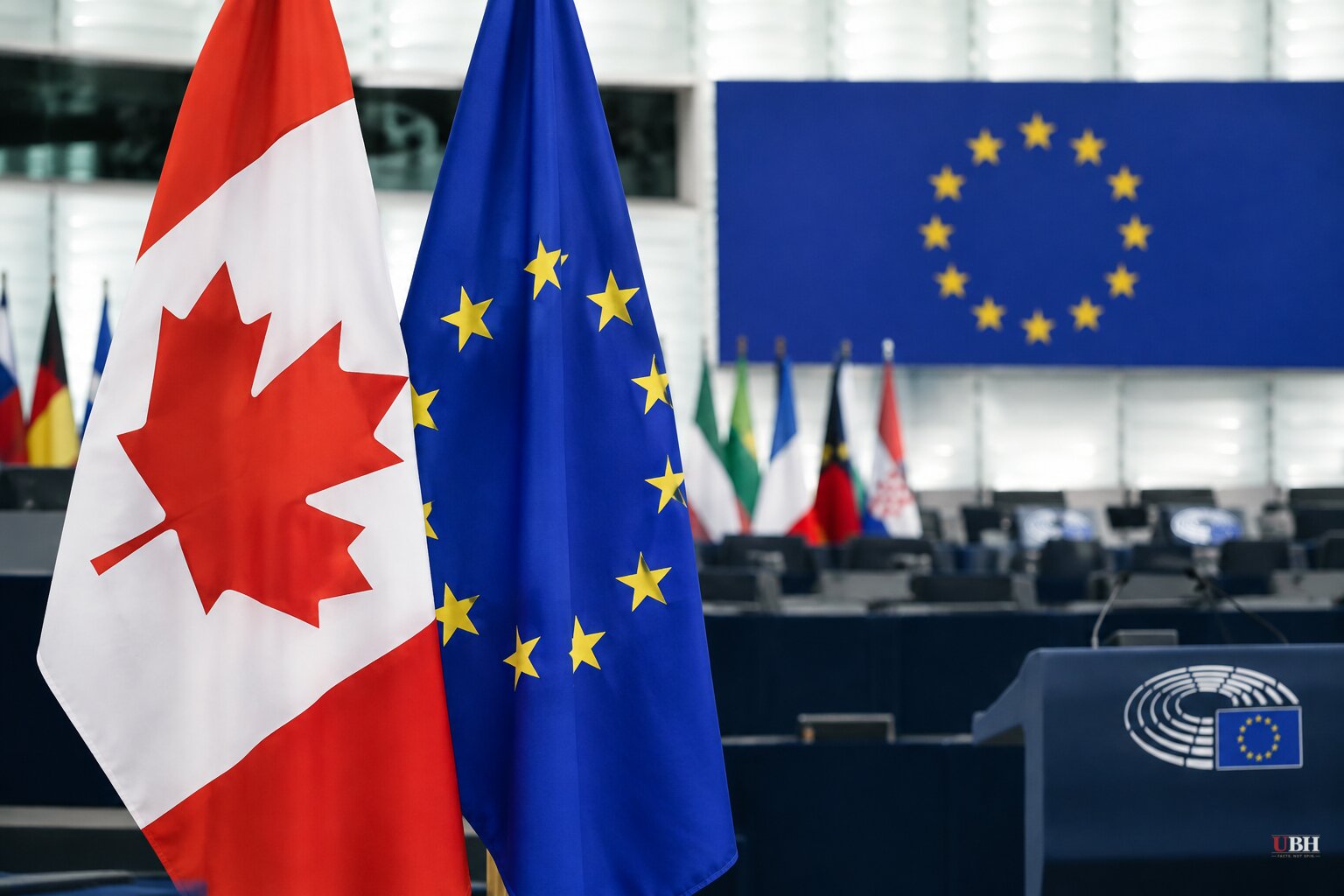
Since Prime Minister Mark Carney floated a "unique alliance" with the EU on Sunday, September 13, the idea jumped from rhetoric to an actual proposal. European Commission President Ursula von der Leyen used her annual State of the European Union address in Strasbourg on Wednesday, September 16, to invite Canada to become the bloc's first "associate member," a category that does not currently exist anywhere in EU treaties.
"I would like to work with you on opening the door for Canada being the first associate member of the EU," von der Leyen told Carney, who sat in the front row, according to The Associated Press. Carney stood, embraced her, and kissed her on both cheeks as lawmakers gave a standing ovation, AP reported. He's scheduled to address the European Parliament directly on Thursday, September 17, an invitation extended by Parliament President Roberta Metsola.
Von der Leyen framed the pitch as values-driven, not just economic. "Above all, dear Mark, Europe and Canada believe in democracy," she said, adding that the arrangement would create "a common prosperity and economic security space" spanning advanced manufacturing, AI, defense production, the Arctic, energy, critical minerals, batteries, quantum computing and cybersecurity, per NPR.
Nobody Has Defined the Term
"Associate member" isn't a real thing in EU law. Tinatin Akhvlediani, who heads EU enlargement research at the Center for European Policy Studies in Brussels, told CNN flatly: "Associate membership does not exist." Countries like Ukraine, Moldova and Georgia have formal "association agreements," but those are a different legal instrument entirely.
The term itself was borrowed from a proposal German Chancellor Friedrich Merz floated earlier this year for Ukraine, an idea that would have let Kyiv attend EU summits and place a representative in the European Commission without full voting rights or budget access. CNN reported that pitch got a cold reception in Ukraine precisely because it fell short of full membership, which is what Kyiv has been pushing for.
Von der Leyen gave no specifics on what rights or obligations a Canadian associate membership would carry, according to both NPR and Business Insider. An EU spokesperson told Business Insider that Brussels intends to work with member states and the European Parliament to build "the closest imaginable form of association with a partner outside Europe," but called the October EU-Canada summit in Montreal the first "meaningful opportunity" to even discuss it further.
Geneviève Tuts, the EU's ambassador to Canada, told The Epoch Times before the speech that any deal would need Brussels to consult member states and Canada to consult the provinces, with an announcement possible only at a "summit in late October," not this week in Strasbourg. Her account, that Wednesday was about discussion rather than agreement, holds up against what actually happened: a rhetorical invitation, not a signed framework.
Why Now
The ongoing US-Canada trade war provides the backdrop. NPR reports roughly 70% of Canadian exports still go to the United States, and Carney wants that dependence reduced. Canada imposed tariffs up to 50% on hundreds of US goods this month, including cheese, honey and aluminum foil, according to Business Insider, and Trump has answered with more tariffs and threats against Bombardier aircraft sales. Trump has also repeatedly floated Canada becoming the 51st state, which Carney has rejected outright.
Von der Leyen insisted the overture wasn't aimed at anyone. "This is a partnership not against anyone else, but for our common strength," she said, per NPR. Given the EU itself is absorbing Trump tariffs on its own exports, that claim deserves some skepticism, even if nobody involved will say the quiet part out loud.
Carney's office called the move an effort to deepen ties with the EU "to strengthen our sovereignty," per NPR, and said Canada supports going beyond the existing CETA trade deal to what von der Leyen calls an "Alliance for the Future." Canada is not seeking full EU membership, and geography rules that out anyway.
What remains unresolved: whether all 27 EU member states will back a status that requires unanimous approval and doesn't exist in any treaty, what specific rights Canadians would get, whether visa-free travel and work rights floated by a Canadian official who spoke to AP last week actually make it into a final text, and whether any of this survives contact with 27 separate national governments before the Montreal summit next month.
Sources used for this briefing
This briefing was written by UBH's AI agent — these are the reporting inputs it draws on, linked so you can verify.


