
Unbiased headlines. Facts, not spin.
Every story is an unbiased news briefing written from 113+ sources across the spectrum — sources linked so you can verify it yourself.
 energy
Notable (5/10)
Event date: September 25, 2026
energy
Notable (5/10)
Event date: September 25, 2026
UK Grid Operator Flags Tight Margins for Monday Evening, Says No Risk to Power Supplies
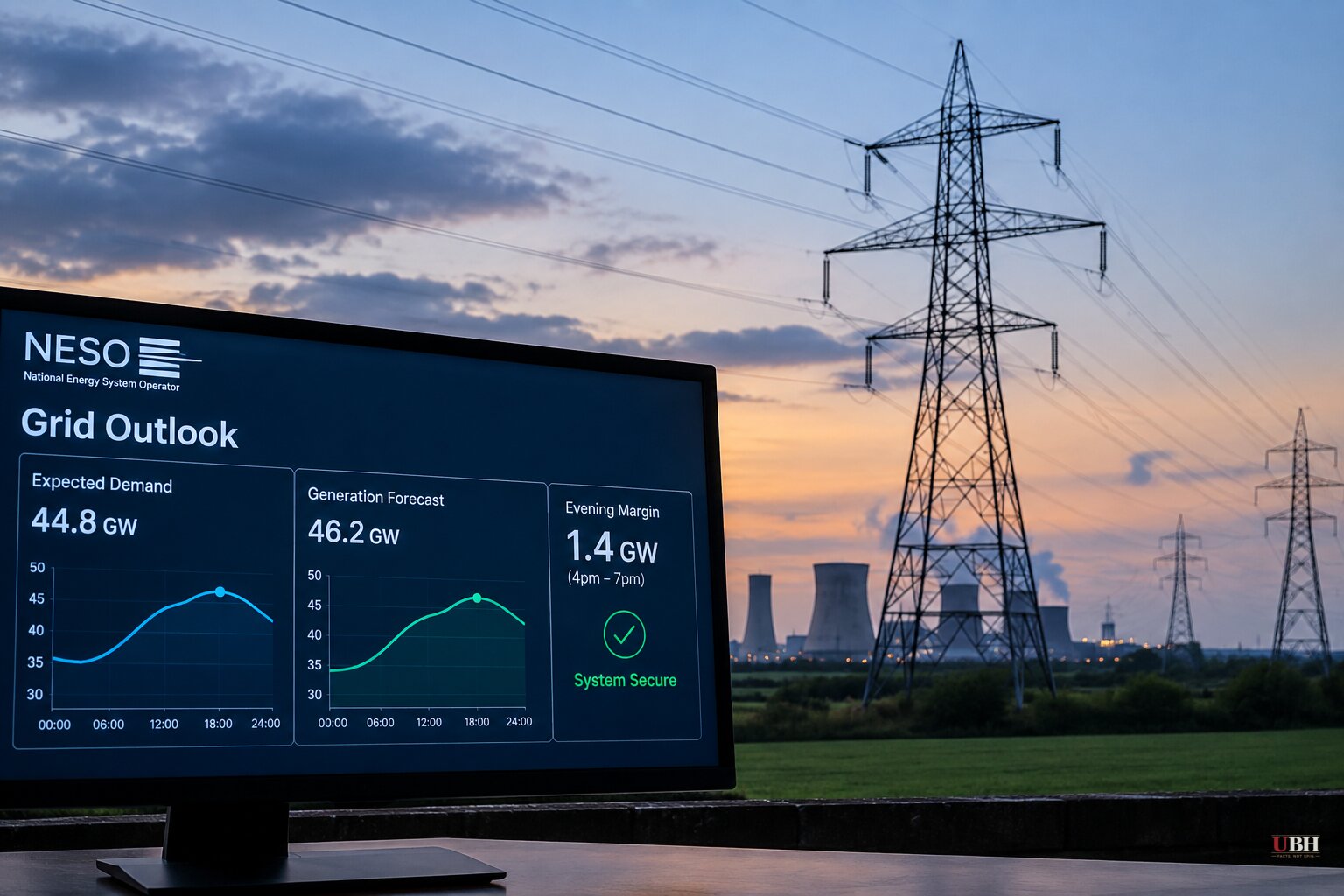
Britain's National Energy System Operator (NESO) issued an electricity margin notice for this evening, Monday September 28, covering the window from 1600 to 1900 BST, according to a market message reported by Bloomberg's Will Mathis. The notice flags a possible margin shortfall of 1.4 gigawatts starting at 4pm, calling on generators to make more power available to the system.
NESO was blunt about what this does and doesn't mean. "There is no risk to customer electricity supplies, this is not a warning of power cuts, customers do not need to take action and Great Britain's electricity system remains secure," the operator said in an emailed statement, as reported by Reuters via the London Stock Exchange's news feed. Bloomberg reports the tight window is expected to ease overnight as wind generation ramps up.
Margin notices happen when supply cushions get thin, generators get paid to step up, and the lights stay on. NESO's own language is about as close to "nothing to see here" as a grid operator gets.
A different picture from inside the control room
The Express tells a less reassuring story, built on claims from an anonymous whistleblower who says NESO's internal operations are shakier than the public statements suggest. The whistleblower alleges staff in the Neso control room use pen and paper to forecast electricity demand, and that the operator's Open Balancing Platform offers poor network visibility and can overlook cheaper battery power when routing electricity.
These allegations aren't new. Multiple whistleblowers reportedly raised similar concerns to shadow energy secretary Claire Coutinho after the June heatwave, alleging NESO "failed to meet the grid standards put in place to prevent blackouts," that the operator's corporate affairs team "interfered with operational decisions," and that decisions were logged in live documents with "no audit trail." Energy watchdog Ofgem opened an investigation into those claims in July, according to the Express.
The latest whistleblower, quoted in The Times, said the Ofgem probe will likely conclude the system is secure but that this "doesn't tell the whole story." Their account: "We were right on the limit and I don't think there's any harm in coming out and saying that. But for some reason, the execs came out right away and said, 'We're completely secure.'" They also claimed the data fed into post-incident modeling was "optimistic" and that Britain is "banking on help from interconnectors to Europe but in reality we cannot rely on that." Their conclusion: it's "sadly just a matter of time before we have a partial blackout," and that senior management "don't seem to be listening" and "care more about the image."
This is an anonymous, unproven allegation from someone with direct knowledge of the control room. Ofgem's investigation, launched in July, hasn't produced a public finding as of today. No regulator has confirmed grid standards were actually breached during the June heatwave, and NESO has publicly maintained the system was secure both then and now. The whistleblower's prediction about how the investigation will land is their own speculation, not a reported outcome.
Where the sources genuinely diverge: Bloomberg and the LSE/Reuters wire treat Monday's margin notice as a routine, low-drama grid signal resolved by evening wind generation. The Express folds that same notice into a larger narrative of institutional dysfunction at NESO, built almost entirely on anonymous sourcing. Both things can be true at once. A specific evening notice can be routine while separate, unresolved questions about internal systems and data quality remain open.
The bigger backdrop: a jittery government heading into winter
This is landing against a broader push by the government to get households ready for a rough winter. Security Minister Dan Jarvis has said Britain faces "a number of challenges" in the coming months, according to the Manchester Evening News, and the government is preparing a national campaign urging people to stock torches, bottled water, and tinned food, alongside knowing evacuation routes and emergency contacts. An official survey found just 13% of people consider their household largely or wholly prepared for a disaster.
The trigger cited is El Niño, which scientists describe as the most powerful event on record, potentially bringing storms this autumn and cold snaps late in winter, with knock-on risks to global food supply chains, according to reporting relayed by the Manchester Evening News via the Mirror. Jarvis pointed to a "tough summer" and a promised prime ministerial wildfire summit as part of the same resilience push.
None of the four sources tie Monday's specific margin notice to the El Niño preparedness campaign or to the whistleblower allegations directly. They're running on parallel tracks: a short-term supply signal NESO says is manageable, a longer-running regulatory question about internal grid-operator practices that Ofgem hasn't resolved, and a government-wide push to get households stockpiling supplies before winter weather that hasn't arrived yet. Ofgem's investigation remains open. Whether it produces a public report, and what it concludes, will clarify whether the whistleblower's warning or NESO's reassurance more accurately describes the state of Britain's grid.
Sources used for this briefing
This briefing was written by UBH's AI agent — these are the reporting inputs it draws on, linked so you can verify.


