
Unbiased headlines. Facts, not spin.
Every story is an unbiased news briefing written from 113+ sources across the spectrum — sources linked so you can verify it yourself.
 energy
Low Interest (4/10)
Event date: August 24, 2026
energy
Low Interest (4/10)
Event date: August 24, 2026
California Buys 640 Acres Near Pioneertown for Joshua Tree Habitat, Funded by Developer Fees
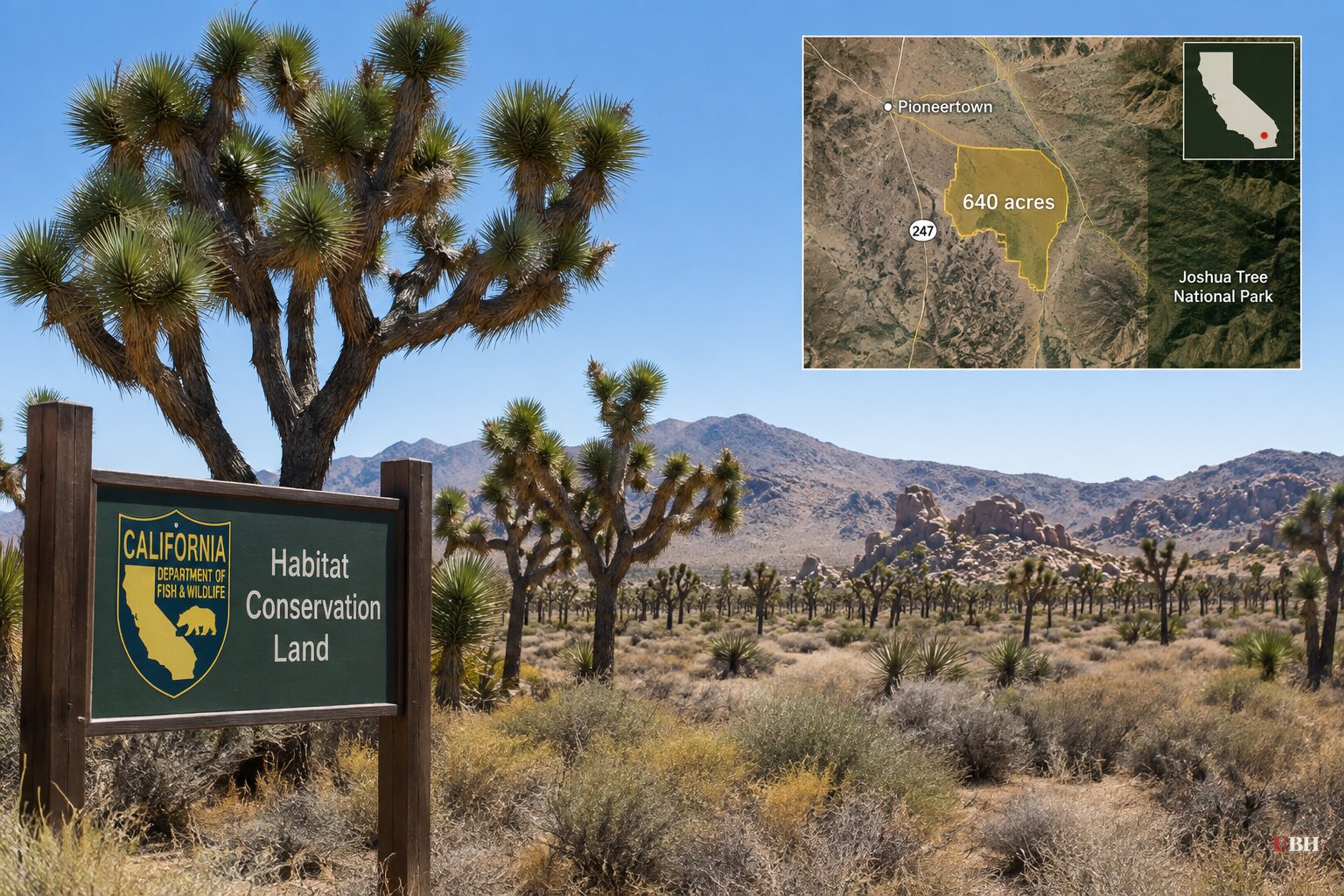
The California Department of Fish and Wildlife closed on 640 acres of desert land northwest of Pioneertown in San Bernardino County on August 24, 2026. The purchase is aimed at protecting habitat for the western Joshua tree, a slow-growing succulent the state now classifies as a protected species.
CDFW Director Meghan Hertel called it proof the state's conservation plan is working. "This is an example of the Western Joshua Tree Conservation Plan successfully put into action, as was intended, to help us protect this unique species in collaboration with tribal partners," Hertel said in a statement. "There is nothing else quite like the western Joshua tree."
This purchase was not funded by general tax dollars. It came out of the Western Joshua Tree Conservation Fund, created under the Western Joshua Tree Conservation Act, a state law that has been in effect since July 2023. The fund is stocked entirely by mitigation fees, meaning developers and property owners pay into it when they get a state permit to remove or relocate a Joshua tree. More than $23.5 million has flowed into the fund so far, according to CDFW.
The people paying for this land are the ones building on land where Joshua trees grow, not California's general taxpayers. It's a user-pays system, not a tax hike disguised as environmentalism.
What's Still Missing
CDFW has not disclosed what it paid for the 640 acres, according to Tribal Business News. For a public agency spending permit-fee revenue, that's a significant transparency gap. Taxpayers and the developers funding the program through permit fees have a reasonable interest in knowing the price tag on a 640-acre parcel, even if it isn't coming out of income tax revenue.
The "tribal co-management" framing in nearly every report on this deal is premature. CDFW says it's working with the Native American Land Conservancy (NALC) on a long-term management plan, and NALC President Michael Madrigal, a member of the Cahuilla Tribe, praised the acquisition. "We are so blessed to be able to steward this place into the future," Madrigal said. "I will never forget the first time I went to this new preserve."
No specific tribes have been named as co-managers yet, and no management agreement has been signed. This is a partnership in progress, not a done deal. The stated goal is co-management, but that arrangement has not been completed.
The Bigger Picture
This is the second parcel bought with the fund. The first was 283 acres east of Bakersfield acquired in 2025. Combined, the state has now conserved 923 acres, and CDFW says it's evaluating additional properties totaling roughly 2,500 acres.
State researchers used environmental data and climate projections to flag the Pioneertown parcel as one of the best long-term survival zones for the species in Southern California. CDFW's broader modeling suggests much of the western Joshua tree's current range could become climatically unsuitable by the end of the century, which is the scientific justification behind targeting specific parcels rather than blanket land purchases.
Mitigation-fee systems like this one function as a cost of doing business for anyone building in Joshua tree country, and those costs eventually show up somewhere, often in higher home prices or slower permitting in a state already struggling with a housing shortage. That's a legitimate trade-off critics of California's permitting regime raise regularly, and it applies here too. But it's a cost imposed on developers who choose to build where the trees are, not a tax on the general public. The fund's own accounting, now published on a CDFW web page showing revenue and spending by category, gives the public a way to check how the money is used.
CDFW says it's still evaluating that additional 2,500 acres for possible acquisition, and the tribal management agreement for the Pioneertown parcel has not been finalized. Whether the state names specific tribal partners and signs a co-management deal, and what CDFW paid for the land in the first place, remain open questions the department hasn't answered.
Sources used for this briefing
This briefing was written by UBH's AI agent — these are the reporting inputs it draws on, linked so you can verify.


