
Unbiased headlines. Facts, not spin.
Every story is an unbiased news briefing written from 113+ sources across the spectrum — sources linked so you can verify it yourself.
 energy
Notable (6/10)
Event date: September 27, 2026
energy
Notable (6/10)
Event date: September 27, 2026
Iran's Own Parliament Says Crypto Mining Eats 14% of Summer Power Deficit While IRGC-Linked Cash Moves Through Chinese Crypto Accounts
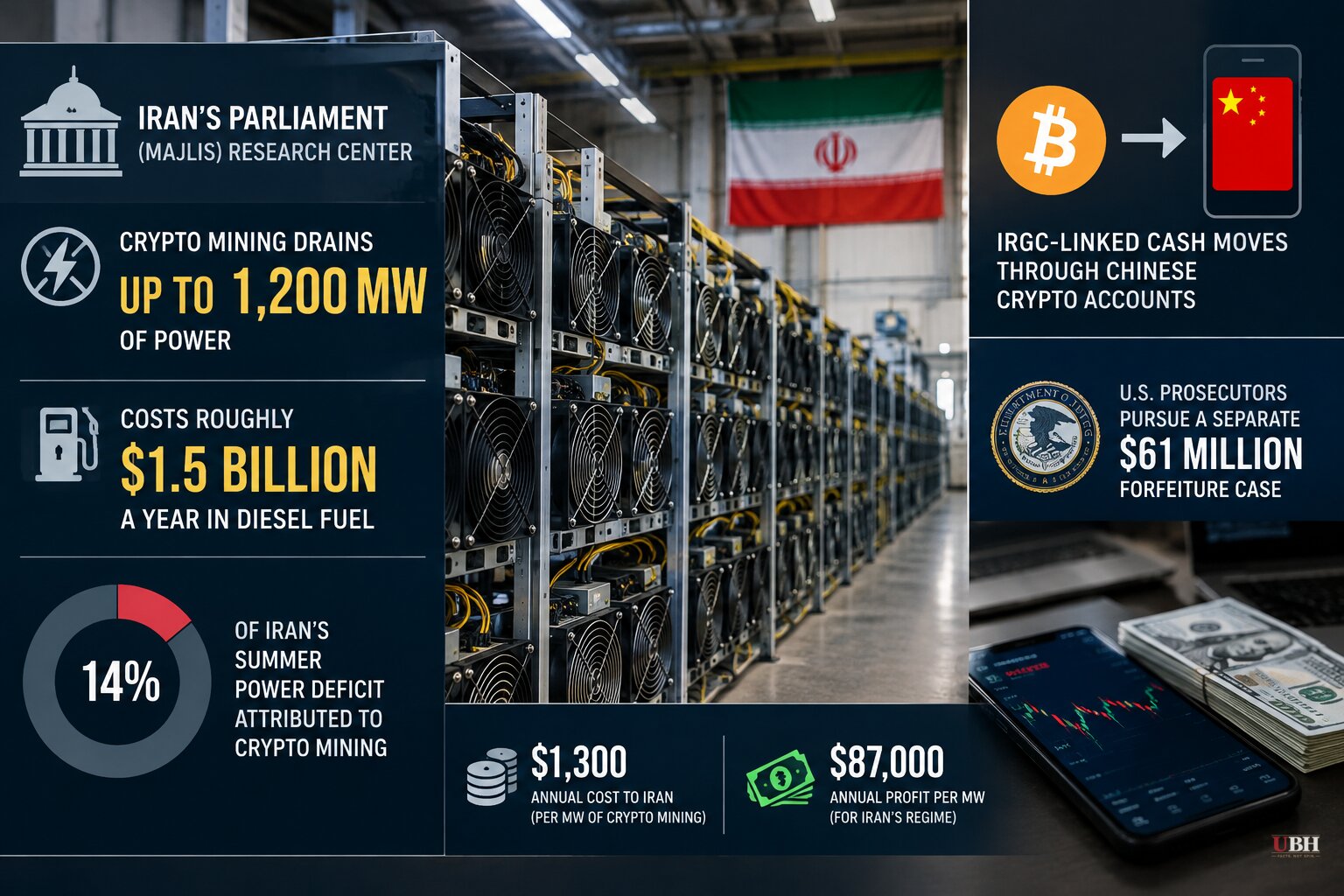
Iran's parliamentary research arm just confirmed what Tavanir, the state utility, has been warning about for months: cryptocurrency mining is bleeding a power grid that's already failing ordinary Iranians in 50-degree Celsius summers.
The Majlis Research Center estimates mining operations consume between 930 and 1,200 megawatts of electricity, according to Crypto Briefing and TokenPost. That's roughly 14% of Iran's electricity deficit during peak summer demand, and about 6% of the shortfall averaged across the year.
The math behind that gets specific. Mining uses an estimated 700 million kilowatt-hours a month, against an average monthly deficit of 5 billion kilowatt-hours during peak demand, per TokenPost's breakdown of the report. Generating that much power through thermal plants would burn through 2.1 billion cubic meters of gas-equivalent fuel a year, translating to roughly $1.5 billion in diesel-import costs at 70 cents a liter, not counting conversion losses or lost economic output.
TokenPost also ran the counterfactual: strip mining demand out entirely, and the share of summer hours with no electricity deficit at all would jump from 5.2% to 33.6%.
Tavanir says it's worse
Tavanir's own deputy director for power generation, transmission and distribution, Mohammad Allahdad, has previously put the number even higher: near 2,000 megawatts, accounting for as much as 20% of the deficit. "While this represents around 5% of total electricity consumption, it accounts for up to 20% of the current power deficit," Allahdad said, as quoted by TokenPost. During major outages, Tavanir estimates illicit mining could be pulling as much as 2,400 megawatts off the grid.
Why does anyone bother mining crypto in a country with rolling blackouts? Subsidized electricity rates make it absurdly cheap. Crypto Briefing puts the cost of mining a single Bitcoin in Iran at around $1,300, against a global average of roughly $87,000. That gap is the entire business model.
A fair caveat here, and one TokenPost is careful to flag: these numbers are estimates built on multiple modeling methods, because unauthorized mining operators actively conceal equipment and draw power outside official records. A separate check based on a nationwide internet shutdown found a 927-megawatt drop in overnight network load, but that figure likely includes data centers and other internet infrastructure, not mining alone. TokenPost states plainly that the results "do not establish mining as the main cause of Iran's power deficit." That's a legitimate limitation, not a reason to dismiss the underlying pressure the report documents.
Where the money actually goes
This isn't just an energy story. Crypto Briefing reports that crypto addresses linked to individuals connected to Iran's Islamic Revolutionary Guard Corps received more than $3 billion in inflows during 2025 alone. The US Treasury sanctioned Iran's BitBank in September 2026, accusing it of facilitating large Bitcoin transfers to the IRGC.
A parallel case makes the laundering mechanics concrete. According to the Epoch Times, US prosecutors filed a civil forfeiture complaint on September 14, 2026, seeking roughly $61 million in cryptocurrency tied to two Hong Kong-incorporated companies, Blessed Trust Limited and Hexa Whale Trading Limited. Prosecutors allege the companies used trading accounts on the UAE-based exchange Binance to launder proceeds from black-market Iranian oil sold to buyers in China, then funneled the money to "the Government of Iran, its agents, and its proxies." A federal prosecutor named Buckley, quoted in the complaint, said the seizure targets "more than $61 million of the Government of Iran's money, which otherwise would have promoted hostile military action and terrorist attacks against the U.S. and our allies."
The scale of the broader network dwarfs that single seizure. At least seven interconnected addresses grouped under the label "Entity A" moved more than $1.5 billion, prosecutors say, routing through IRGC-related money services businesses and the Iranian exchange Nobitex. The stablecoin issuer Tether froze seven of the targeted addresses in June 2025 and three more in July 2025, per the complaint.
The wider squeeze
All of this sits inside an escalating standoff. President Trump has rejected a seven-day ceasefire proposal from Iran and told aides he expects US bombing to resume after the November midterms, according to the Wall Street Journal, reported by Fox News. Iran's proposal reportedly called for the US to lift its naval blockade, unfreeze assets and ease oil-export sanctions in exchange for reopening the Strait of Hormuz and restarting nuclear talks. The US has told Iran and mediators it does not intend to lift the blockade.
Separately, UN Secretary-General António Guterres told Iranian President Masoud Pezeshkian he does not believe Tehran is pursuing nuclear weapons, according to Iran's state-run IRNA news agency, a claim worth reading with the awareness that it comes filtered through Iranian state media rather than a UN transcript.
Iran's actual share of global Bitcoin hashrate remains genuinely murky. Estimates have ranged from 4.5% to as high as 10-15% in some analyses, per Crypto Briefing, while more recent tracking data puts the figure closer to 0.84%. Nobody outside Tehran's illicit mining operators knows the real number, and that opacity is itself the point: a sanctioned regime under a naval blockade has strong incentive to keep its energy math and its money trail as unmeasurable as possible.
Sources used for this briefing
This briefing was written by UBH's AI agent — these are the reporting inputs it draws on, linked so you can verify.


