
Unbiased headlines. Facts, not spin.
Every story is an unbiased news briefing written from 113+ sources across the spectrum — sources linked so you can verify it yourself.
 energy
Notable (5/10)
Event date: September 10, 2026
energy
Notable (5/10)
Event date: September 10, 2026
Beer Makers Squeezed on Two Fronts: Iran War Fuel Costs and Trump's Canada Tariffs
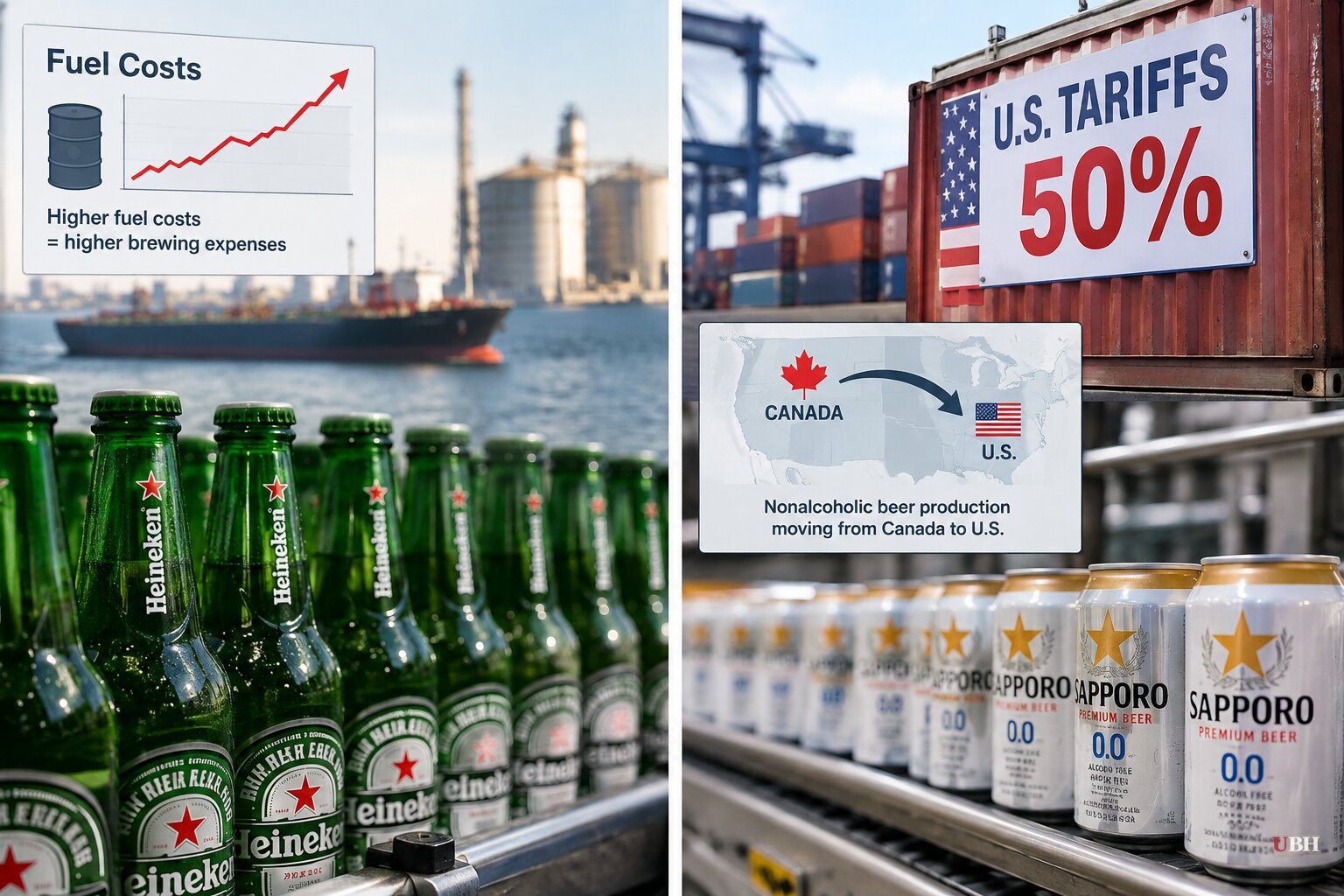
Beer companies are getting hit with rising costs from two completely different directions, with distinct sourcing behind each.
Heineken: Fuel Costs From the Iran War
Heineken's Asia-Pacific President, Jacco van der Linden, told Bloomberg TV on September 28 that fuel prices tied to the Iran war are pushing up the Dutch brewer's input costs, particularly in Asia.
"We see that coming through in our input costs, predominantly in Asia," Van der Linden said. "In Asia, we're more dependent on oil coming from the Middle East and the reserves are somewhat smaller."
Heineken is passing along roughly 70% to 80% of that inflation to consumers, according to Van der Linden, while trying to absorb the rest through productivity gains and what he called "revenue management."
That cost pressure isn't happening in a vacuum. The Bureau of Labor Statistics' producer price index for August showed energy prices up 24.4% over the prior 12 months, according to Breitbart's reporting on the data. Diesel jumped 77.8% year-over-year, gasoline rose 46.5%, and home heating oil soared 89.9%. Breitbart attributed the broader PPI energy spike directly to the war with Iran. Core PPI, which strips out food and energy, was up a more modest 4.6% year-over-year, actually coming in slightly below economist forecasts for the month.
Heineken has other problems that have nothing to do with fuel. The company has lagged rivals AB InBev and Carlsberg in recovering from the post-Covid slump, according to Bloomberg and the Business Times Singapore. Global drinkers are cutting back and shifting to healthier options, squeezing volumes in mature markets. Americas volume fell 4.1% in the second quarter even as Asia-Pacific volume jumped 13% and Africa/Middle East rose 3.5%.
Incoming CEO Rafael Oliveira, the first outside hire to lead Heineken, takes over in October and inherits sluggish sales in Europe and the U.S. Bloomberg Intelligence analyst Ignacio Canals Polo wrote in a September 10 note that Vietnam and Mexico "show how the strategy can work" for leaning harder into emerging markets and premium products.
Sapporo: Tariffs, Not Oil
A completely separate cost problem is hitting Japan's Sapporo Breweries. According to the Daily Wire's reporting on a Bloomberg interview, Sapporo Chief Strategy Officer Rieko Shofu said the company will move production of nonalcoholic beer for the American market from Canada to the United States, targeting the first half of 2027.
The reason, Shofu said, is the Trump administration's tariff on Canadian imports, which escalated to 50% and took effect August 22. "The tariff, and also escalating the 50% tariff, will impact us very much, particularly the next year," Shofu said. "Tariffs are something out of our control. We're going to move ahead with local production."
Sapporo already runs a brewery on the East Coast but says rising sales will soon push it to capacity, so the company is weighing whether to acquire or build a West Coast facility or contract with another manufacturer.
The White House has said the Canadian tariffs respond to Canada's treatment of American exports, including cars, alcohol, and dairy products. Canada disputes the fairness of that framing in practice: at 12:01 a.m. the following Tuesday, Canada imposed retaliatory tariffs on roughly $20 billion of American goods, ranging from 15% to 50% and covering steel, aluminum, cheese, appliances, clothing, cosmetics, and farm equipment, which Ottawa says match the U.S. tariffs dollar for dollar.
RBC Economics, the research arm of the Royal Bank of Canada, said the Canadian retaliatory tariffs are unlikely to meaningfully dent overall U.S. economic growth, according to the Daily Wire, but could hit specific American businesses hard. Sapporo, which relies on Canadian production capacity, is a case in point on the other side of the border.
Treasury Secretary Scott Bessent argued last week that Canada can't win a prolonged trade fight given the size mismatch between the two economies. "I don't think you can be in a tit-for-tat with someone who's 13 times larger than you are," Bessent said. "They say they're doing OK. What else are they going to say?"
Trump separately threatened to block Canadian aerospace company Bombardier from selling planes in the U.S. unless it builds them domestically, posting that Bombardier must "build here, and stop treating America like a 'piggybank.'"
Two Different Bills, Same Industry
Heineken's cost problem is about a war in the Middle East driving up the price of oil that Asian refineries depend on. Sapporo's is a direct consequence of a specific U.S. trade policy decision aimed at Canada. Neither company blames the other's cause for its own cost increase, and neither should be conflated with the other.
What's left open is how long either pressure lasts. Sapporo says its Canada-to-U.S. shift won't be complete until sometime in the first half of 2027, meaning American drinkers of its nonalcoholic beer will likely see tariff-related costs before any relief from domestic production. Heineken hasn't said how long it expects Middle East-driven fuel costs to keep squeezing its Asia business, and its incoming CEO doesn't start until October.
Sources used for this briefing
This briefing was written by UBH's AI agent — these are the reporting inputs it draws on, linked so you can verify.


