
Unbiased headlines. Facts, not spin.
Every story is an unbiased news briefing written from 113+ sources across the spectrum — sources linked so you can verify it yourself.
 energy
Notable (5/10)
Event date: September 22, 2026
energy
Notable (5/10)
Event date: September 22, 2026
Retired EV Batteries Could Solve Europe's €4.3 Billion Renewable Energy Waste Problem
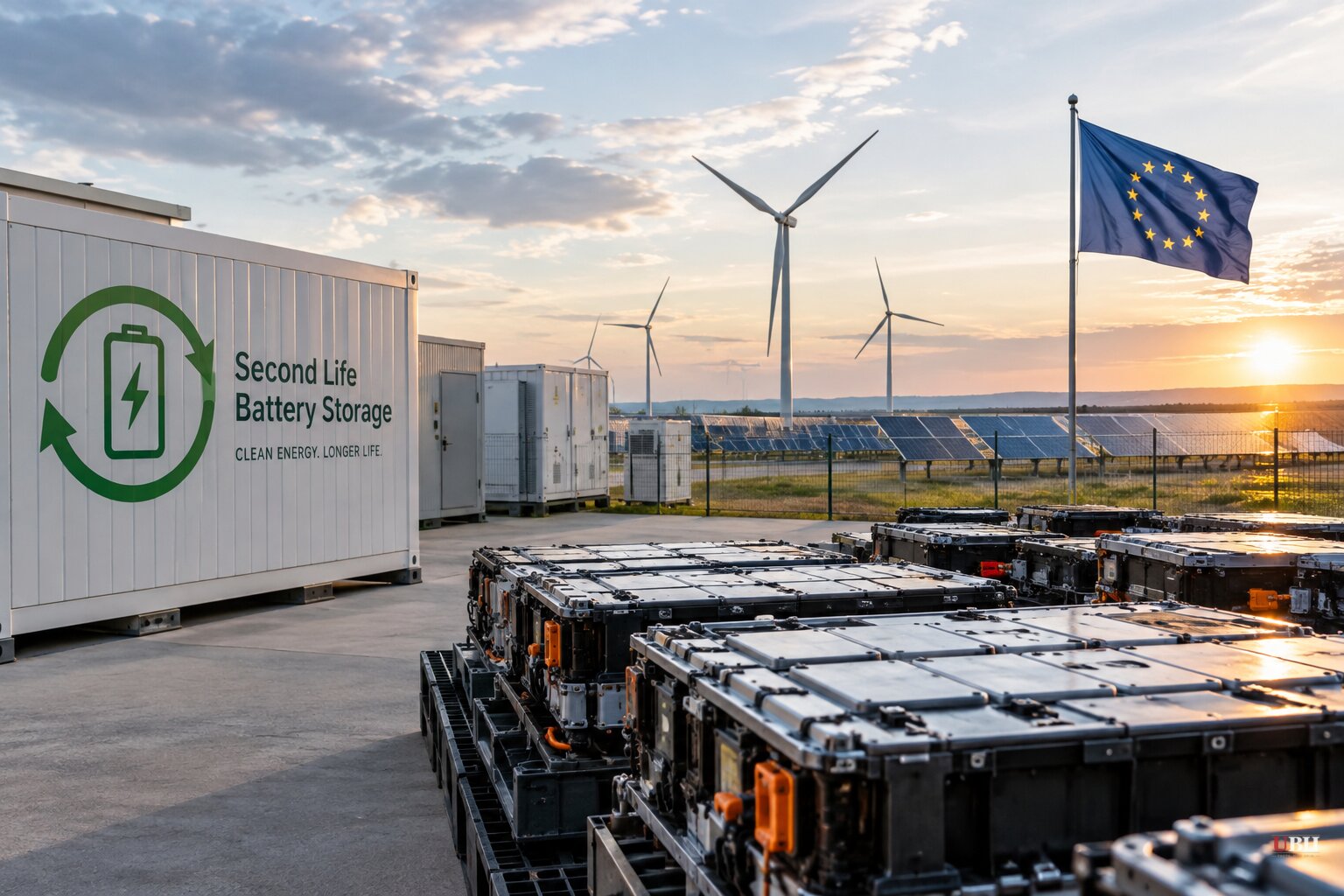
Europe has a wasted-power problem, and the fix might be sitting in a junkyard.
According to a 2026 report from consulting group AFRY, commissioned by the non-profit Beyond Fossil Fuels, 375 gigawatts of clean energy projects and 455 gigawatts of battery storage projects are stuck in distribution grid queues across Europe. That's more than €100 billion in renewable capacity waiting to connect, according to Euronews.
The result: grid operators shut down wind and solar farms when supply outpaces demand, a practice called curtailment. In 2024 alone, the EU curtailed 10 terawatt-hours of renewable power, enough to run three million homes for a year, wasting €4.3 billion, Euronews reported.
The Second-Life Fix
A retired EV battery isn't dead. Most come off the road still holding 70 to 80 percent of their original capacity, according to Euronews. Not enough for a car, plenty for a house or a business.
Two European startups are betting on exactly that. REBATTEX, founded in early 2026 by CEO Andy Rietschel along with Tobias Wåhlén and Pär Melin, is building a Sweden-based B2B exchange to let dismantlers sell used EV batteries with verified condition data, according to autorecyclingworld. Rietschel says the market for these batteries is fragmented: a dismantler knows the battery's origin and part number, but a buyer hundreds of kilometers away has no way to verify its state of health or trust the paperwork.
French startup Battwoo is already deploying the batteries. The company refurbishes units at a workshop in Madrid and installs them as stationary storage, aiming to stretch battery lifespans from 15 to 30 years, according to pv magazine. Commercial director Melchior Martinache told the outlet a 350 kWh system built from 56 retired modules, equal to five EVs, now powers a padel club's floodlights in France's Hauts-de-France region. Another system supports cold storage at the Les Fruits de Saint-Aubin apple cooperative. Battwoo says it's negotiating three more deals and plans to scale from sub-500 kWh installations up to 2-3 MWh systems.
The U.S. Numbers Tell a Different Story
Across the Atlantic, battery storage is also growing, but the politics are messier.
The U.S. installed a record 18.9 gigawatt-hours of storage in the second quarter of 2026, up 17 percent year-over-year, according to the American Clean Power Association and Wood Mackenzie's U.S. Energy Storage Monitor, released September 22 and reported by the American Public Power Association. Systems are also getting longer-duration, averaging 3.5 hours versus 2.8 hours a year earlier.
But the residential side is shrinking. Home battery installs fell 15 percent quarter-over-quarter, and the sector is expected to contract 4 percent for all of 2026 because of what the report calls "tax credit elimination, consumer hesitancy, and a challenging third-party-ownership transition." Puerto Rico's residential market alone dropped from 129 megawatts in Q1 to 73 megawatts in Q2.
Utility Dive put the bigger picture in sharper focus. RMI's forecast of 30 percent annual battery growth over five years leans on a Wood Mackenzie projection from 2024, back when the Biden-era Inflation Reduction Act subsidies were fully intact. Wood Mackenzie has since cut that forecast twice: first to 16 percent growth, and now, in its September 2026 update, to a flat 2026 followed by just 8 percent growth through 2031.
Analysts cited by Utility Dive point to President Trump's August 2026 executive order restricting foreign-made bulk power components, layered on top of existing tariffs and tax rules that penalize systems built with China-linked parts. China dominates global battery manufacturing, and the administration's stated goal is building a domestic supply chain rather than depending on a strategic rival for critical grid infrastructure.
What Storage Advocates Say It's Worth Losing
RMI's report, cited by Utility Dive, makes a real case for why slower growth carries a cost. During a 2022 California heat wave, 3.4 gigawatts of grid batteries covered 6 percent of the state's power needs and helped avoid the kind of rolling blackouts that hit California in 2020, when battery capacity was under 1 gigawatt and demand was actually lower.
RMI also tracked direct payments to local governments: a 250 MW/500 MWh battery plant that came online in February will send Medway, Massachusetts $46 million over 20 years. Nevada's Purple Sage Energy Center pays $3.4 million a year to local governments after tax abatements, and the Libra solar-and-storage project will pay $170 million in property and sales taxes over its lifetime. RMI also calculated health-cost savings from swapping gas peaker plants for batteries: $5.3 million annually for Suffolk County, New York, and $3.8 million for Harris County, Texas.
Those numbers are real and worth weighing against the cost of slower deployment. The federal government has a legitimate interest in not building the next decade of American grid storage on a foreign supply chain it doesn't control, separate from the question of whether it's smart policy.
The industry is delivering measurable local benefits, and the federal government has a stated interest in building a domestic battery supply chain. Wood Mackenzie's downgraded forecast, from 30 percent to 8 percent growth through 2031, is the number to watch as that tension plays out over the next several years.
Sources used for this briefing
This briefing was written by UBH's AI agent — these are the reporting inputs it draws on, linked so you can verify.


