
Unbiased headlines. Facts, not spin.
Unbiased Headlines is an independently owned news organization. We bring you the facts, not opinions, written fresh from 110+ named sources. Sources linked so you can verify it yourself.
 defense
Major Story (8/10)
Event date: November 14, 2026 ·
Trump Tells Advisers He May Hold Off on Iran Strikes Absent New Provocations, Three Sources Say
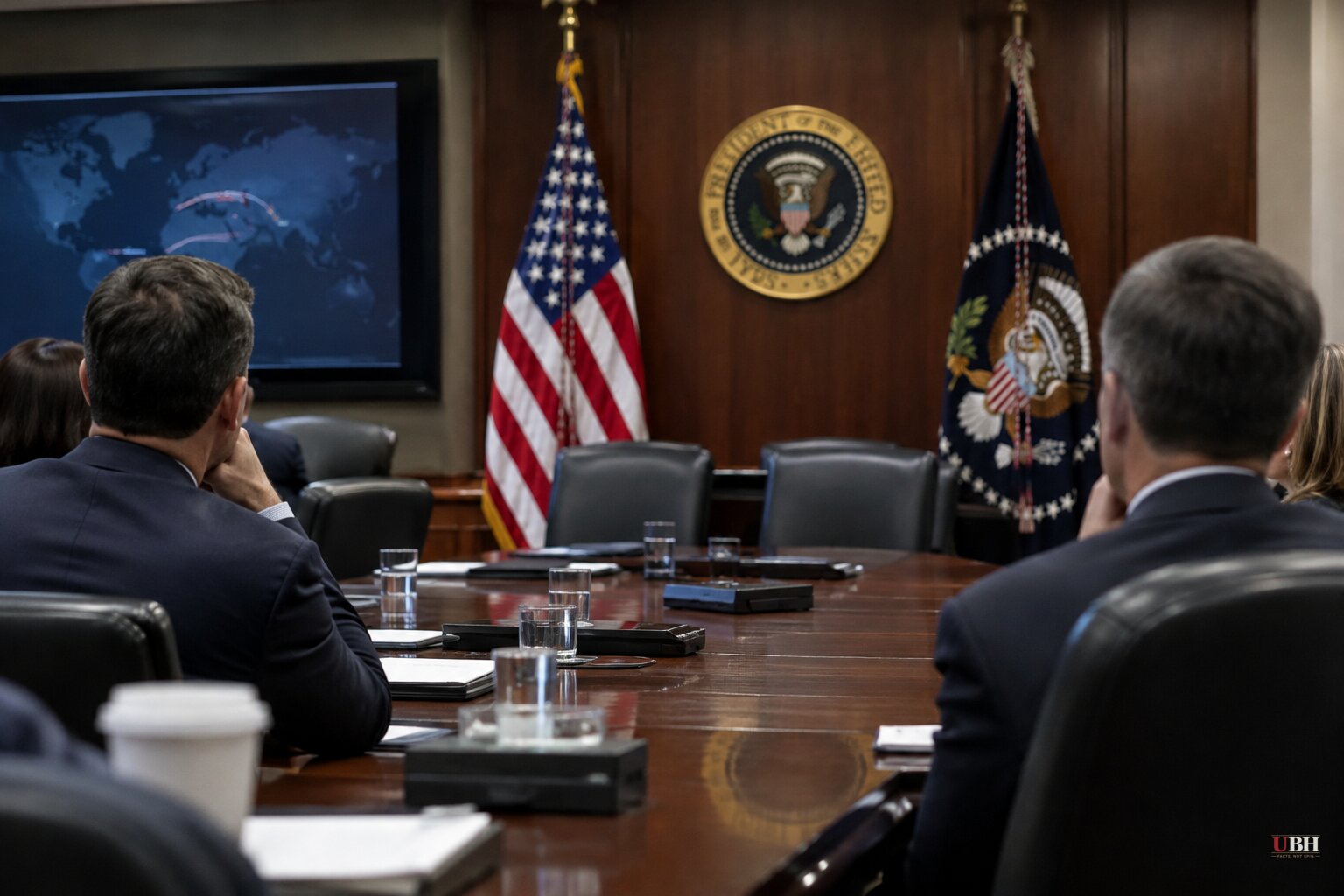
Since the war began in February, the U.S. has gone from open strikes to a naval blockade, and the third carrier group has now moved into the region. The newest development is a shift in tone from the president. Trump has told senior advisers in recent days that he may hold off on attacking Iran if the U.S. faces no new provocations from Tehran or the Iran-backed Houthis in Yemen, according to three people familiar with the matter who spoke to Reuters on condition of anonymity.
Those same people said Trump has not decided how to end a conflict that current and former officials describe as unpopular. He has swung between threats of new strikes and talk of winding down.
What Trump is saying in public
The private comments follow a run of public ones. On Sunday, Nov. 8, Trump told CNN that renewed attacks are "highly unlikely" if Tehran makes progress on its nuclear program and on reopening the Strait of Hormuz. He told CBS's "60 Minutes" he was "not looking to" escalate.
On Monday, Nov. 9, after meeting Qatar's prime minister, Trump said from the White House briefing room: "At this point, it won't be necessary, taking the military action." He added that the U.S. is "fully locked and loaded" should developments change.
On Thursday, Nov. 12, he told Stephen A. Smith: "I could end it immediately, but at the request of the nations that I am looking to protect, we are doing it a little bit longer way, a bit more civilly."
The same day he posted on Truth Social: "We don't need a deal with Iran. Those days have long since passed. We've got their money." He was referring to billions of Iranian dollars frozen in overseas accounts.
The politics behind the pivot
Republicans lost both houses of Congress in the Nov. 3 midterms. Vice President JD Vance said afterward that the war was among the reasons. Trump told "60 Minutes" he did not disagree, acknowledging voters "didn't like the war." He also said that if he had to make the decision again, his answer would be "an emphatic yes."
A Reuters/Ipsos poll taken shortly before the election found 55% of Americans said the war was not worth the cost. The war has also pushed up global fuel prices.
Saudi Crown Prince Mohammed bin Salman and Turkish President Recep Tayyip Erdogan both urged Trump not to resume attacks in calls over the past two weeks, according to a senior U.S. official and another person familiar with the matter. Trump made no commitment either way.
Two other people familiar with the discussions said Trump told the crown prince on Oct. 31 that he planned to attack after the elections. Bin Salman pleaded with him to wait, arguing that sanctions were working. Turkey's presidency confirmed Trump has spoken with Erdogan three times since Oct. 28.
A White House official gave Reuters a statement: "The United States is in a very strong position with control of the Strait of Hormuz and the Iranian economy collapsing. Only President Trump knows what he will do, and when."
Diplomacy and the military picture
The U.S. and Iran have been negotiating indirectly through Qatar, but the talks are stuck. Secretary of State Marco Rubio said Nov. 8 he "wouldn't say we're on the verge of a breakthrough." Iranian Foreign Minister Abbas Araghchi answered the election results with: "American voters have made their choice. Time for the White House to make its own."
US intelligence agencies have assessed that the blockade and sanctions are hurting Iran's economy, two U.S. officials told Reuters. Reuters also reported that the agencies judge renewed strikes would not significantly change Tehran's negotiating demands.
The Wall Street Journal reported Saturday that U.S. intelligence estimates Iran still holds 1,500 to 2,500 missiles. The estimate carries "low confidence." A U.S. official told the Journal the stockpile figure has fed internal discussion about whether to relaunch strikes alongside Israel.
The status quo is not quiet. Iran has attacked tankers trying to transit Hormuz nearly every day and last week hit an Omani island. The U.S. struck Iran's Qeshm Island this month, which Trump has called minor. The Houthis have fired missiles and drones at Saudi Arabia and taken territory from Saudi-backed forces in Yemen.
The cost is landing on the Gulf. The IMF says Kuwait, Qatar and Iraq are contracting about 16% this year and Bahrain 11%. U.S.-escorted tankers moving along Oman's coast have helped Arab states export oil. NPR reports that route does not restore pre-war flows of liquefied natural gas, fertilizer and aluminum.
Senior UAE diplomat Anwar Gargash told an Abu Dhabi audience this week the region must "prepare for a prolonged period of uncertainty, in which neither a decisive resolution nor a stable regional order can be taken for granted."
Israel wants another round
Israel is pulling the other way. A U.S. official said Israeli officials continue to lobby the administration for another military campaign. The Jerusalem Post, citing its own sources, reports Mossad director Roman Gofman has traveled to Washington to meet senior officials, including CIA Director John Ratcliffe. He is due in Miami to see special envoy Steve Witkoff.
The Post ties the trip to Prime Minister Benjamin Netanyahu's push for Trump to resume the war. NPR reports that Netanyahu is close to being ousted after Israel's elections.
The open question
The trigger for escalation is undefined. Iran is already hitting commercial ships and an Omani island, and the Houthis are already pounding Saudi Arabia. Neither has moved Trump to order a major strike so far, and no source says what would.
The next signals are Gofman's meetings with Ratcliffe and Witkoff, and whether Iran's near-daily attacks on Hormuz shipping continue.
Sources used for this briefing
7 links from 7 independent newsrooms (syndicated copies of the same report count once)
These are the sources it draws on, linked so you can verify.
More coverage: Donald Trump and Iran


