
Unbiased headlines. Facts, not spin.
Unbiased Headlines is an independently owned news organization. We bring you the facts, not opinions, written fresh from 110+ named sources. Sources linked so you can verify it yourself.
 defense
Breaking / Critical (9/10)
Third US carrier enters Middle East as Iran fires drones at Bahrain and says it is still at war
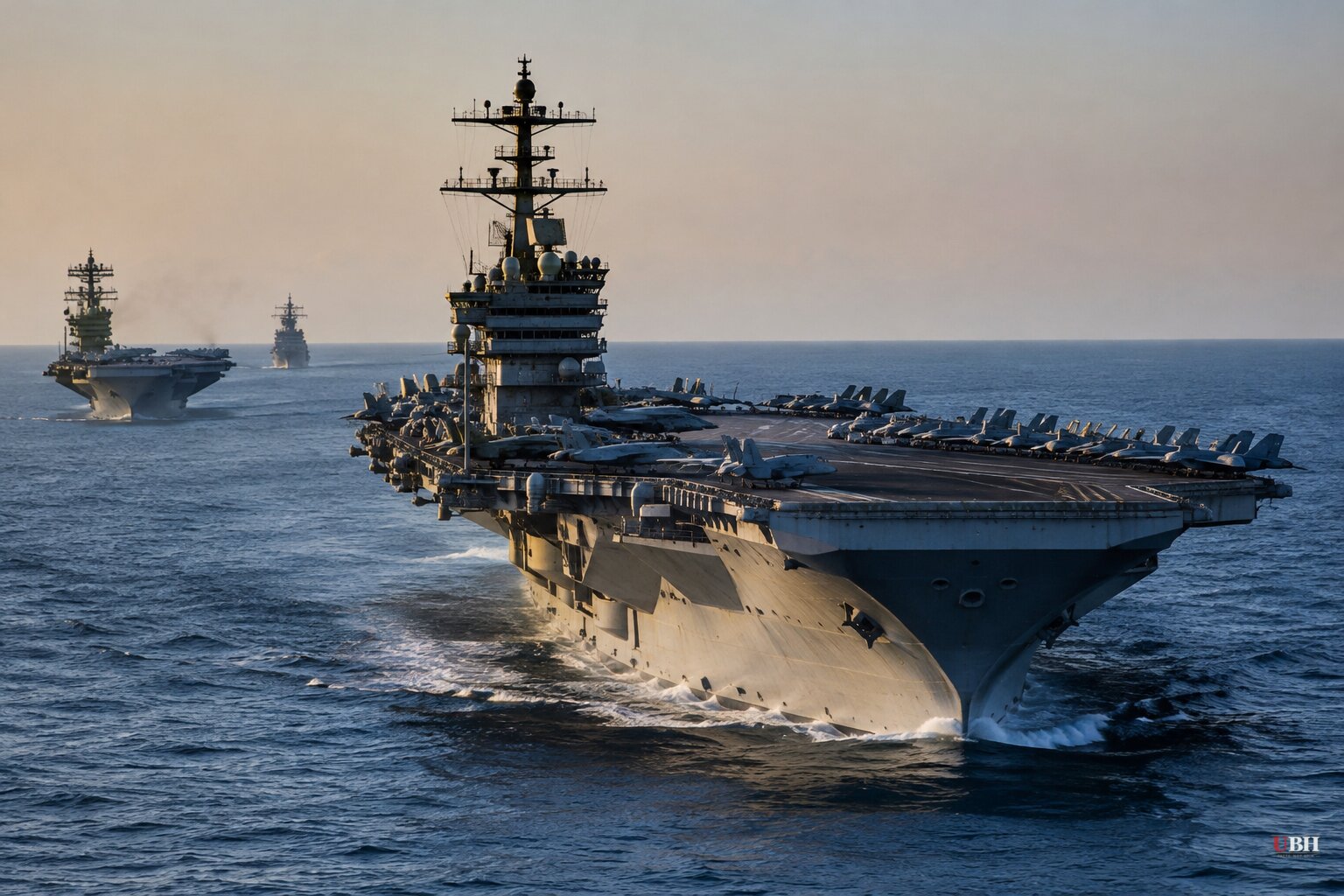
The USS Theodore Roosevelt carrier strike group entered the US Central Command area of operations on Sunday, Nov. 15, a US military official said. It joins the USS George H.W. Bush and USS George Washington, both already operating in the Arabian Sea.
The three carriers are part of a force of more than 20 Navy ships enforcing a blockade of Iranian ports, according to ABC News, citing a US official. The Roosevelt left Singapore in early November and crossed the Strait of Malacca toward the Indian Ocean.
The blockade and the carriers
The blockade began April 13, after nuclear negotiations collapsed. It covers commercial vessels entering or leaving Iranian ports in the Persian Gulf and the Gulf of Oman.
Central Command said US forces had redirected 100 commercial vessels by May 23 while letting 26 humanitarian aid ships through.
The war itself began Feb. 28 with US and Israeli strikes on Iran. Three carriers were also in the region at once in April, the first time that had happened since the 2003 Iraq War.
How long this latest three-carrier presence lasts is not settled. A US military official told CBS News it is expected to be temporary as strike groups rotate. The Roosevelt had been expected to replace one of the two carriers already there, though American officials said all three could stay if necessary.
Drones at Bahrain
The Islamic Revolutionary Guard Corps said it launched six drones at a US air defense radar system at the Al-Riffa helicopter base in Bahrain on Sunday. It described the strike as a response to "blatant aggression of the US military" and claimed a "successful impact."
Bahrain's military said it intercepted the Iranian attacks before they hit their targets. The interior ministry urged residents to stay calm and move to the nearest safe location.
The launch came two days after US forces intercepted two Iranian drones headed toward Bahrain on Friday, and it ended a lull of roughly two months in such attacks. The last comparable incident was in early September, when Iranian drones tried to hit a US base in the United Arab Emirates.
The US embassy in Manama issued a security advisory telling Americans to stay alert, citing the threat of attacks by Iran-backed Houthi forces.
Separately, a drone struck the Khor Mor gas field in Iraq's Sulaymaniyah province on Sunday. The strike set off a large fire and cut nearly 2,800 megawatts of regional power generation. No group has claimed it. Kurdish officials called it a "terrorist attack," and the Iraqi prime minister's office ordered a joint investigation with Kurdish authorities.
Washington's signals
Trump told reporters Sunday that new strikes on Iran are "highly unlikely" as long as negotiations keep making progress. He also said the US could hit Iran's nuclear facilities "within five minutes" if needed, after Central Command offered a reward for information on any movement of Iran's enriched uranium. "If they are, we want to know about it and we'll take them out," he said.
Trump has told senior advisers he may hold off on further strikes unless Iran or the Houthis attack American interests, according to the Jerusalem Post. The Saudi crown prince, Mohammed bin Salman, and Turkish President Recep Tayyip Erdogan have urged him to avoid another round of escalation. Israeli officials keep pressing Washington to consider renewed operations, according to Reuters.
The US military recently dismissed an Israeli media report that it was preparing to resume operations as "pure speculation," according to Anadolu.
The Wall Street Journal reported Sunday that US intelligence agencies estimate Iran still has between 1,500 and 2,500 missiles. Officials described the estimate as low-confidence because it is hard to tell how many are operational or in storage.
Tehran says the war is not over
Iran's deputy foreign minister, Kazem Gharibabadi, said in a televised interview with IRNA on Sunday that Tehran is preparing for three scenarios: diplomacy, economic blockade and military aggression. "From a legal perspective, we are still in a state of war and not in a neither-war-nor-peace situation," he said.
He listed Iran's demands: a permanent end to the war on all fronts, removal of the US blockade, resolution of the frozen-assets issue, and lifting of certain sanctions, including those on its oil sector.
Parliament Speaker Mohammad Bagher Ghalibaf, a senior negotiator, said the conflict could end if Washington accepted Iran's "logical conditions." He said Tehran would not accept "neither war nor peace." If the US resumes strikes, he warned, Iran's forces would "determine the geography of battle."
Iran's Foreign Ministry spokesman, Esmail Baghaei, rejected Germany's demand that Tehran halt uranium enrichment. He said Iran has the right to enrich as a member of the Nuclear Nonproliferation Treaty. He also dismissed IAEA concerns about a possible new enrichment facility in Isfahan as "nontechnical speculation" and said Iran has not suspended its safeguards obligations.
A whistleblower complaint over the first day of the war
Army Maj. Stephen Ramsbottom filed a whistleblower complaint with the House and Senate Armed Services Committees on Friday. He survived the March 1 Iranian drone attack on the Port Shuaiba command post in Kuwait, which killed six American soldiers in the first 24 hours of the war. It remains the deadliest attack on US troops in the conflict.
The complaint alleges senior Army officials ignored warnings and failed to plan for anti-drone defenses. It says the post had thin fortifications, "no physician, no fixed aid station, and only one ambulance." Ramsbottom told 60 Minutes: "We just did not plan this well, and this needs to be a lesson that we learn."
These are allegations from one officer. The day after the attack, Defense Secretary Pete Hegseth told a press conference the troops there were well protected.
What comes next
Trump is scheduled to meet Qatar's prime minister, Sheikh Mohammed bin Abdulrahman Al Thani, in Washington on Monday, Nov. 16, according to the White House. Qatar has been stepping up efforts to broker an end to the war.
Trump is also due to start an Asia trip, with stops in Manila on Tuesday and Shenzhen on Wednesday, followed by the APEC summit and a bilateral meeting and working lunch with Xi Jinping on Thursday, Nov. 19.
It is not yet clear whether the Roosevelt will replace one of the carriers already on station or stay as a third.
Sources used for this briefing
6 links from 6 independent newsrooms (syndicated copies of the same report count once)
These are the sources it draws on, linked so you can verify.
More coverage: Iran


