
Unbiased headlines. Facts, not spin.
Unbiased Headlines is an independently owned news organization. We bring you the facts, not opinions, written fresh from 110+ named sources. Sources linked so you can verify it yourself.
 defense
Major Story (8/10)
Russian Strikes Kill Three in Ukraine, Drones Hit Three Ships Off Romania Before Ramstein and Berlin Meetings
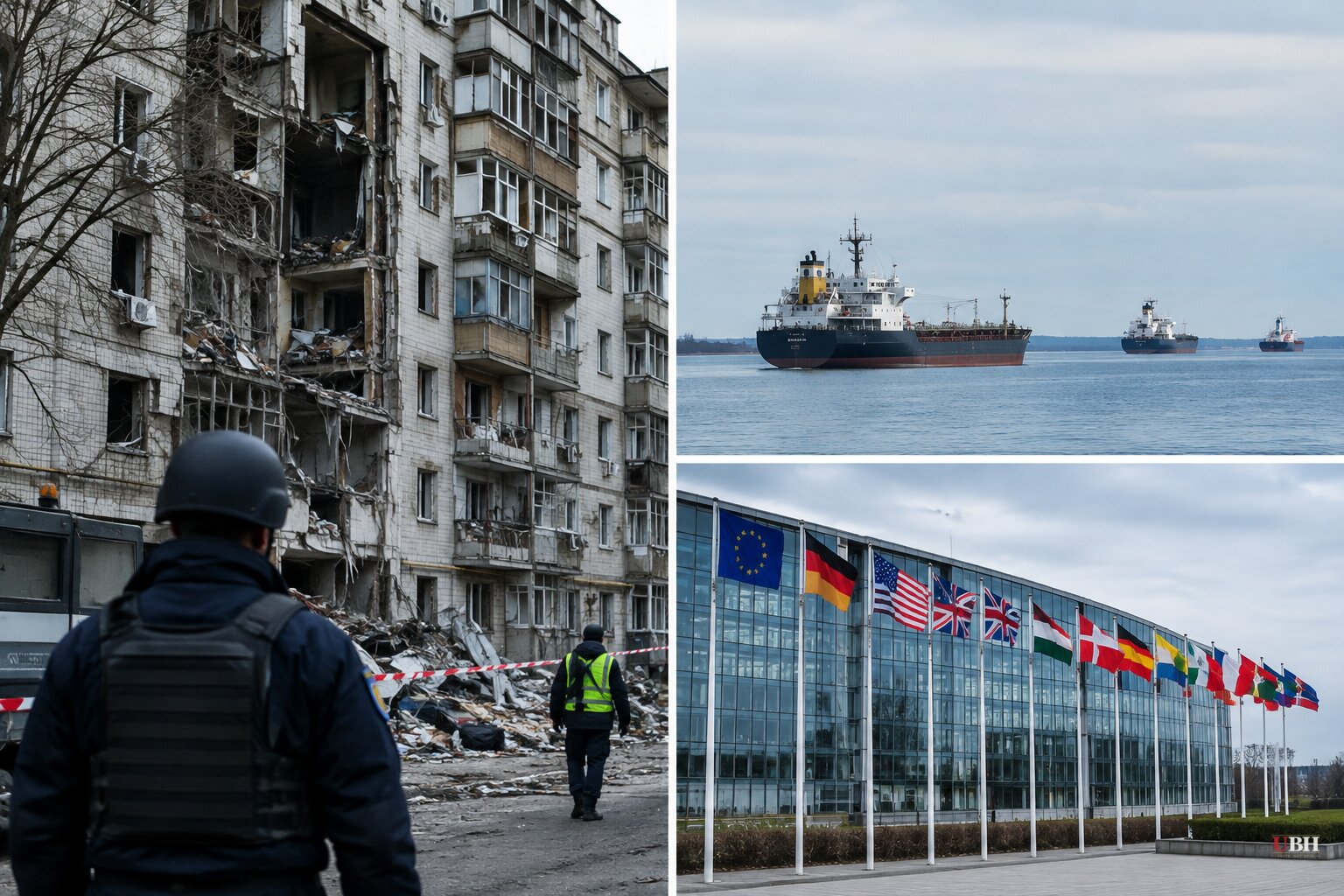
Russian attacks killed at least three people across Ukraine on Monday, Nov. 16, as European governments prepare for a week of meetings meant to lock in weapons, money and a common line on peace talks.
In the southern Kherson region, a man on a moped was killed in the village of Sadove, Governor Oleksandr Prokudin said. In Dnipro, one person was killed, according to Oleksandr Hanzha, head of the Dnipropetrovsk regional military administration. A 59-year-old man died in a drone attack in Bilenke, in Zaporizhzhia region, said Mykhailo Semikin, the region's acting military administration head.
Ukrainian drones killed one person in Russia's Belgorod region, local authorities said. Russia's Defence Ministry said it intercepted 1,336 Ukrainian drones overnight. That figure is Moscow's own claim.
Ships hit near Romania's coast
The war is spilling toward NATO territory. Drones struck three vessels on Sunday near the Sulina Canal, a shipping route linking the Danube to the Black Sea that Ukraine uses to export goods. Romanian Defence Minister Stefan Radu Oprea said there were no injuries and crews put out the fires.
Romanian Foreign Minister Dan Neculăescu said arriving at Monday's EU foreign ministers' meeting: "We have had four alerts in 24 hours, and we have had three ships hit over the weekend. This is unacceptable." He plans to push for tighter NATO-EU coordination and more allied capabilities in Romania. He will also brief colleagues on a Black Sea Maritime Security Hub, being fast-tracked for 2027, meant to detect drones and attacks on undersea cables.
Estonia is taking its own step. Foreign Minister Margus Tsahkna said Estonia is preparing to close its road border crossings with Russia after an attempted sabotage of the drone maker Threod Systems. Estonian security authorities attribute the attempt to Russia's GRU military intelligence. "Hostile actions must have consequences," Tsahkna wrote on X.
Money and weapons
The European Commission sent Kyiv $1.88 billion on Monday for drones, ammunition and air defense systems. It is part of a larger $99 billion loan.
The Ukraine Defense Contact Group, known as the Ramstein Group, meets in Brussels on Nov. 17, led by the defense ministers of Germany and Britain. President Volodymyr Zelenskyy said in his Nov. 15 address that it "must deliver results." His priorities are more Patriot missiles and systems and NASAMS. He also said Ukrainian intelligence indicates new Russian strikes are being prepared.
Kyiv has struggled against Russia's jet-powered drones, which fly nearly twice as fast as older models. It has pressed allies for faster deliveries of better defenses.
Later in the week, the Coalition of the Willing meets in Berlin. German Chancellor Friedrich Merz, French President Emmanuel Macron and British Prime Minister Andy Burnham will lead it, and Merz expects more than 20 heads of state and government. He set two goals: secure funding for Ukraine's defense in 2027 and reach a unified position for upcoming peace talks.
Zelenskyy also plans a review of existing support coalitions, separating those "truly fulfilling their tasks" from "empty shells." Since Nov. 9, nearly 3,000 troops from 11 countries have been running the coalition's first exercise for a postwar scenario, led by France and Britain. It covers Poland, airspace over Romania and the western Black Sea, and runs through Nov. 22.
The fight over what comes first
The diplomatic split is out in the open. After trilateral talks in Abu Dhabi last week, the United States encouraged Ukraine and its backers to accept a Russian demand for a new security framework for Europe, suggesting it could help bring peace. Before that round, Russian Foreign Minister Sergey Lavrov said Trump's team had put "collective security," covering a wider area than Russia and Ukraine, at the top of the agenda.
European governments read it differently. They see an attempt to weaken NATO by forcing the alliance to pull troops and equipment westward, back toward the positions of the era before the Czech Republic, Hungary and Poland joined in 1999.
EU foreign policy chief Kaja Kallas drew the line on X: "In 2021, Russia's demands were a pretext for war. In 2026, they are pretext to keep the war going." She added: "A ceasefire must come first. It must be the basis to start the talks about anything else." EU foreign ministers will discuss their own demands on Moscow in reply.
Before the Abu Dhabi round, Russia also insisted Europe would not sit at the table, and Putin has sought to negotiate Ukraine's future directly with Washington. Trump said on "60 Minutes" that the two sides were "very close" to a deal. He has made earlier statements about the war that did not materialize.
Europe is building its own channel. Leaders agreed at an informal meeting in Dublin on Friday that the UK, France, Germany, Italy and Poland, alongside officials from the European Council and NATO, will speak for Europe in any future negotiations. What mandate that group carries is still under discussion this week.
The immediate test comes Tuesday in Brussels: whether the Ramstein ministers commit to the Patriot and NASAMS deliveries Zelenskyy is asking for. Berlin then has to produce a 2027 funding figure and one position on whether a ceasefire must precede any talk of Europe's security architecture, which is the very point Washington and Brussels are now divided on.
Sources used for this briefing
8 links from 7 independent newsrooms (syndicated copies of the same report count once)
These are the sources it draws on, linked so you can verify.
More coverage: Ukraine


