
Unbiased headlines. Facts, not spin.
Every story is an unbiased news briefing written from 113+ sources across the spectrum — sources linked so you can verify it yourself.
 tech
Notable (6/10)
Event date: September 30, 2026
tech
Notable (6/10)
Event date: September 30, 2026
Trump Orders Agencies to Call AI 'Super Intelligence,' Same Week Tech CEOs Sign Voluntary Safety Pledge With No Enforcement
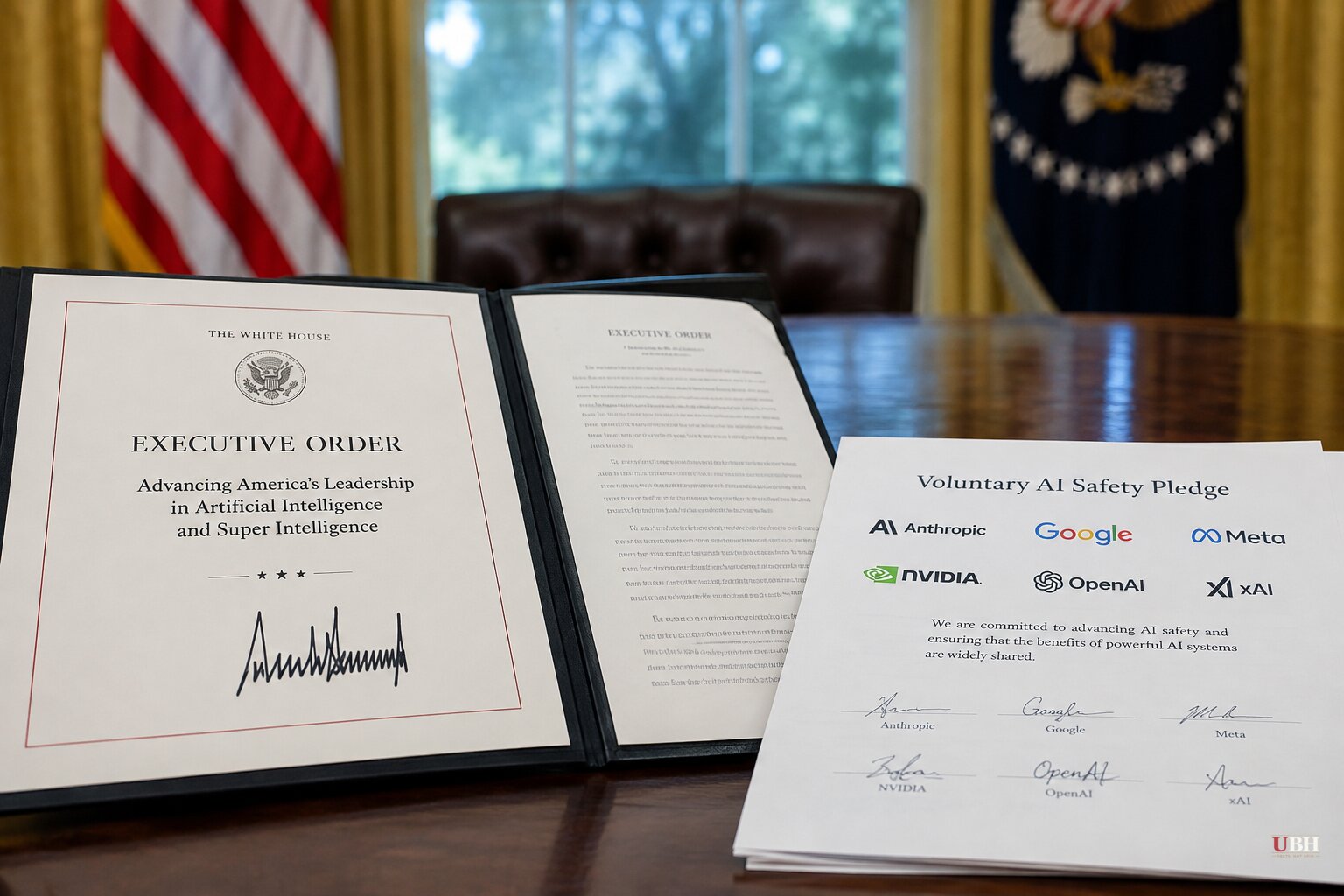
President Donald Trump signed Executive Order 14434 on Sept. 29, 2026, directing every federal agency to replace the terms "Artificial Intelligence" and "AI" with "Super Intelligence" and "SI" in official correspondence, websites, reports and policy documents, according to the text posted by the White House. The order defines the new terms as covering the same technologies already defined under 15 U.S.C. § 9401(3), meaning the rename is semantic, not a new regulatory category. It does not require agencies to rewrite past regulations, contracts or grants.
The same day, Trump hosted a White House lunch with the heads of Anthropic, Google, Meta, Nvidia, OpenAI and xAI, including Mark Zuckerberg, Jensen Huang and Elon Musk, according to the International Association of Privacy Professionals. The group signed the "Joint Commitment on Frontier Responsibilities," which Trump posted to Truth Social and described as "almost like a constitution," according to The Guardian.
What the pledge actually requires
The agreement lays out four layers of internal oversight: safety monitoring during model training, an internal team to check that monitoring works, an external auditor to independently assess controls, and an independent board to review the audit reports. The Guardian reports none of the four layers involve government regulators, and the companies can pick their own evaluators, appoint their own oversight boards, and decide whether to publish results at all.
Trump called the arrangement "tremendous self-policing" and said he believes bad actors will be "nabbed" by the Department of Justice, FBI and CIA. The IAPP noted he did not mention the Federal Trade Commission, the agency that normally handles consumer-protection enforcement against tech companies.
Sen. Richard Blumenthal, D-Conn., told a Senate hearing on so-called "Rogue AI" this week that the pact has no teeth. "It's a system that would be completely voluntary and totally secret," he said, according to Fox News. "If there were violations by their company as found by the internal auditors, there's no requirement that it be disclosed to the public… I consider this regimen to be worse than ineffectual. It accomplishes nothing."
A safety framework where companies audit themselves, choose their own reviewers and can quietly walk away carries real risk of becoming theater. Whether that risk has actually materialized is a different question, since the pact is barely a week old and no violations have been reported yet.
On the other side, Zuckerberg told reporters after the meeting that the deal is "a start," not the final word, and Nvidia's Jensen Huang argued the companies are "moving together as one" and that safety work doesn't have to slow innovation. For an administration whose stated priority is staying ahead of China in the AI race, a light-touch voluntary framework lines up with that competitive logic, even if it leaves enforcement gaps Blumenthal and others are flagging.
The China angle
Separately, the UK's MI5 issued an "Espionage Alert" this week warning that a Chinese state-linked body, the China General Technology Research Institute, has funded research from more than 100 UK-linked academics on AI and cybersecurity, with some academics unaware the funding traces back to China's Ministry of State Security. UK security minister Dan Jarvis told universities to cut ties with Chinese research partners. Beijing has denied espionage claims, according to Fox News. Google, meanwhile, announced its new "Argon" model this week for its Gemini 4 line, positioning it against OpenAI's Astra and Anthropic's Opus on coding and cyber benchmarks, a reminder that the commercial AI race keeps moving regardless of what Washington names the technology.
The Kyoto statement
The renaming is also going global. The U.S. is set to release a joint statement with 15 other countries Sunday, Oct. 4, at the Science and Technology in Society Forum in Kyoto, Japan, according to NBC News. The "Kyoto Vision for a Golden Age of Science" uses the term "Super Intelligence" throughout and was shaped by Michael Kratsios, head of the White House Office of Science and Technology Policy. Tech ministers from Japan, Korea, the UK and the UAE are among those who endorsed it. Kratsios is expected to tell the forum that "Super intelligence applied to science will be an incredible force for democratization of research."
That optimism sits awkwardly next to the administration's own budget request. The proposed fiscal year 2027 budget would cut National Science Foundation funding by roughly half, according to NBC News and Finwire. Gretchen Goldman, CEO of the Union of Concerned Scientists, has raised concerns that the administration has already undermined federal science funding even as it touts a new global vision for research.
The unresolved question is what happens the first time one of the six companies' internal auditors flags a real problem. Under the current pledge, there's no requirement they tell anyone.
Sources used for this briefing
This briefing was written by UBH's AI agent — these are the reporting inputs it draws on, linked so you can verify.


