
Unbiased headlines. Facts, not spin.
Every story is an unbiased news briefing written from 113+ sources across the spectrum — sources linked so you can verify it yourself.
 tech
Major Story (7/10)
Event date: September 29, 2026
tech
Major Story (7/10)
Event date: September 29, 2026
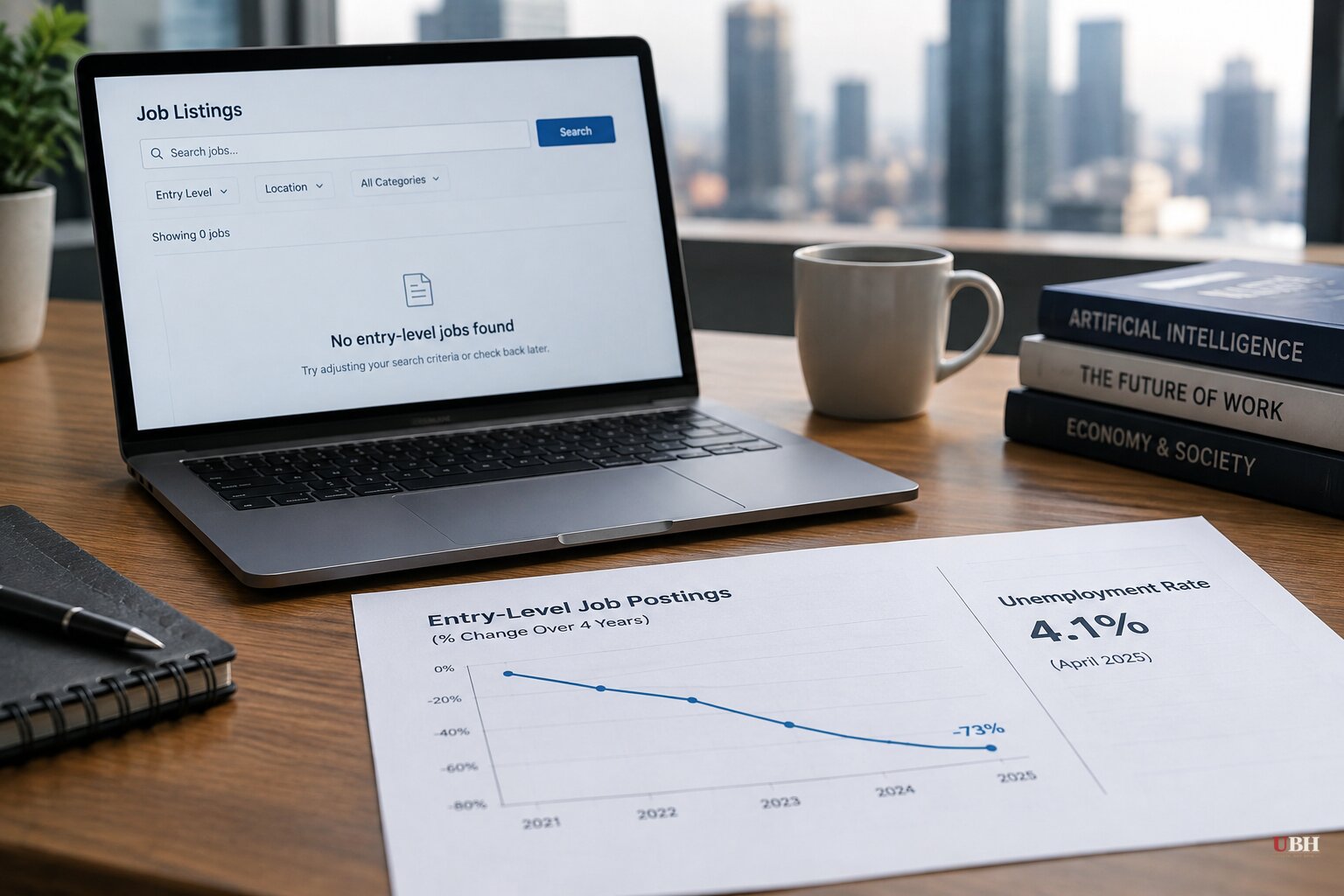
Entry-Level Job Postings Have Dropped 73% in Four Years, But Unemployment Still Sits at 4.1%, Harvard Review Finds
Since Verizon CEO Dan Schulman's October 1 prediction that AGI could arrive within 18 months and push unemployment up 20 to 30%, economists and researchers have been digging into whether the AI jobs apocalypse is actually showing up in the data. Short answer: not yet, not clearly, and maybe not for a while.
Anthropic CEO Dario Amodei set the terms of this debate back in 2025 when he said AI could eliminate up to half of entry-level white-collar jobs within one to five years. That line keeps getting recycled because the headline numbers around it are genuinely ugly. Entry-level job postings have fallen by as much as 73% over four years, according to figures cited by the Harvard Gazette.
But the overall unemployment rate is sitting at 4.1%, largely propped up by growth in healthcare, the Harvard Gazette reported. And a survey from Accenture found 52% of top executives actually expect AI to increase entry-level hiring, not shrink it. For every story about AI-driven layoffs, there's another dismissing it as what's being called "AI-washing," companies blaming AI for cuts they'd have made anyway.
What Harvard's economists actually found
Doug Elmendorf, a Harvard Kennedy School economist and former Congressional Budget Office director, co-authored a National Bureau of Economic Research working paper this spring with Karen Dynan of Harvard and Louise Sheiner of the Brookings Institution. The paper lays out four scenarios for how AI could reshape the economy, ranging from a modest GDP boost with minimal job losses to much faster growth paired with persistently high unemployment.
The authors declined to put odds on which scenario is more likely. But Elmendorf told the Harvard Gazette he leans toward "measured worry." "I think it's very likely that there will be significant job losses from artificial intelligence in the coming couple of decades, but that most, not all, but most, of those people will be able to find new work," he said.
For scale, the co-authors compare AI's potential disruption to the China trade shock of the early 2000s, when a flood of cheap Chinese exports cost the American Midwest and South an estimated 1.5 to 2 million manufacturing jobs between 2000 and 2007. Their AI scenario is bigger: roughly 3 million people, or about 2% of the labor force, out of work at any given time, which adds up to many millions of displaced workers over the coming decades even as most eventually find new jobs.
Joseph Fuller, a Harvard Business School professor who worked with Accenture Research to build a model analyzing specific work tasks, argues that much of what's holding back large-scale disruption right now is simply that companies are bad at implementing AI, not that the technology can't do the job.
A $965 billion bet against the CEO's own warning
Anthropic is currently valued at $965 billion, according to Crypto Briefing. A prediction market tracking whether that valuation falls to $600 billion by December 31 currently puts the odds at just 2%, meaning traders aren't pricing in a near-term collapse tied to Amodei's own warnings about AI's labor impact. If anything, that's a bet that Anthropic keeps growing even as its CEO talks up the disruption his product could cause.
The jobs data everyone's watching
Economists surveyed by Reuters projected the Bureau of Labor Statistics' September jobs report would show payrolls up 100,000 and unemployment holding at 4.2%, according to The Daily Upside. James Ragan, co-chief investment officer at D.A. Davidson, told Reuters that "expectations are the labor market has improved in recent months." That report was the last monthly snapshot before the Federal Reserve's rate decision at the end of October.
The Daily Upside's rundown ahead of that report bundled the jobs question with a grab bag of unrelated figures: a 24-year high in the 10-year Treasury yield, record diesel prices, Oura's IPO pricing plans, a George Washington University study estimating robotaxis could cut frontline driving jobs by 57% to 76%. None of those data points are tied together by the source, and they make it harder, not easier, to isolate what AI specifically is doing to the labor market right now.
The strongest case for worry, stated plainly
Anyone pointing to the 73% drop in entry-level postings has a real data point, not a hunch. If that trend continues at the same pace, it would represent a structural shift in how companies hire junior employees, regardless of what the topline unemployment rate shows. Elmendorf's own paper doesn't dismiss that concern. It just says the current data can't yet tell you which of the four scenarios the economy is heading toward.
Both Amodei and OpenAI's Sam Altman urged the United Nations Security Council to adopt new AI safety standards this week, according to The Daily Upside, suggesting even the people building this technology think the labor disruption question is serious enough for international attention. Whether the September jobs report, once its actual figures are confirmed, shows any sign of that disruption remains an open question heading into the Fed's late-October meeting.
Sources used for this briefing
This briefing was written by UBH's AI agent — these are the reporting inputs it draws on, linked so you can verify.


