
Unbiased headlines. Facts, not spin.
Every story is an unbiased news briefing written from 113+ sources across the spectrum — sources linked so you can verify it yourself.
 tech
Notable (6/10)
Event date: September 25, 2026
tech
Notable (6/10)
Event date: September 25, 2026
Cognition's Devin Hits $1 Billion Run-Rate Revenue as CEO Scott Wu Targets 35 Million Engineers
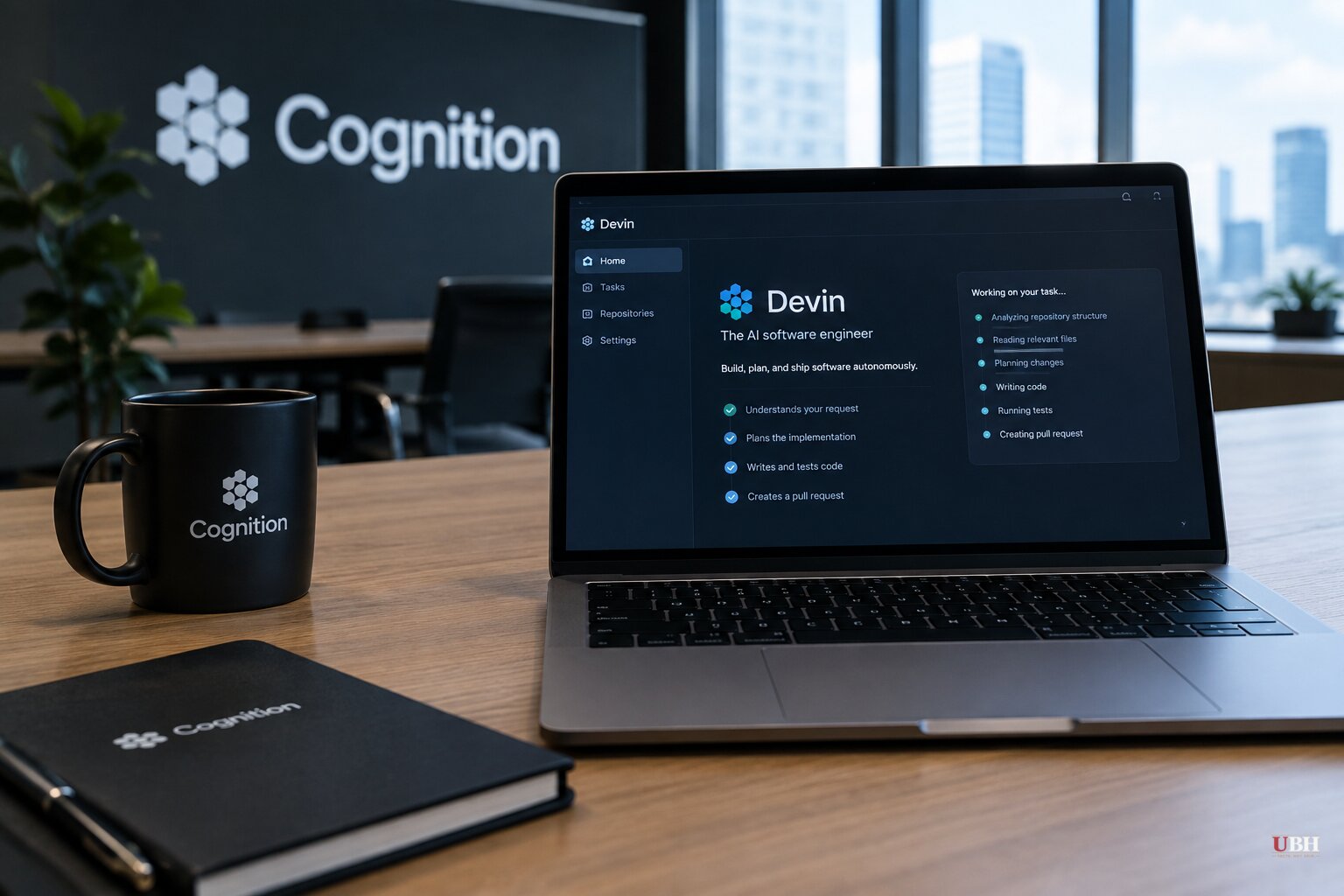
Cognition says its AI coding agent Devin crossed $1 billion in annualized run-rate revenue on September 25, 2026, according to productmarketfit.tech. Twenty-four months earlier, the company was at $1 million.
The climb happened in stages. Cognition's annualized run-rate revenue stood at $492 million in May 2026, according to Token Post. By the time the company announced its Series E round in September, that figure had grown to nearly $900 million, Token Post reported. Crypto Briefing put the September number at over $1 billion. The gap likely reflects a few weeks of growth between the funding announcement and the September 25 milestone, not a contradiction.
The money followed the revenue. Cognition raised more than $1 billion in May 2026 at a $25 billion pre-money valuation, pushing the post-money figure to $26 billion, according to Crypto Briefing. A Series E round later that year brought in more than $2 billion at a $48 billion valuation. Total funding has now passed $2.5 billion.
What Devin Actually Does
Most AI coding tools sit inside a developer's editor and suggest the next few lines of code. Devin works differently. A developer assigns it a ticket in Slack or Jira, and Devin opens its own machine, writes the code, tests it, and returns with a pull request for a human to approve, according to productmarketfit.tech.
Cognition says the product works well enough that the company uses it on itself. Crypto Briefing reported that 95% of Cognition's own code is written by Devin or related tools. productmarketfit.tech put that figure at 90%, describing a jump from 13% to 90% over five months as the company scaled its own engineering team. Either number is a serious claim about a company betting its own codebase on its own product.
Enterprise clients include Mercedes-Benz, Goldman Sachs, and, according to productmarketfit.tech, the U.S. Navy. The headline case study is Mercedes-Benz, where Devin reportedly compressed an eight-month modernization project into eight days, per Crypto Briefing. On September 29, Cognition and MongoDB announced a partnership called Devin for MongoDB Modernizations, aimed at moving enterprise customers off legacy infrastructure faster, according to a PR Newswire release. Bilt's chief technology officer, Kosta Krauth, said in the release that his team used Devin to rebuild search and personalization on MongoDB Atlas, averaging dozens of merged pull requests a day during the final push.
The 10x Claim and the Job Question
Wu estimated in a May 27, 2026, interview that 30 million to 35 million people work as software engineers worldwide, and said Cognition's aim is to make them 10 times more efficient, according to Token Post. His framing is that cheaper, faster software development expands how much software gets built overall, rather than shrinking the number of people building it.
That's a reasonable bet if demand for software is effectively unlimited. But there's an opposing concern worth stating directly: if one engineer with Devin can do the work that used to take a team of ten, a company doesn't have to grow its project list. It can just grow its margins and shrink its headcount. That's the skeptical read Crypto Briefing raised, and it's the question every engineer watching this space is actually asking.
Token Post's reporting is the most careful on this point. It noted that Wu's stated ambition does not establish that Devin has actually made engineers 10 times more productive, and that no source has quantified customer-wide productivity gains or effects on hiring. The 10x number is a goal, not a measured result.
A Feud That Turned Public and Ugly
Cognition's rise hasn't been free of friction. Factory AI, a rival coding-agent startup, and Cognition got into a public fight after Chris Degnan, a former Factory board observer and advisor who previously served as Snowflake's chief revenue officer, left to become Cognition's chief revenue officer.
Factory CEO Matan Grinberg wrote on X that he terminated Degnan's role after learning Degnan had been holding recurring conversations with Cognition executives while advising Factory on confidential matters. Grinberg also alleged Cognition employees faked job interviews with Factory to gather internal information, according to Business Insider.
Degnan denied the allegations, saying he had resigned from Factory and told Grinberg directly he was joining Cognition. "Cognition has never asked about information on Factory, nor would I ever give it," he wrote on X, per Business Insider. Wu also rejected Grinberg's claims, writing that Cognition would "never ask our engineers or anyone on our team to collect info about any competitor under-the-table." None of the allegations have been independently verified, and no legal action has been reported.
The fight split investors publicly. Khosla Ventures founder Vinod Khosla, whose firm has backed both companies, called Factory a "struggling second tier competitor" acting out of desperation, Business Insider reported. Khosla Ventures managing director Keith Rabois took Factory's side, calling the alleged conduct unethical. The clash broke out just after Factory raised $200 million at a $5 billion valuation and Cognition closed its $48 billion round, underscoring how much money is now chasing this single product category.
Cognition also bought Windsurf, a company five times its size, in a 72-hour window after Google hired away Windsurf's founders, according to productmarketfit.tech. That deal, like the revenue numbers, has not been independently audited by a financial regulator, and Cognition is privately held with no public filings to verify the figures beyond what the company itself has disclosed.
For engineers and employers alike, a key question is whether Cognition's revenue curve keeps tracking its valuation curve once enterprise customers move past pilot projects like the Mercedes-Benz case and into renewal decisions.
Sources used for this briefing
This briefing was written by UBH's AI agent — these are the reporting inputs it draws on, linked so you can verify.


