
Unbiased headlines. Facts, not spin.
Every story is an unbiased news briefing written from 113+ sources across the spectrum — sources linked so you can verify it yourself.
 tech
Major Story (7/10)
Event date: August 4, 2026
tech
Major Story (7/10)
Event date: August 4, 2026
Amazon Pledges $1 Billion to Data Center Towns as Community Backlash Spreads From the US to Europe and Asia
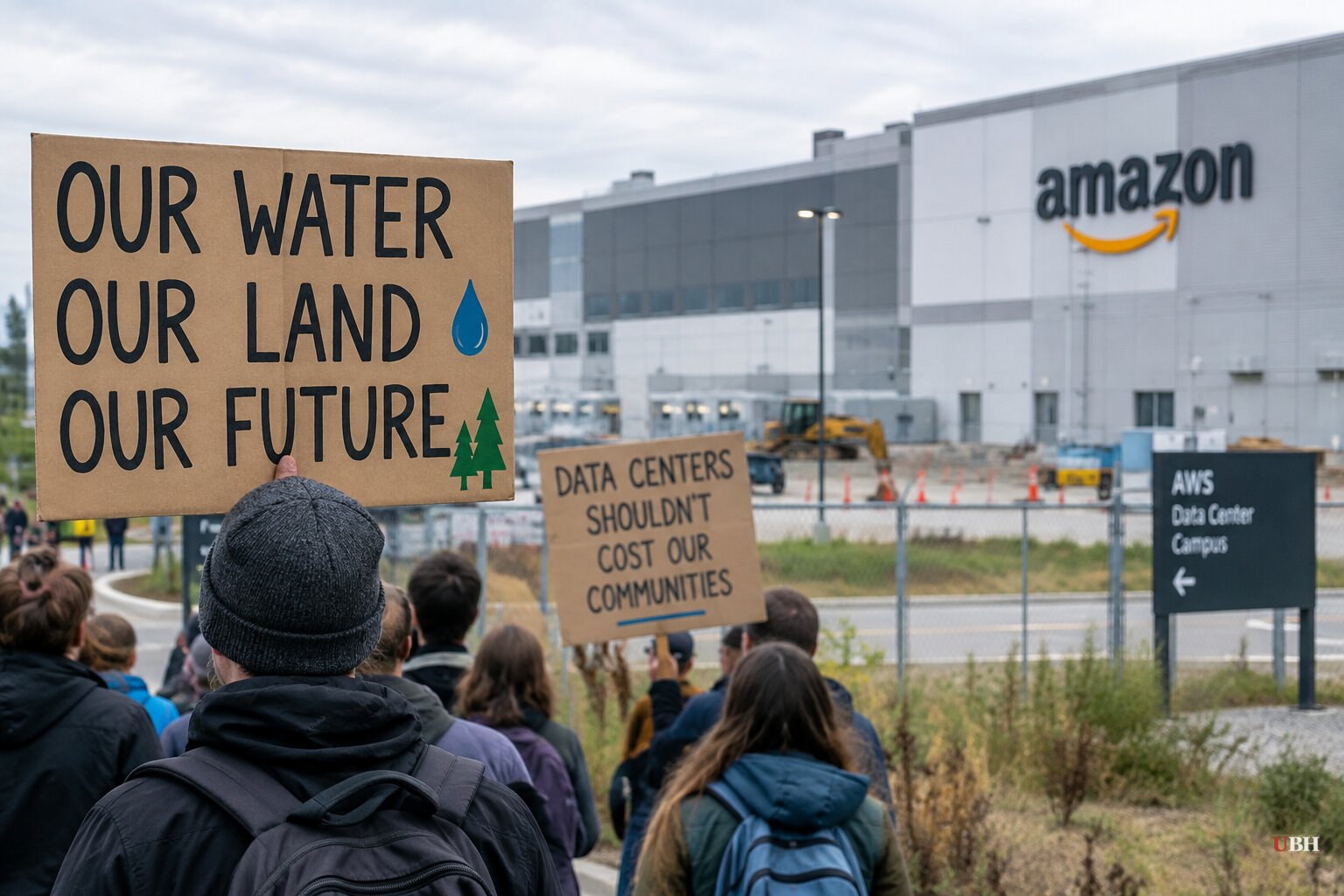
Since local moratoriums against data centers started spreading across dozens of US states earlier this year, the fight over AI infrastructure has jumped the Atlantic and the Pacific. Amazon Web Services used Friday, October 2, to announce its biggest response yet: a pledge of more than $1 billion over five years to communities hosting its data centers, on top of a prior $1 billion given out over the last three years.
AWS CEO Matt Garman unveiled the program, called "Built Together," in a blog post, according to CBS News and GeekWire. The money funds free community college, job training, home and school energy upgrades, and water and energy conservation projects chosen by host communities. Amazon also says it will stop using non-disclosure agreements with government agencies on data center deals, install lower-emission backup generators, and publish its annual energy and water use.
The Math Behind the Headline
GeekWire ran the numbers CBS News did not: $1 billion over five years works out to roughly $200 million a year. Amazon is projecting about $220 billion in capital spending this year alone, mostly on data centers and chips, according to GeekWire. That makes the new community fund about one-tenth of one percent of this year's capex. Whether that is a meaningful olive branch or a rounding error depends on who you ask, and neither CBS News nor GeekWire's sourcing settles that question.
Garman's Case: We Can't Afford to Lose
Garman framed the opposition in stark geopolitical terms. "There is urgency to this data center buildout because we aren't the only country that sees the benefits of AI for the economy and national security, and the countries that lead in AI will shape it and get the most from it," he wrote, according to CBS News. He went further in his GeekWire-reported remarks, saying local opposition is stoked by "misinformation and outright lies" and suggesting foreign nations could be "intentionally seeding misinformation in the U.S. about data centers to trick us into slowing down." He cited over 100 data center moratoriums under consideration nationally and called them a "losing ticket" with consequences that "would last generations."
Garman also pushed back point by point on community complaints. He called it false that data centers are draining local water supplies, saying Amazon's average facility uses less than 13,000 gallons a day. He called blaming data centers for rising electricity rates "misleading and convenient scapegoating," and said backup generators sit idle 99.9% of the time. None of these figures have independent verification in available reporting. They are Amazon's own numbers about its own operations.
The Other Side of the Ledger
The community concern Garman is rebutting is real. A CBS News poll found more Americans oppose data centers in their area than favor them, and an Economist/YouGov poll from late August found 63% of Americans would oppose one near their home, according to GeekWire. Data Center Watch, which tracks these fights, counted at least 75 projects worth about $130 billion blocked or delayed in just the first three months of 2026. Environment America separately found grassroots efforts have thwarted at least 45 developments worth $68 billion across 27 states, per CBS News. Thirty states have introduced or passed legislation addressing the issue, and some towns have imposed moratoriums before any builder even proposed a site.
Schneider Electric projects US electricity demand will rise 16% by 2029, driven mainly by data centers, and the Electric Power Research Institute found AI searches use ten times the electricity of a normal web search, both cited by CBS News. For homeowners watching utility bills climb, that reflects a lived cost. Amazon disputes how much of it its own facilities actually cause.
The Fight Goes Global
The same tension is now showing up overseas, according to CNBC. Research from STL Partners found public opposition has already delayed or canceled about $42 billion in European data center investment, versus $77 billion in the US. The European Data Center Monitor counted more than 70 projects rejected or restricted between January and April, more than all of 2025 combined, with pushback moving from town halls to courts and parliaments.
Scotland has paused planning approvals for new hyperscale facilities, with campaigners pointing to Ireland's grid-driven moratorium as a warning, CNBC reported. Denmark passed emergency legislation pushing data centers to the back of the grid power queue. Spain now requires new facilities to source 80% of their electricity from renewables. South Korea's national government is pushing to accelerate AI data center development even as local authorities there propose tighter residential zoning restrictions, a contradiction Hyper.ai's reporting flagged as a source of investor uncertainty.
Olivier Darmouni, an associate professor at HEC Paris, told CNBC the cumulative pushback could be "the straw that breaks the camel's back," partly because "the gains of AI are very diffused" while the costs land locally. Eulalia Flo of Equinix and Dominic Ward of Verne both told Hyper.ai the industry can no longer treat itself as an invisible utility and must answer directly to community demands for transparency.
Asya Walters of Alvarez & Marsal noted that while the US has historically offered a more streamlined regulatory path for builders, European and Asian markets now carry inconsistent national rules that complicate long-term investment planning. With over 100 US moratoriums still pending and European restrictions hardening by the month, the open question is whether Amazon's $200-million-a-year community fund, or anything like it from Microsoft, Google or Meta, actually changes votes in the state legislatures and town councils where these fights are being decided.
Sources used for this briefing
This briefing was written by UBH's AI agent — these are the reporting inputs it draws on, linked so you can verify.


