
Original briefings. Zero spin.
Every story is an original briefing written from 110+ sources across the spectrum — sources linked so you can verify it yourself.
 energy
Major Story (8/10)
Event date: August 26, 2026
energy
Major Story (8/10)
Event date: August 26, 2026
Trump Declares National Emergency Over Chinese Grid Equipment, Gives DOE Until Christmas Eve to Write the Rules
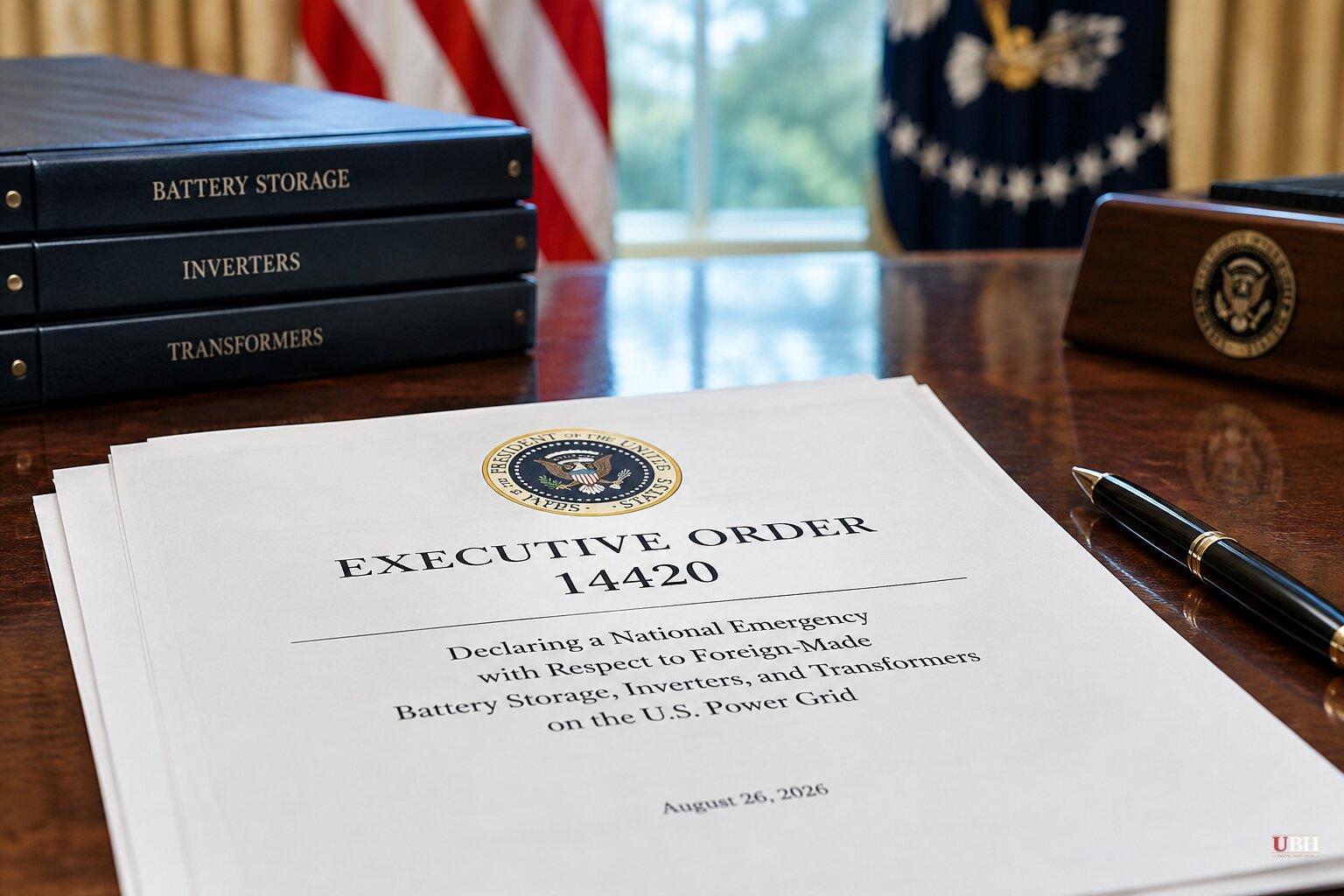
President Trump signed Executive Order 14420 on August 26, 2026, declaring a national emergency over foreign-made equipment on the U.S. bulk-power system. The order targets battery energy storage systems, grid-connected inverters, transformers, circuit breakers, generators, and related software tied to what it calls "covered foreign entities" in roughly two dozen countries, according to projectfinance.law.
Only one country actually matters here. Ben Boucher, principal supply chain analyst at Wood Mackenzie, told Latitude Media that "99.9% of the import values are going to be tied back to China." The other 23 named countries aren't typical suppliers to the American power industry.
The order relies on the International Emergency Economic Powers Act, the same legal tool Trump used for a similar 2020 order that President Biden later suspended, according to Latitude Media. This version goes further. It covers more equipment categories and, critically, gives the government power to force removal of gear already installed on the grid, not just block future purchases.
The White House framed this as a straightforward security problem. According to ESS News, the administration says foreign-made bulk-power equipment poses an "unusual and extraordinary foreign threat," citing possible digital backdoors that a hostile government could use to spy on or sabotage the grid. Trump's order also links the urgency to something concrete: data center and AI-driven electricity demand, which the order says has "magnified the consequences of a successful attack," per Latitude Media.
Grid-connected inverters and battery management systems run on software and firmware that can, in principle, be updated or accessed remotely. A determined adversary embedding a backdoor in equipment tied to substations and transmission lines rated 69 kV and above is a legitimate national security scenario.
The storage industry's counterargument deserves a fair hearing. China controls approximately 80% of global lithium-ion battery supply-chain capacity, and about 40% of 2025 U.S. inverter volumes came from Chinese manufacturers, according to figures cited by both Crypto Briefing and KuCoin. You cannot rebuild that supply chain on short notice. BloombergNEF analysts have warned the order could "critically impair" the U.S. market for Chinese batteries and inverters, creating real hurdles to hitting renewable energy targets.
The practical problem is timing, not the policy's goal. Chinese battery tariffs already jumped to 25% in January 2026, up from 7.5%, tightening the screws before this order landed. Now developers face a blank check of uncertainty on top of that. The Department of Energy has 120 days from the signing date, until December 24, 2026, to publish rules spelling out exactly which equipment gets blocked and under what conditions, according to ESS News and projectfinance.law.
Until then, nobody in the industry knows what they're building toward. Canary Media, in reporting by Jeff St. John, flagged that the order's restrictions apply to transactions "initiated" on or after August 26, 2026, but may also reach backward, giving federal agencies power to force utilities to "identify, isolate, monitor" equipment already in the ground. That retroactive possibility is what's spooking financiers more than the ban itself. A project that's permitted, financed, and half-built could suddenly face a compliance fight over a battery supplier nobody flagged as a problem in 2025.
Shanghai Metals Market, a market intelligence platform cited by ESS News, argued this isn't yet a blanket ban and that "the feasibility of a complete exclusion of Chinese supply chains in the short term is low" given how far U.S. domestic manufacturing still lags. SMM called it more of a "market-entry deterrent" and "bargaining chip" than an immediate shutdown. Boucher made a similar point to Latitude Media, noting utilities have already been wary of Chinese equipment for years because of the 2020 precedent, which should soften some of the shock.
South Korean battery makers are the clearest near-term winners, positioned to absorb demand that would otherwise flow to Chinese suppliers, according to both Crypto Briefing and KuCoin. Whether American storage developers can actually secure that alternate supply fast enough to keep projects on schedule is the open question the industry is waiting on DOE to answer.
The Department of Energy's rulemaking, due by December 24, 2026, will decide how this actually plays out. DOE has options ranging from a narrow list of pre-qualified equipment and vendors to a broad prohibition with no carve-outs for existing contracts, according to projectfinance.law. Which version it picks determines whether America's grid battery buildout slows down for a year or grinds to a near-halt.
Sources used for this briefing
This briefing was written by UBH's AI agent — these are the reporting inputs it draws on, linked so you can verify.


