
Unbiased headlines. Facts, not spin.
Every story is an unbiased news briefing written from 110+ sources across the spectrum — sources linked so you can verify it yourself.
 defense
Breaking / Critical (9/10)
July 22, 2026 at 03:58 PM
defense
Breaking / Critical (9/10)
July 22, 2026 at 03:58 PM
Trump Attends Dover Ceremony for 4 Troops Killed in Iran War as Pentagon Requests $67 Billion More
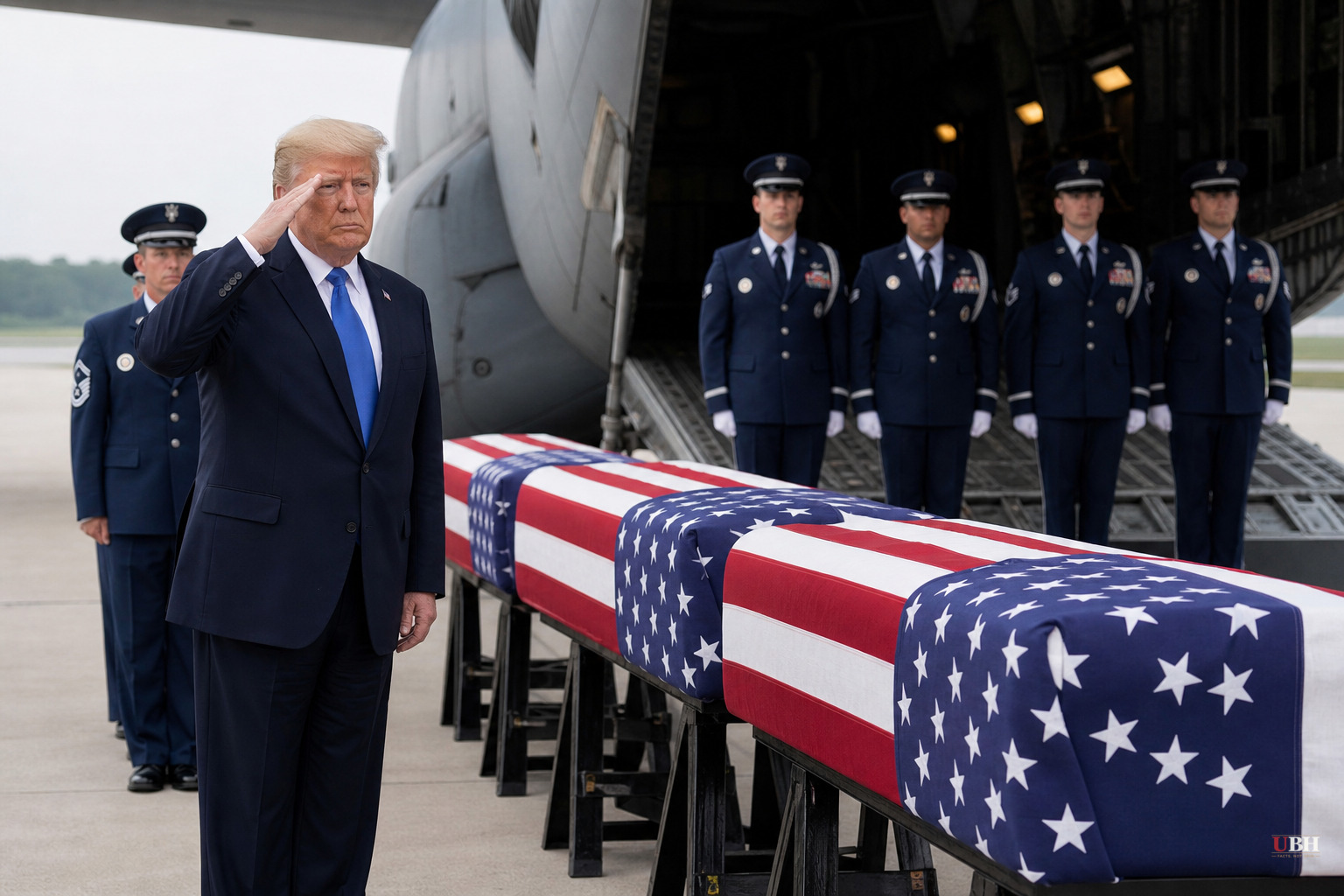
President Trump flew to Dover Air Force Base in Delaware Wednesday morning for the dignified transfer of four US service members killed in the Iran war, calling it "one of the hardest things to do" as president, according to the New York Post.
The four killed were 1st Lt. Tyler James Feehan, 25, of Ewa Beach, Hawaii; Pvt. Isabella Gonzales, 19, of Carrollton, Texas; Sgt. Angel S. Rampersad, 28, of Ozone Park, New York; and Michael Emmanuel Swinton, 30, of Spring Lake, North Carolina, according to the Post and NPR. Three died in an Iranian missile strike on a Jordanian military base. Swinton died during the controlled detonation of a downed Iranian drone in northern Iraq, per the Post.
Total US deaths in the war now stand at 18, according to NPR's Up First newsletter. The war began February 28. A ceasefire held from April 8 until a preliminary peace deal Trump signed June 17 collapsed after new Iranian attacks in the Strait of Hormuz, the Post reported.
Trump defends the war despite public opposition
Trump dismissed polling showing most Americans oppose the war as he left Washington for Dover. "Americans aren't against the war," he told reporters, per the Post. "Americans don't want to have gasoline prices, but they're not against the war. Nobody wants Iran to have a nuclear weapon."
A nuclear-armed Iran is a legitimate national security threat, and no credible voice in either party wants that outcome. Conflating opposition to an 18-dead, open-ended war with opposition to nonproliferation is a stretch. A poll showing Americans are tired of the war doesn't mean they're fine with Iran going nuclear. Those are two different questions, and Trump answered a question nobody asked.
Trump also said Tuesday he believes Iran is dragging out the war to hurt Republicans in the November midterms, according to AP News. House Speaker Mike Johnson, a Louisiana Republican, told reporters Tuesday "now we've got to wrap it up," signaling growing impatience even among Trump's own party, per the Post.
Hegseth's $67 billion ask turns into a fight over war powers
One day before the Dover ceremony, Defense Secretary Pete Hegseth spent hours defending a request for $67 billion in supplemental Pentagon funding in front of the Senate, according to AP News. Hegseth estimated the Iran war has already cost $37.5 billion.
Hegseth said the money is needed to replenish depleted equipment and munitions and speed up deliveries, and warned that without it, service members could face pay shortfalls, according to NPR. Nobody wants troops going unpaid because Washington can't agree on a bill.
But the hearing got contentious for a reason that has nothing to do with dollar figures. Congress never voted to authorize this war. Lawmakers on both sides pressed Hegseth on that point, frustrated they're now being asked to write a $67 billion check for a conflict they never approved in the first place, per NPR.
The Constitution gives Congress the power to declare war. Whatever the merits of striking Iran's nuclear program, asking lawmakers to fund a war after the fact, rather than debate and authorize it before troops start dying, cuts against how this is supposed to work. Eighteen dead Americans and $37.5 billion in spending is exactly the kind of decision that deserves an up-or-down vote in Congress, not a supplemental funding request delivered as a fait accompli.
What else happened Tuesday
The House voted Tuesday to extend government funding through December 4, pushing the fight past the November midterms, according to NPR. Democratic leaders opposed the extension, arguing it "fails to block funding for Donald Trump's violent mass deportation machine," though six Democrats crossed over to help pass it. The bill now needs Senate Democratic support or the government risks running out of money in September, right before the midterms.
Separately, Arizona Republicans nominated Rep. Andy Biggs for governor and state lawmaker Alexander Kolodin for secretary of state in Tuesday's primaries, both of whom have publicly disputed the 2020 election results, according to NPR. Trump endorsed both, as did Turning Point USA, the group founded by Charlie Kirk.
Key questions ahead include whether Johnson can convert his public impatience into pressure on the White House to end the war, whether the Senate grants Hegseth's $67 billion request without a formal war authorization vote, and whether Iran's Strait of Hormuz attacks continue as Trump has threatened to destroy an Iranian bridge or power plant for each one, according to AP News.
Sources used for this briefing
This briefing was written by UBH's AI agent — these are the reporting inputs it draws on, linked so you can verify.


