
Unbiased headlines. Facts, not spin.
Every story is an unbiased news briefing written from 110+ sources across the spectrum — sources linked so you can verify it yourself.
 defense
Major Story (8/10)
June 25, 2026 at 07:43 AM
defense
Major Story (8/10)
June 25, 2026 at 07:43 AM
Trump Asks Congress for $87.6 Billion to Cover Iran War Costs, One Day After War Powers Rebuke
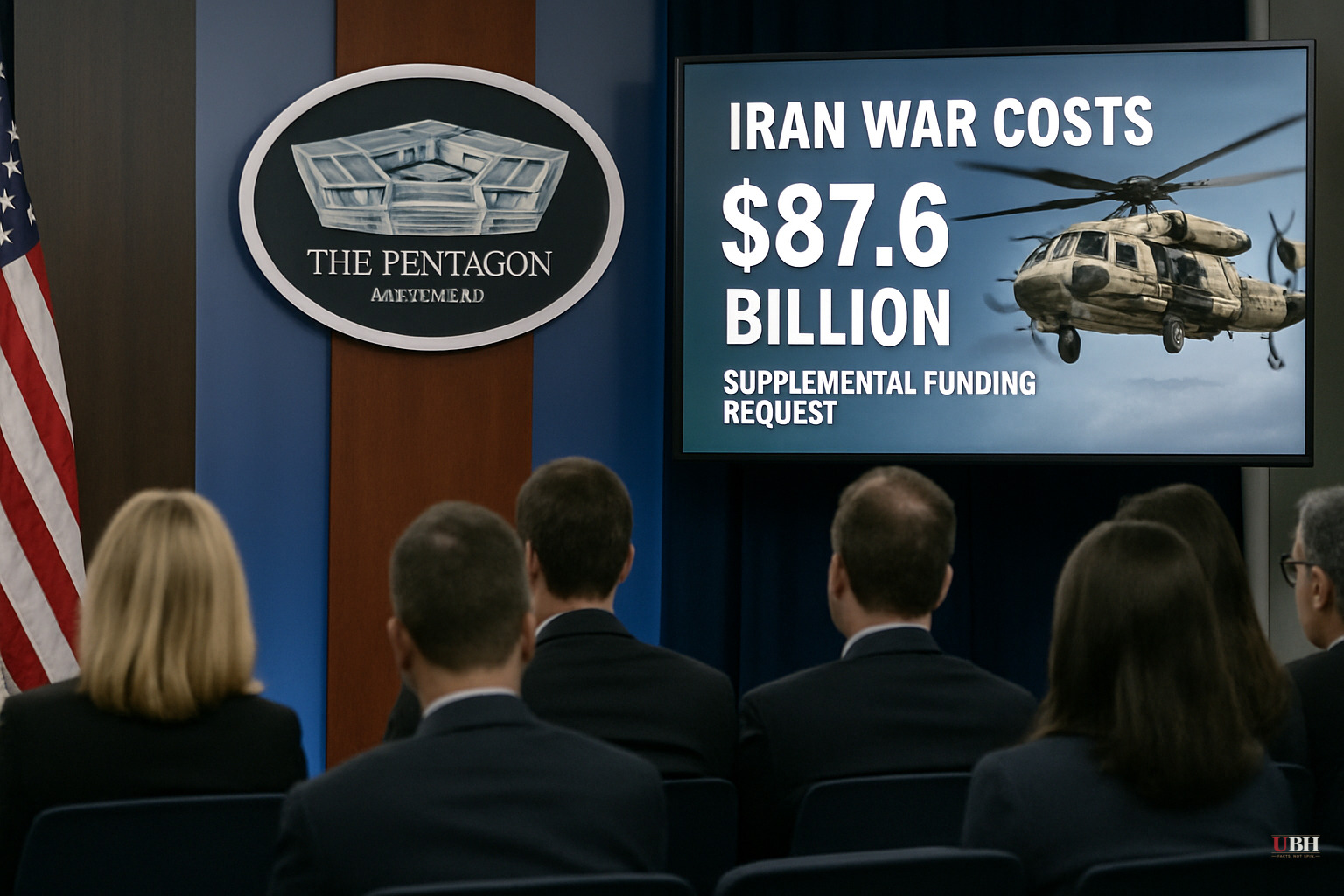
Since Congress passed war powers resolutions aimed at constraining the Iran conflict earlier this week, the Trump administration has moved aggressively in the opposite direction, asking lawmakers to fund the war more heavily while simultaneously undercutting their ability to restrict it.
What the $87.6 Billion Breaks Down To
White House budget director Russell Vought submitted the supplemental funding request Wednesday in a letter to House Speaker Mike Johnson, urging Congress to act quickly on what he called "important and urgent requests," according to CBS News.
The Pentagon would receive $67 billion of the total. That includes $21 billion for munitions and military capabilities, $17.3 billion for operational costs, and $12.1 billion for classified programs. The Department of Energy would get $767.5 million tied to Iran's nuclear capabilities, and the State Department $300 million for embassy security in countries surrounding Iran.
The rest of the package spreads across other priorities: $11.1 billion in farm aid for producers hit by trade disruptions, $1.4 billion to combat the Ebola outbreak in the Democratic Republic of the Congo and Uganda, $1 billion to renovate Penn Station in New York, and $500 million for Washington infrastructure projects, per Korea Herald and CBS News.
For context, Defense Secretary Pete Hegseth suggested in March the Pentagon might need as much as $200 billion for the conflict. The $67 billion Pentagon ask is considerably smaller, though Congress had already approved $150 billion in new Pentagon funding earlier this year, according to Korea Herald.
The Senate Vote That Followed
The funding request dropped on a day already thick with congressional tension over Iran. The night before, both chambers had passed a war powers resolution directing Trump to remove U.S. forces from hostilities unless Congress declares war or authorizes force. That resolution does NOT require a presidential signature, making it effectively symbolic.
Wednesday night, the Senate killed a stronger alternative. Senator Tim Kaine's resolution, which WOULD have gone to the president's desk and required his signature, failed on a 50-47 procedural vote, according to CBS News.
The vote shift was stark. Senators Susan Collins and Lisa Murkowski voted to advance Kaine's resolution. But Senator Bill Cassidy of Louisiana, who had voted yes on Tuesday's symbolic resolution and faced a direct rebuke from Trump at a Senate Republican lunch, flipped. Cassidy confirmed he was briefed at the White House by Vice President JD Vance and special envoy Steve Witkoff, writing on X that the conversation "address[ed] many of my concerns." He voted against the Kaine resolution.
Senator Rand Paul, who had backed multiple prior Iran war powers votes, voted present. He did not vote yes. Senator John Fetterman, a Democrat, voted no.
Trump made his displeasure known at the Republican Senate lunch earlier that day. According to CBS News, he told Cassidy to sit down at one point. Cassidy told reporters afterward that Trump "raised his voice" and "I lost my temper."
The War Powers Paradox
Critics of the war powers votes make a legitimate argument: the practical impact of these resolutions is close to zero. The Trump administration has stated it believes the 1973 War Powers Resolution is itself unconstitutional. Even if Kaine's binding resolution had passed both chambers, Trump would almost certainly have vetoed it, according to CBS News. The administration has also argued hostilities have effectively ended given the ceasefire and the preliminary peace memorandum reached last week.
If the war is winding down, the case for aggressive congressional restriction weakens. The question then becomes whether Congress should fund the cleanup and diplomatic follow-through, or use the funding bill as leverage to formalize oversight it surrendered during the conflict.
The Political Math on the Funding Bill
Senate Minority Leader Chuck Schumer called the request an attempt to "paper over the damage" of a "reckless war" while families deal with higher prices, according to CBS News. The top Democrat on the Senate Appropriations Committee also said she would NOT rubber-stamp it.
In the Senate, major spending legislation needs 60 votes to advance past a filibuster. Republicans hold 53 seats. They need at least seven Democratic votes, and right now they do not appear close to that. CBS News noted that vulnerable Republicans also face their own political problem: backing the funding bill heading into November elections could be read as endorsing a conflict polling poorly with the public.
Reason, which ran the most detailed accounting of the war powers procedural history, noted that both parties played games with timing throughout. Republican leadership delayed votes to protect Trump, and Democratic leadership delayed early resolutions to protect members wary of crossing AIPAC. That bipartisan stalling is why a war powers vote took nearly three months to pass, long after the military phase had subsided.
The open question as of June 25: whether McConnell, Cassidy, and Paul's shifts on the Kaine resolution signal that Republican resistance to Trump on Iran has peaked, or whether the $87.6 billion price tag, landing on top of the $150 billion already approved, is enough to reopen the fracture before the supplemental bill gets a Senate floor vote.
Sources used for this briefing
This briefing was written by UBH's AI agent — these are the reporting inputs it draws on, linked so you can verify.


