
Original briefings. Zero spin.
Every story is an original briefing written from 110+ sources across the spectrum — sources linked so you can verify it yourself.
 energy
Major Story (7/10)
September 3, 2026 at 12:11 PM
energy
Major Story (7/10)
September 3, 2026 at 12:11 PM
Trump Administration Moves to Bar Worst-Case Climate Models From Federal Policy, as Energy Analysts Warn Carbon Sinks Are Weakening
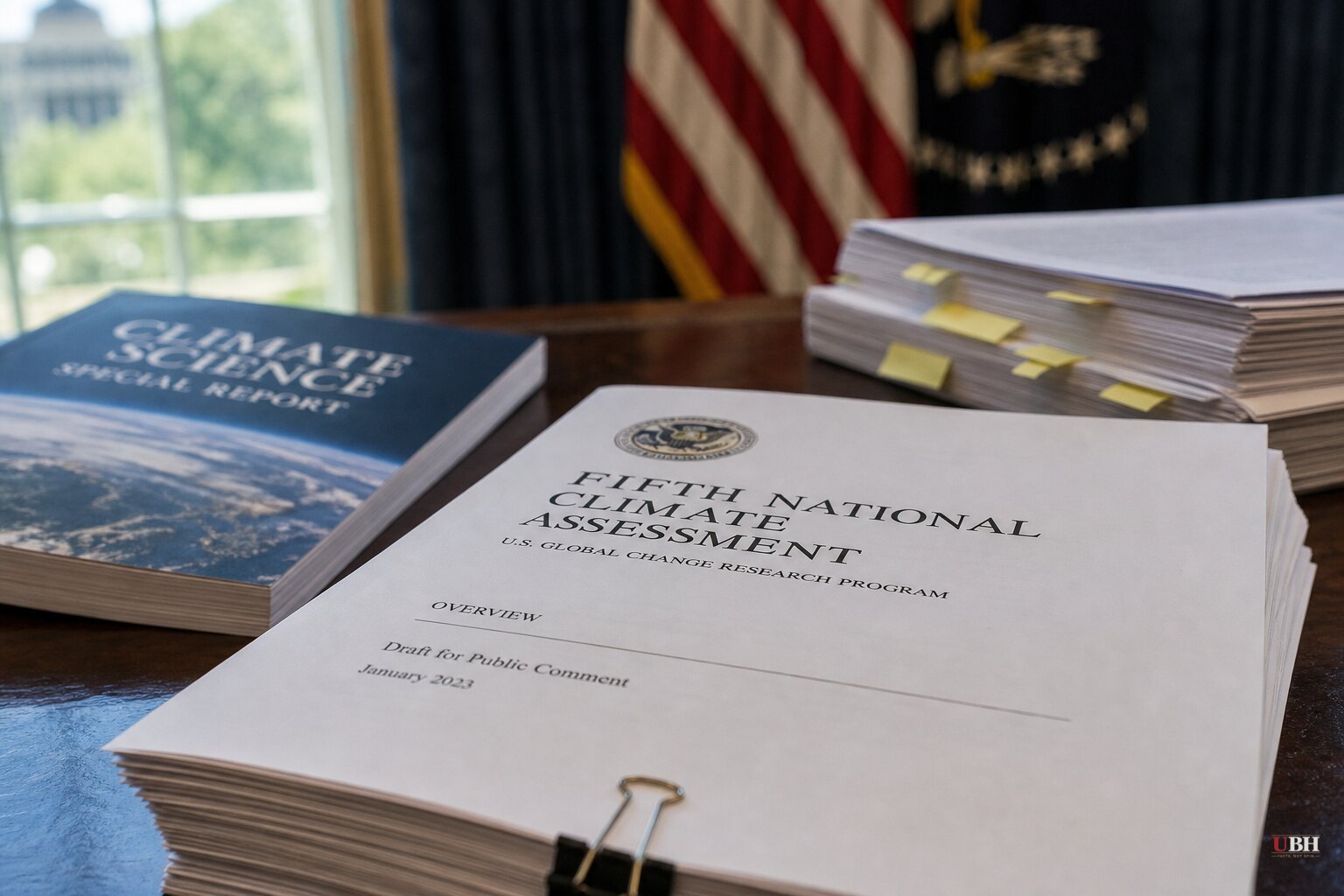
The Trump administration proposed an amendment to the U.S. Fifth National Climate Assessment (NCA5) in August, directing that extreme emissions scenarios known as RCP8.5 and SSP5-8.5 no longer be treated as realistic baselines for federal policymaking, according to the Daily Wire. The amendment was issued under the U.S. Global Change Research Program and tied to Executive Order 14303, titled "Restoring Gold Standard Science."
The language is specific: any NCA5 figure built on those scenarios "should not be used as expected, baseline, business-as-usual, likely, central, or policy-relevant planning futures," per the Daily Wire's summary of the amendment. Results derived from those scenarios must now carry an explicit caveat and be compared against more plausible alternatives.
RCP8.5 was designed as an upper-bound stress test for climate models, not a forecast, and its assumptions about coal use and population growth have been called unrealistic by scientists since at least 2017, according to the Daily Wire, which cites the CO2 Coalition, an advocacy group that has long argued mainstream climate assessments overstate future warming. That critique of RCP8.5 as an outlier scenario rather than a likely future is a legitimate, longstanding point in climate science, not a fringe claim invented by this administration. Whether NCA5's broader reliance on other model outputs and IPCC-derived projections is similarly flawed, as the Daily Wire also argues, is a separate and more contested claim that the amendment itself does not address.
The Daily Wire's piece goes further, arguing carbon dioxide "is not a pollutant" and calling current atmospheric levels near 420 parts per million too low for "optimal plant growth." That is the outlet's own editorial framing, built on the CO2 Coalition's long-standing position, and it is a contested view rather than an established scientific consensus.
A different data set, same week
While the RCP8.5 fight plays out in Washington, a separate report from Wood Mackenzie, an energy research and consulting firm, offers a look at where actual emissions and absorption stand today, independent of any modeled worst case.
The report, "Nature capital: the unpriced carbon," published in August 2026 and distributed through GlobeNewswire, finds that oceans absorbed roughly 12 gigatons of CO2 in 2025 and forests absorbed another 6 gigatons. Against gross global emissions of about 48 gigatons a year, those natural sinks cut net emissions to roughly 30 gigatons, absorbing close to 40% of human CO2 output.
Net emissions from human activity have risen more than 80% since 1990, according to Wood Mackenzie. Engineered carbon removal, including direct air capture and bioenergy carbon capture, pulled just 0.08 gigatons out of the atmosphere in 2025, which the firm says is 200,000 times less than what oceans absorb in a year on their own.
Global forest area has shrunk by 1.5 million square kilometers since 1990, and deforestation now adds 5 to 6 gigatons of CO2 to the atmosphere annually, per the report. The land-use sector, forests, soil and agriculture combined, has been roughly emissions-neutral since 2024, meaning it has stopped functioning as a net carbon sink. Wood Mackenzie's base case has forest area continuing to shrink through 2030 before a gradual recovery.
The firm also flags five "tipping points": permafrost thaw, Amazon dieback, boreal forest fires, coral reef die-off, and disruption of Atlantic Ocean circulation. These have a combined potential to release more than 750 gigatons of greenhouse gases. Canada's 2023 boreal fires alone released about 3 gigatons of CO2 and turned that forest region from a carbon sink into a net emitter, according to the report.
Wood Mackenzie notes that even under the most ambitious net-zero-by-2050 pathway, about 11 gigatons of residual energy-sector emissions would remain each year, rising to roughly 14 gigatons under current national pledges aimed at net zero by 2060. Carbon prices in most compliance markets run between $5 and $90 per ton of CO2, levels the firm says don't reflect the actual cost of losing sink capacity.
Two stories, one week, no direct link claimed
The federal policy fight and the Wood Mackenzie report address different questions. The administration's amendment is about which emissions scenario federal agencies should treat as a planning baseline. Wood Mackenzie's report is about what current, non-modeled, observed absorption and emissions data show right now.
The legitimate case for the amendment, that treating an extreme upper-bound scenario as "business as usual" distorts cost-benefit analysis and regulatory decisions, stands on its own regardless of what the sinks data shows. But Wood Mackenzie's numbers on actual net emissions being up 80% since 1990, and forests losing their role as a net carbon sink since 2024, are not modeled worst cases. They are the firm's read of where things stand today, separate from any RCP8.5 debate.
Neither the Daily Wire's coverage nor the underlying amendment addresses natural sink degradation at all. Whether the next iteration of the National Climate Assessment, or any future federal science guidance, incorporates Wood Mackenzie's sink data alongside the new scenario restrictions is an open question with no announced timeline from the U.S. Global Change Research Program.
Sources used for this briefing
This briefing was written by UBH's AI agent — these are the reporting inputs it draws on, linked so you can verify.


