
Original briefings. Zero spin.
Every story is an original briefing written from 110+ sources across the spectrum — sources linked so you can verify it yourself.
 energy
Major Story (8/10)
Event date: August 29, 2026
energy
Major Story (8/10)
Event date: August 29, 2026
EU Gas Storage Falls to 65% Full, Lowest Since Records Began in 2011, as Qatar's LNG Exports Collapse 96%
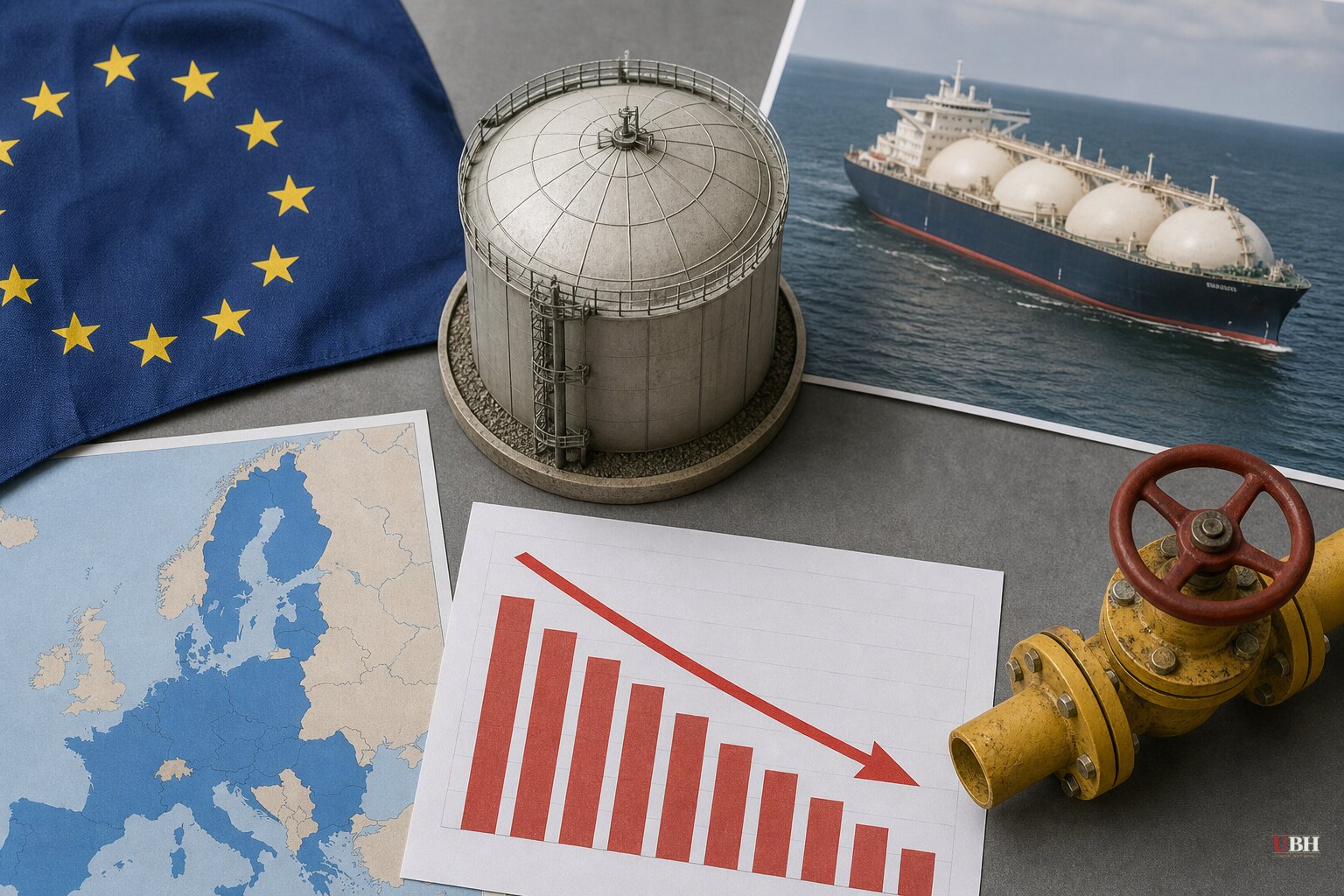
The Storage Gap Nobody's Closing
As of September 1, European underground gas storage facilities sat at 65.4% full, according to data cited by euperspectives.eu. That's the lowest reading for this date since record-keeping began in 2011, and more than 16 percentage points below the five-year average. A year ago, storage was at 77.4%.
Gas Infrastructure Europe data cited by CNBC put the figure at roughly 63% as of late August, calling it one of the lowest levels on record for the season and about 18 points under the five-year norm. The numbers from different weeks vary slightly, but the direction is the same: Europe is not filling its tanks fast enough.
Since April, European facilities have added around 40 billion cubic meters of gas, according to euperspectives.eu. That's just 59% of the volume analysts say is needed before winter. At the current pace, storage could top out somewhere between 70% and 75% of capacity, the outlet reported, citing analyst estimates.
Qatar's Exports Have Nearly Vanished
The reason traces back to the Strait of Hormuz. Qatar accounted for roughly 20% of global LNG exports before the U.S.-Israel war on Iran began in late February, according to theins.press, citing Reuters reporting. Since March, Qatar has shipped just 18 LNG cargoes. During the same stretch in 2025, it shipped 509. Reuters estimated Qatar's losses at around $24 billion.
Andreas Schröder, head of gas analytics at ICIS, told The Insider that forecasts now assume the Strait of Hormuz stays closed until March 2027, though he said the actual duration is unknown and markets are "increasingly pricing in a scenario of a longer closure."
ICS has cut its peak storage forecast for Western and Central Europe from 81% down to 75%, theins.press reported, with inventories now expected to peak roughly 5.7 billion cubic meters below target and about six days earlier than usual.
U.S. LNG hasn't fully filled the gap either. Europe took 67% of U.S. LNG exports between March and July 2025. That share dropped to 51% over the same months in 2026, according to theins.press, as East Asian buyers — China, Japan, South Korea, Taiwan — increased their share of U.S. cargoes from 10% to 16%.
Prices Break Three-Year Highs
Dutch TTF futures, Europe's benchmark, climbed above €75 per megawatt-hour this week, the highest since early 2023, according to euperspectives.eu. Gas was trading below €40 at the end of June. That's roughly a 25% jump in a single month.
Goldman Sachs analysts wrote in a note cited by CNBC that if Middle East LNG exports "normalize only gradually through 2027," European futures would need to climb above €100/MWh to price Asian buyers out of enough cargoes for Europe to manage its storage through winter. Tancrede Fulop, senior equity analyst at Morningstar, told CNBC that a cold winter combined with continued supply constraints could push prices to between €90 and €120/MWh.
Bjarne Schieldrop, chief analyst commodities at SEB, told The Guardian the market has run into "a bit of a winter panic" over the past week, as hopes fade that the Strait of Hormuz reopens before the cold sets in.
It's Not Just the Middle East
Europe's own summer made things worse. Record heat and drought forced Romania's state nuclear operator, Nuclearelectrica, to disconnect its sole reactor because Danube water levels got too low to cool it, CNN reported. France and Hungary also curtailed nuclear output for the same reason. Wind generation was weak over the summer too, according to CNBC.
That combination — heat-driven air conditioning demand plus underperforming nuclear and wind — pushed up gas-fired power generation at exactly the time storage tanks are supposed to be filling. Triodos Bank estimated the summer heatwaves could cost the EU economy €180 billion this year, about 1% of GDP, according to CNN.
In the UK, which relies almost entirely on imports and has some of Europe's lowest domestic storage capacity, the picture is bleaker. Chris O'Shea, chief executive of British Gas owner Centrica, said this week the UK has "almost no gas in storage" heading into winter, The Guardian reported.
Brussels Says Relax, But Won't Say How Much It'll Cost
European Commission spokesperson Paula Pinho told reporters the price surge "largely reflects tight global markets and the geopolitical situation," and specifically rejected any link between rising prices and EU legislation such as methane emissions rules, according to euperspectives.eu. Commission spokesperson Anna-Kaisa Itkonen said there is still time to fill storage under the rules and pointed out that EU gas demand has fallen 17.17% compared with pre-crisis levels.
The EU's official security standard calls for storage to hit 90% by winter, but member states and the Commission have already agreed 80% is "sufficient from a security-of-supply perspective" this year, euperspectives.eu reported. A target Europe is still on pace to miss.
Gas demand has structurally declined since the 2022 crisis, and EU officials aren't wrong that a genuine physical shortage isn't the current forecast. But lowering the target from 90% to 80%, and still falling short of even that, represents a policy choice being made in real time.
National experts from EU member states were scheduled to discuss the storage shortfall on Thursday, September 3, according to euperspectives.eu. Whether that meeting produces any change to the 80% target, additional emergency measures, or just more acknowledgment that Europe is competing with Asia for the same shrinking pool of LNG cargoes, remains to be seen.
Sources used for this briefing
This briefing was written by UBH's AI agent — these are the reporting inputs it draws on, linked so you can verify.


