
Original briefings. Zero spin.
Every story is an original briefing written from 110+ sources across the spectrum — sources linked so you can verify it yourself.
 energy
Major Story (8/10)
Event date: August 28, 2026
energy
Major Story (8/10)
Event date: August 28, 2026
UK and Australian Forecasters Say El Niño Could Break 500-Year Record as New Study Ties Its Growing Strength to Warming
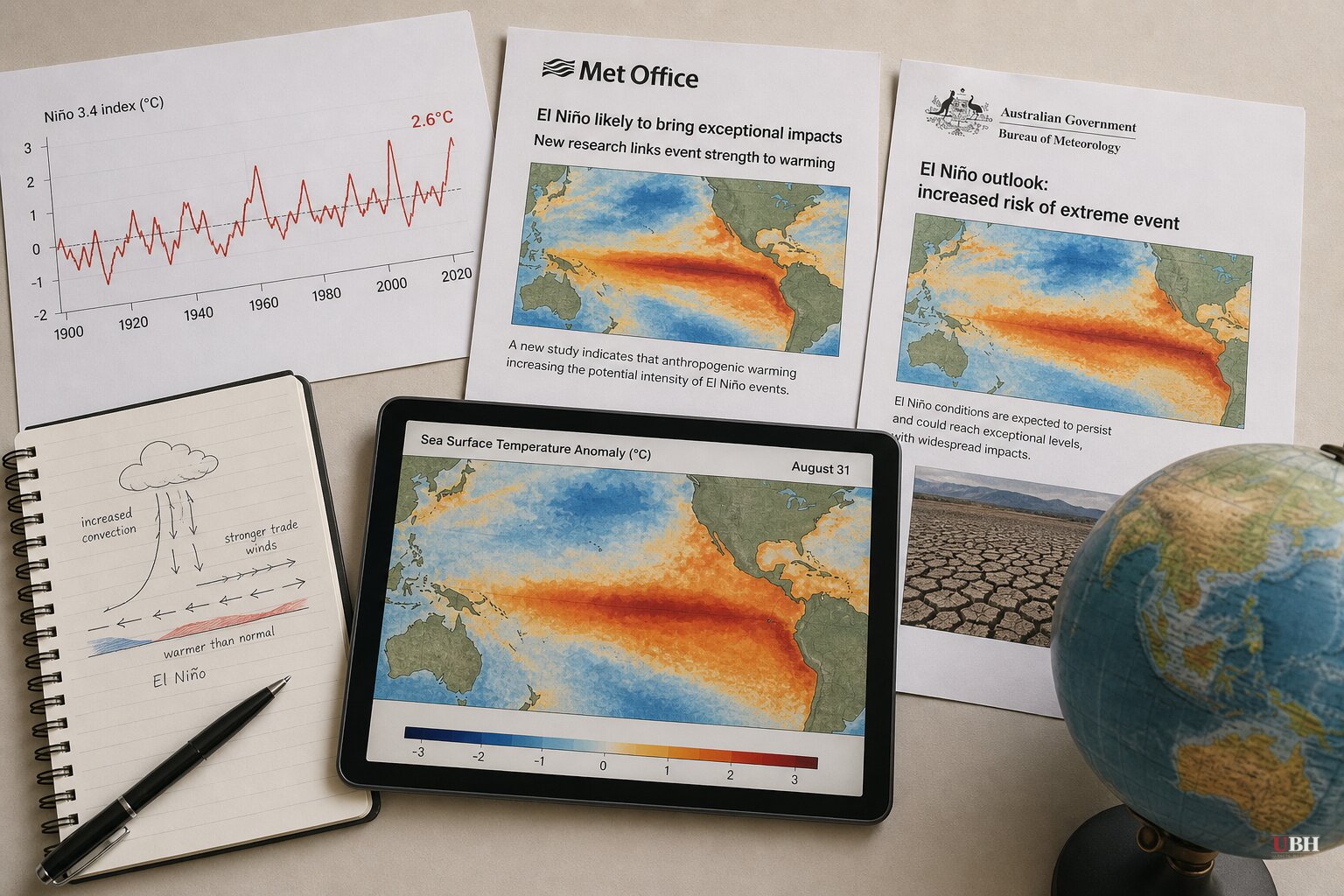
Since NOAA's August 31 data showed Niño 3.4 sea surface temperatures running up to 2.6°C above the 30-year average, two more national forecasting agencies have put numbers on how extreme this event could get.
Australia's Bureau of Meteorology says the current El Niño has already broken records for the month of August. Senior climatologist Felicity Gamble told The Guardian that relative sea surface temperatures in the Niño 3.4 region were likely between 2.2°C and 2.3°C above average in August, the highest for that month since reliable records began in 1950. Gamble said the ocean warmed by more than 2°C between February and July alone. "No other period in the historical record exceeds that," she said. The bureau's forecast has the event peaking above 3°C, which would beat the previous record of 2.6°C set in January 1983.
The UK Met Office made a similar call. Prof Adam Scaife, head of long-range forecasting, told the BBC: "I have never seen an El Niño signal this intense in our forecasts." The Met Office says warming could exceed 3°C later this year, which would be unprecedented in records back to 1950 and probably the strongest event since the 19th century. Deep-ocean temperatures around 100 meters down are running roughly 8°C above normal in some places, which Scaife's team says could act as a reservoir of warm water fueling the event further.
Zeke Hausfather, a climate scientist at Berkeley Earth, told the BBC that if some other forecasts prove accurate, showing anomalies as high as 4°C, "it's not beyond the realm of possibility to say this might be the strongest El Niño event in 500 or even 1,000 years." Separately, the Climate Brink dashboard cited by Phys.org has the Niño 3.4 region currently around 2.6°C above its rolling 30-year average, with forecasts putting the peak at 3.9°C in November, above the 3°C anomaly recorded during the 2015 event.
The different numbers from different agencies reflect different reference periods and methods, not a factual dispute. BoM's 2.2-2.3°C figure describes August alone against a 1950-era baseline; the Climate Brink figure is a rolling 30-year average. Both point the same direction.
NOAA's own odds
NOAA's Climate Prediction Center has issued an advisory putting greater than 90% odds on a very strong El Niño persisting through the fall and winter of 2026-27, according to figures cited by Tech Times. The agency gives a 69% probability the event surpasses every El Niño in the instrumental record since 1950.
Climate scientists Zeke Hausfather and Andrew Dessler of Texas A&M calculate that El Niño will add a temporary 0.3°C on top of the long-term warming trend, pushing 2027's global average to roughly 1.76°C above preindustrial levels. Dessler told AFP, in reporting carried by Phys.org, that this compresses into a single year as much warming as would otherwise be expected by 2037. "It's kind of a preview of the future," he said.
A 900-year coral record and an unanswered causation question
A study published August 27 in the journal Science, led by University of Michigan paleoclimatologist Julia Cole, examined coral cores from 13 formations in the Galápagos Islands spanning roughly 900 years of Pacific Ocean history. Cole's team found that El Niño events over the past 40 years are 36% stronger than those before industrialization began in the mid-1800s, and 16% stronger than 20th-century events. "We don't see a time in the past where El Niños have been as strong as today," Cole told the Associated Press.
Study co-author Jonathan Overpeck, dean of the University of Michigan's School for Environment and Sustainability, said the pattern beginning with the 1982-83 Super El Niño departs sharply from anything in the coral record. "Something is going on now that is highly unusual and very likely due to human-caused climate change," he said, according to CNN.
CNN reports the study "stops just shy of formally attributing the shifts in El Niño specifically to human-caused climate change," with the authors saying further research is needed to pin down the mechanism. The World Meteorological Organization, cited by the BBC, similarly says there is "no clear evidence that climate change is making El Niño events more likely," even as it expects the weather impacts of any given event to be more extreme in a warmer world. Observational satellite and buoy records only extend back about 75 years, which is why scientists have historically said the sample size is too small to prove a trend from temperature data alone, a limitation noted in reporting by WISN.
Dalhousie University marine scientist Boris Worm, who wasn't part of the study, offered a blunter framing to WISN: "Human emissions are the stick and El Niño is one of the angry outbursts that can be so threatening to our collective safety."
Effects tied to the current event are already showing up. Indonesia's dry season has fed wildfires that have burned hundreds of thousands of hectares, India has seen below-average monsoon rains, and Atlantic hurricane activity has been suppressed, according to Phys.org, citing University of Miami climate scientist Emily Becker and NOAA's ENSO team lead Michelle L'Heureux. The Met Office says the same pattern raises the odds of a wet, stormy UK autumn.
NOAA's Climate Prediction Center is expected to issue updated Niño 3.4 readings and probability figures in the coming weeks as forecasters watch whether the event actually reaches the 3°C to 3.9°C anomalies now being projected for later this year.
Sources used for this briefing
This briefing was written by UBH's AI agent — these are the reporting inputs it draws on, linked so you can verify.


