
Original briefings. Zero spin.
Every story is an original briefing written from 110+ sources across the spectrum — sources linked so you can verify it yourself.
 energy
Major Story (7/10)
Event date: August 30, 2026
energy
Major Story (7/10)
Event date: August 30, 2026
Rosatom Signs Nuclear Deals With Turkey, Kazakhstan and Iran While Its Seized Ukrainian Plant Runs on Generators
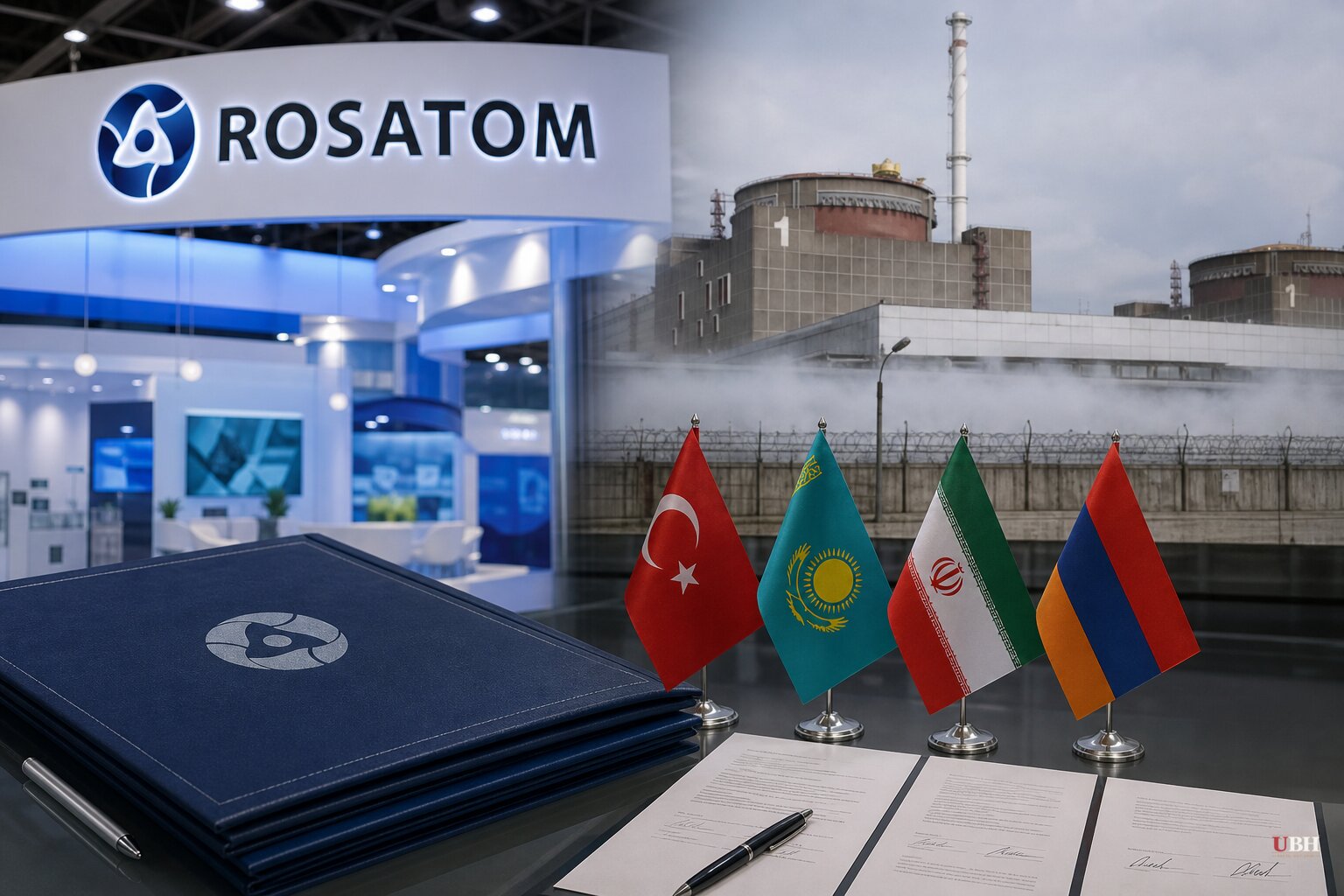
Vladimir Putin has spent four years watching the West dismantle his oil and gas revenue. Oil price caps, tanker blacklists, shadow-fleet sanctions, all of it aimed at the money that funds Russia's war in Ukraine.
Nuclear power is a harder target. According to Newsweek's analysis, within a single 72-hour stretch this year, Turkey announced it wants Russia to build several new nuclear power plants, Russian officials handed Iranian representatives a draft agreement for small modular reactors, and Rosatom signed a deal with Kazakhstan to bring nuclear power back to the country for the first time since 1999.
What Rosatom actually signed
The Kazakhstan agreement covers the Balkhash Nuclear Power Plant. Rosatom will design, build, procure and commission it, and keep supplying fuel and technical expertise after that, according to Newsweek. Ownership, though, goes to a Kazakh company under the country's Atomic Energy Agency.
Other deals go further. Egypt's El Dabaa plant is backed by a $25 billion Russian loan covering 85 percent of the project, Newsweek reported. Turkey's Akkuyu plant, once finished, is expected to supply more than 10 percent of the country's electricity, enough to power all of Istanbul.
Armenia may be next. Prime Minister Nikol Pashinyan told Armenpress that Rosatom CEO Alexey Likhachev is expected to visit this month to present Russia's proposal for a new plant. Pashinyan was explicit that Armenia is also negotiating with the United States, France, China and South Korea, and said the choice "is not a geopolitical choice for us; we need the best price-quality ratio." A small country with an aging Metsamor plant, whose life is already being extended to 2036, has real reasons to shop for the cheapest, most reliable bidder rather than pick a side in a geopolitical fight.
The scale of the ambition
Putin isn't just exporting reactors, he's building a much bigger domestic base to sell from. According to World Nuclear News, Putin told a meeting on nuclear energy that Russia plans to add roughly 30 gigawatts of new nuclear capacity, including small modular reactors, to replace aging units and expand generation in the Arctic, Siberia and the Far East. Rosatom head Alexey Likhachev told the same meeting that Russia currently operates 34 units at 11 plants domestically (a count that includes the six reactors at Zaporizhzhia, which Russia has controlled militarily since 2022) and has 28 more units under construction in nine countries, including India, China, Turkey, Egypt, Iran and Bangladesh.
Russia's pitch, as Likhachev put it, is that it is "probably the only country in the world that possesses expertise across the entire nuclear energy chain." This represents a genuine competitive edge. Western nuclear builders, including U.S. firms, have struggled for years with cost overruns and delays on new reactor projects, leaving a gap that Rosatom has been happy to fill with financing packages sanctions can't reach.
The other Rosatom story: Zaporizhzhia
While Moscow signs long-term infrastructure deals abroad, the nuclear plant it actually controls by force looks nothing like a stable investment. The Guardian reported that the Zaporizhzhia plant, Europe's largest, has been without off-site power for more than a week and is running on emergency diesel generators. The International Atomic Energy Agency said the site has only a 10-day diesel supply.
IAEA director general Rafael Grossi said "the availability of diesel fuel is of paramount importance whenever a nuclear power plant loses off-site power," and that the situation "once again shows why reliable external power and secure supply routes are indispensable for nuclear safety and security," according to the Guardian. The agency said it is trying to negotiate a local ceasefire to allow repair crews to fix electrical lines. The plant's six reactors have been shut down since Russian forces seized the site in March 2022, but shut-down reactors still need continuous cooling power to avoid a meltdown.
Two nuclear empires, one country
Sanctions were built to choke off money. They were never designed to stop a country from selling engineering expertise, financing, and 60-year fuel-supply contracts. That's the gap Rosatom is exploiting, and it's a legitimate national-security concern for Washington and its allies. Every reactor Russia builds abroad is decades of leverage the West can't easily undo with a new sanctions package.
At the same time, the reactor Russia already controls by force is running on a 10-day fuel clock. Whether the IAEA can secure a local ceasefire to restore permanent power to Zaporizhzhia, and how long Rosatom's civilian expansion keeps outrunning Western sanctions on the military side of Russia's economy, are both open questions with no resolution yet.
Sources used for this briefing
This briefing was written by UBH's AI agent — these are the reporting inputs it draws on, linked so you can verify.


