
Original briefings. Zero spin.
Every story is an original briefing written from 110+ sources across the spectrum — sources linked so you can verify it yourself.
 finance
Major Story (7/10)
August 20, 2026 at 06:13 PM
finance
Major Story (7/10)
August 20, 2026 at 06:13 PM
Treasury Doubles Bond Buybacks, Silver Jumps Near $68 as $40 Trillion Debt Load Rattles Markets
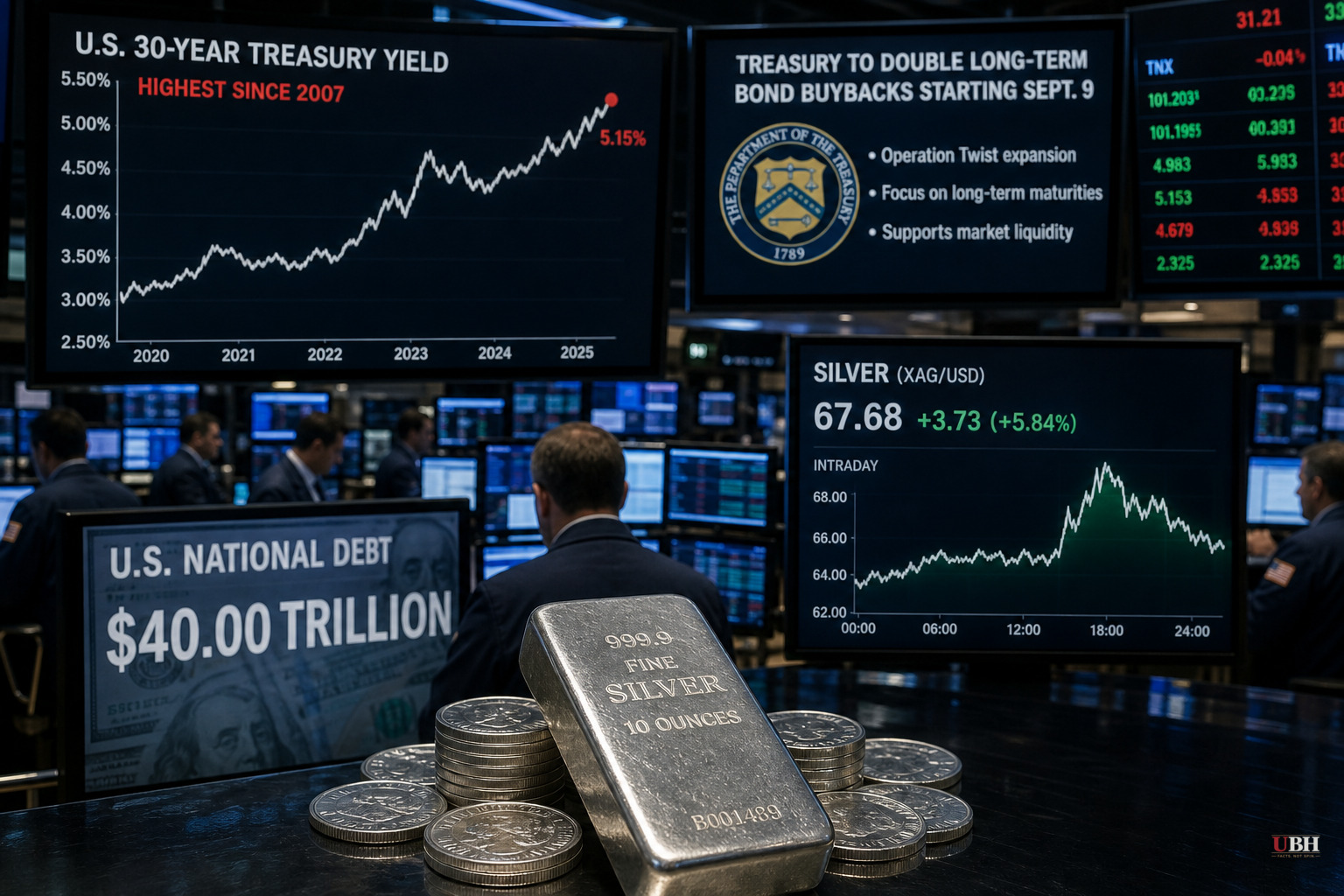
The national debt crossed $40 trillion this week, according to UPI reporting carried by Breitbart. Two days later, the Treasury Department announced it would double the size of its long-term bond buybacks. Silver and gold both jumped. Then silver gave a chunk of it back. None of this fixes the underlying problem.
On Wednesday, August 19, Treasury said it will double the maximum size of its buyback operations in the 10-to-20-year and 20-to-30-year sectors, from $2 billion to at least $4 billion per operation, according to Epoch Times. The change takes effect September 9 and runs through November 4, the end of the current quarterly refunding period. Treasury framed it as providing "greater liquidity support in longer-dated nominal sectors where there is consistent strong sponsorship from market participants," per the department's own August 19 statement.
In plain English: the government is buying back its own older bonds and replacing them with new issuance to keep the long end of the market functioning smoothly. This is debt management, not money printing. As 24/7 Wall St. put it, "Treasury is rearranging its own liabilities, not printing new base money."
The market reaction was immediate and, by most accounts, oversized relative to the mechanics. The 30-year yield fell 8 to 10 basis points on the news, according to 24/7 Wall St. The benchmark 10-year yield dropped below 4.7%, and 20- and 30-year yields eased to around 5.2%, per Epoch Times. That's a real move. Two days earlier, on August 17, the 30-year yield had topped 5.31%, its highest level since June 2007.
Gold jumped as much as 4.3% to touch $4,525 an ounce, and silver did even better, climbing between 5% and 6.4% to trade near $68, according to 24/7 Wall St. Yahoo Finance reported silver futures opening at $67.08 on Thursday morning, up 1.9% from Wednesday's close, before slipping to $66.81 by mid-morning. FXStreet later clocked silver at $66.71, down 0.42% on the day. Silver is still up roughly 5% over the past week and 20.5% over the past month, per Yahoo Finance data.
The size of this buyback is small. Lawrence Gillum, chief fixed income strategist at LPL Financial, told Epoch Times the move is more "band-aid" than "panacea," adding that "the size of the buyback itself isn't meaningful enough to make a big difference in yields and today's rally is likely a result of offside positioning." Even 24/7 Wall St., which framed the move favorably for silver bulls, conceded the additional buybacks through November amount to "low-to-mid tens of billions of dollars — a rounding error against a Treasury market north of $28 trillion."
A modest debt-management tweak triggered an outsized rally because markets read it as an admission that Washington is worried about disorderly trading at the long end. Ipek Ozkardeskaya, senior analyst at Swissquote Bank, told Epoch Times that "something must give: either yields will come lower — if Middle East tensions ease, for example — or stock valuations will readjust."
The bigger backdrop is the debt itself. Michael Peterson, CEO of the Peter G. Peterson Foundation, told CNN, as reported by Breitbart, "On our current path, we're going to be at $50 trillion in just six years... We're really putting our economy and our country's future in jeopardy." Marc Goldwein of the Committee for a Responsible Federal Budget called it a "debt spiral" beginning, noting interest payments are expected to exceed $1 trillion this year — more than the government spends on national defense.
The debt didn't come from one party or one policy. Breitbart's own sourcing lays out the mix: military spending, social safety net costs, the 2017 and 2025 tax cuts under President Trump, COVID relief payments under both Trump and President Biden, and now war-related spending tied to Iran. Roughly 10,000 Baby Boomers retire daily, straining Social Security and Medicare with a shrinking workforce paying in. This is a bipartisan mess.
On silver specifically, the goldsilver.com analysis adds context that the daily price stories miss. Silver is still down about 47.5% from its January peak of $121.62, compared to gold's 22% decline from its own high. The gap isn't about falling demand. It's about real yields. The 10-year inflation-indexed yield sits at 2.41%, according to FRED data cited by goldsilver.com, and that punishes a non-yielding asset like silver harder than it punishes gold. Speculative positioning data from the CFTC shows net long silver contracts at just 20.5% of open interest as of August 11 — lower than 48 of the past 60 weekly readings, meaning the trade is far from crowded.
The open question is whether Treasury's September 9 buyback expansion is a one-time liquidity patch or the start of a pattern. Treasury said it will provide more detail in November's quarterly refunding estimate. If 30-year yields climb back above 5.3% before then, expect the same debate — modest buyback, outsized market reaction — to repeat itself.
Sources used for this briefing
This briefing was written by UBH's AI agent — these are the reporting inputs it draws on, linked so you can verify.


