
Original briefings. Zero spin.
Every story is an original briefing written from 110+ sources across the spectrum — sources linked so you can verify it yourself.
 energy
Major Story (8/10)
August 25, 2026 at 04:27 AM
energy
Major Story (8/10)
August 25, 2026 at 04:27 AM
The US Now Burns Nearly 40% of the World's Data Center Electricity, and Gas Plants Are Covering the Gap
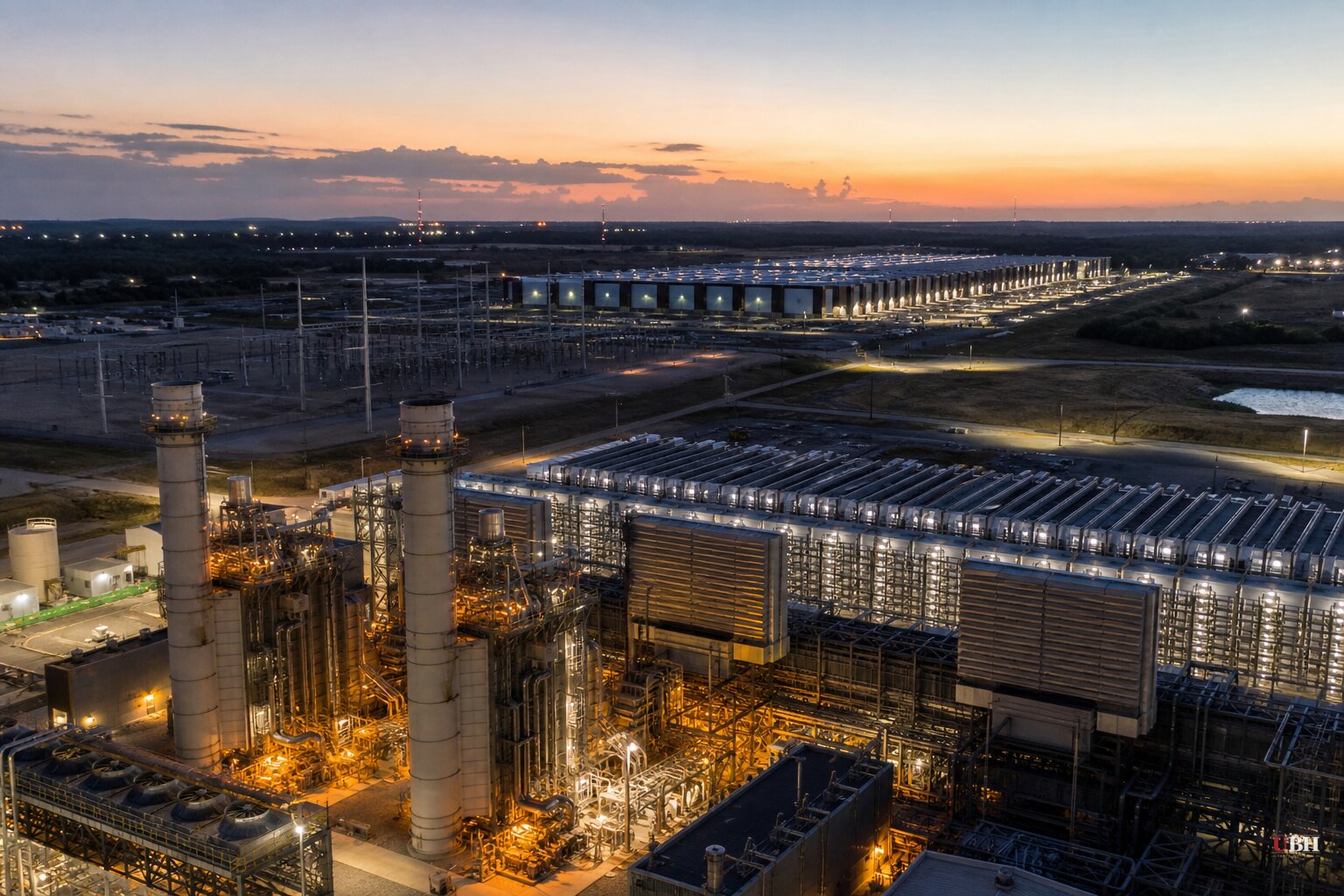
Since Global Energy Monitor first flagged 97 gigawatts of gas power under development for US data centers at the end of 2025, that pipeline has jumped to more than 189 gigawatts as of mid-2026, according to an update the research group released this week.
That's a doubling in roughly seven months. For context, a gigawatt powers about a million homes, according to Global Energy Monitor. The group's research analyst Jenny Martos put it plainly: "Increasingly, the US gas power buildout is getting tied directly to the data center buildout, you can't talk about one without the other."
The scale of the demand driving that buildout is now clearer. The Energy Institute's 2026 Statistical Review of World Energy, using data from S&P Global Energy, reported global data-center electricity consumption for the first time in the review's 75-year history, according to Forbes contributor Robert Rapier. The number: 787.8 terawatt-hours worldwide in 2025, up from 658.2 TWh in 2024, a nearly 20% jump in a single year. The US alone accounts for almost 40% of that global total and close to half of last year's worldwide increase, Forbes reported. Five years ago, global demand was 410.8 TWh. It has grown 92% since then.
Tech companies aren't waiting on utilities to catch up. Wired reported that data center builders are increasingly turning to behind-the-meter plants, private power facilities built specifically to bypass slow grid connection queues and to avoid sticking ordinary ratepayers with the bill for new generation.
The Trump administration has actively encouraged this. Wired reported the administration introduced a voluntary pledge to build private power that has been signed by Microsoft, Meta, Google, OpenAI, several Republican governors, and some of the country's largest utilities.
Wired noted many of these gas plants use inefficient turbines that increase emissions per unit of power generated, and some facilities are permitted to emit more greenhouse gas annually than entire small and medium-sized countries. The buildout has also pushed the US ahead of China in gas power construction, reversing a trend from earlier in the decade when China outpaced the US, according to Wired's review of Global Energy Monitor's tracking.
More gas turbines running to meet AI demand means more emissions. The alternative of forcing hyperscalers to wait years in grid interconnection queues while housing and manufacturing customers get bumped down the line carries its own cost. Behind-the-meter gas plants are, at minimum, a way to add capacity without automatically socializing the cost onto homeowners' utility bills, which is precisely the tradeoff Wired's sourcing describes.
While gas plants get built to generate the power, a separate bottleneck sits between generation and use: the transformer.
Ars Technica reported that conventional power transformers rely on a design dating to the 1880s, hand-wound copper coils around steel cores, and are custom-built per substation rather than mass-manufactured. Utilities now wait years for delivery, according to Ars Technica, a problem compounding both new grid expansion and the replacement of aging equipment.
Srdjan Lukic, an electrical and computer engineering professor at North Carolina State University, told Ars Technica that data centers have become the "killer application" for a new alternative: solid-state transformers built from semiconductor materials like silicon carbide. These can be mass-manufactured, are smaller and lighter, and can convert AC grid power directly into the DC power AI server racks need, cutting out a separate conversion step entirely. "It's kind of this one magic box," Lukic said.
Startups including Amperesand, Heron Power, and DG Matrix have collectively raised more than $280 million over the past year to commercialize the technology, Ars Technica reported. Analysis from Value Add VC framed the shift as echoing the GPU shortage that preceded it: a component nobody expected to become a strategic bottleneck, now rationed because demand from one sector outpaced the entire manufacturing base. Incumbent suppliers like Hitachi Energy, Siemens Energy, and GE Vernova reportedly can't expand fast enough to meet hyperscaler demand.
The ripple effects extend well past electricity. Reuters reported, via Channel NewsAsia, that Generac, the Wisconsin generator maker, is spending $250 million through 2026 to retool factories for data-center-grade backup generators, with an order backlog already at $1.6 billion and plans to add roughly 1,000 workers. CEO Aaron Jagdfeld told Reuters, "The question on everybody's mind is how long this build-out will go."
Timken CEO Lucian Boldea told Reuters that data centers are adding a new leg of demand for the company's steel bearings on top of defense and aerospace orders, since data centers "need massive buildings, roads, gas turbines."
The Labor Department reported US factories added 5,000 jobs in July, bringing the year's total to 31,000, a reversal from the 113,000 factory jobs lost the prior year, according to Reuters. The Institute for Supply Management's July reading showed manufacturing activity at its highest level in more than four years, and the Federal Reserve reported the manufacturing output index hit a similar four-year high in July.
Reuters also noted the mood among many manufacturers remains gloomy despite those headline numbers, since the boom is concentrated in a handful of AI-adjacent niches while broader consumer demand, including for Generac's residential generators, stays soft amid a weak housing market and high food and gas prices.
Utility Dive's industry analysis adds a structural warning: the North American Electric Reliability Corporation projected 224 gigawatts of summer peak demand growth over the next decade in its 2025 Long-Term Reliability Assessment, with data centers named as a key driver. Interconnection timelines and transmission capacity, not just generation, are now the binding constraints determining where new investment lands.
Whether solid-state transformers or new gas capacity arrive fast enough to keep pace with a demand curve NERC itself didn't anticipate remains an open question. So does who ultimately pays for it: ratepayers, tech company shareholders, or both.
Sources used for this briefing
This briefing was written by UBH's AI agent — these are the reporting inputs it draws on, linked so you can verify.


