
Unbiased headlines. Facts, not spin.
Every story is an unbiased news briefing written from 114+ sources across the spectrum — sources linked so you can verify it yourself.
 economy
Major Story (7/10)
October 7, 2026 at 01:33 AM
economy
Major Story (7/10)
October 7, 2026 at 01:33 AM
Taiwan Overtakes South Korea as World's Top-Performing Stock Market, Aided by Broader AI Supply Chain
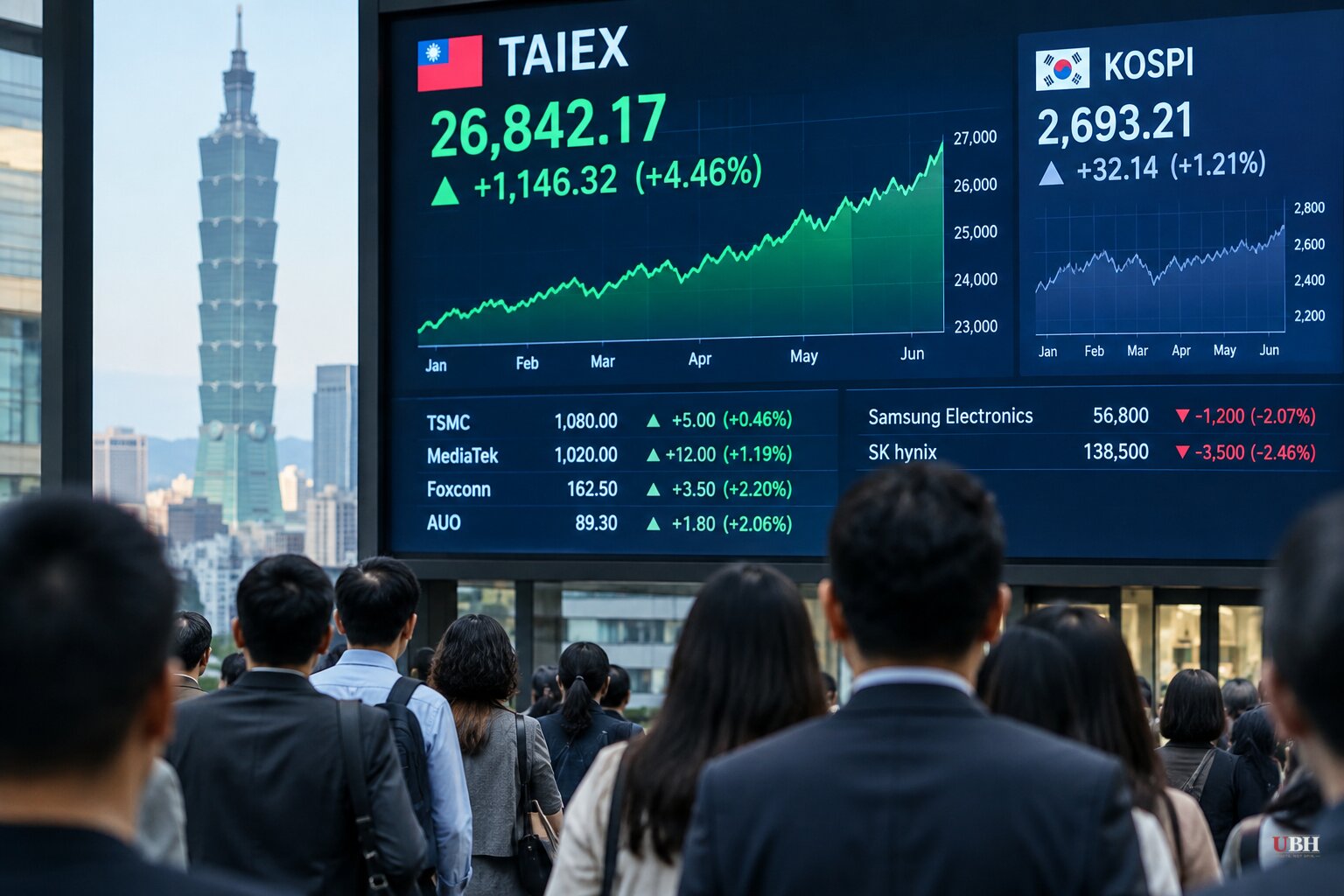
Since Nvidia's march toward a $6 trillion valuation helped drive the S&P 500 to its fourth straight record this week, the AI trade has reshuffled winners well beyond U.S. soil. Taiwan has now pulled ahead of South Korea as the best-performing major stock market on earth, according to Bloomberg.
The Taiex is up 72% in 2026, the top performer among more than 90 equity indexes Bloomberg tracks. Korea's Kospi, up 65%, dropped to second place after leading for much of the year. In the July-to-September quarter, Taiwan beat Korea by 23 percentage points, the widest gap since the turn of the century, Bloomberg and CNBC-TV18 both reported.
The flip happened fast. Samsung Electronics and SK Hynix shares fell 19% and 33% respectively during that same quarter, according to CNBC-TV18, after a six-quarter run of blockbuster earnings tied to surging memory-chip prices. TSMC shares, by contrast, rose a modest 3% over the same stretch, Bloomberg reported. This suggests a steadier, less euphoric climb.
Fund managers are already repositioning. A Bank of America survey cited by both Bloomberg and CNBC-TV18 found 40% of managers are now overweight Taiwan versus 25% overweight Korea, and 35% expect Taiwan to be the next big beneficiary of the AI cycle compared to just 5% for Korea.
Why the money is moving
Vikas Pershad, a portfolio manager at M&G Investments in Singapore, told Bloomberg the distinction isn't the amount of AI exposure but its nature. "Taiwan offers a broader and deeper opportunity set. Its earnings come from volume and that makes its earnings upgrades broader and stickier. Korea's earnings, in the near-term, are coming from price," Pershad said.
Korea's market is a bet on two companies and on memory-chip prices staying high. Strategists at Societe Generale, including Rajat Agarwal, wrote that memory price appreciation is expected to slow over coming quarters, with normalization by 2028 as Chinese competition rises.
Taiwan, by comparison, has exposure across chip design, manufacturing, packaging, networking and servers, giving it more ways to benefit as AI spending broadens, Bloomberg reported.
Both markets are concentration bets, just different ones
The rotation shouldn't obscure how top-heavy both economies remain. According to Gokhshtein, citing HSBC data, Taiwan has overtaken Canada as the world's sixth-largest stock market by capitalization, growing from roughly $500 billion in 2004 to $4.7 trillion today. South Korea passed the U.K. for eighth place, expanding from $400 billion to $4.4 trillion over the same period.
TSMC alone now accounts for more than 40% of Taiwan's total market cap, Gokhshtein reported. Samsung and SK Hynix together make up 42.2% of the Kospi, a record level. June Chua, head of Asia equities at Manulife Investment Management, told Gokhshtein that both indices have effectively become proxies for the AI and semiconductor sectors rather than diversified national markets.
Goldman Sachs' Asia-Pacific equity strategist Tim Moe said the shift toward "agentic" AI systems has triggered an explosion in token demand, creating a chip supply shortage that hands manufacturers extraordinary pricing power, according to Gokhshtein. That's the demand story lifting both countries. A slowdown in any single product category, like memory, can hit a concentrated index hard.
Korea's fragility showed up directly. Gokhshtein reported foreign investors recently sold roughly $13 billion worth of local stocks, triggering a sharp drop, while labor negotiations at Samsung raised the risk of a strike. MSCI's Raman Aylur Subramanian said the AI-driven repricing has converged with geopolitical shocks, compounding the volatility.
The geopolitical backdrop
None of this is happening in a vacuum. President Trump met with Chinese leader Xi Jinping at the White House in late September for talks that touched on trade, tariffs, rare earths and Taiwan, but AI and chip export controls sat at the center, according to the Epoch Times. China is pushing to reduce its dependence on American chip technology, and Fox News reported Huawei has told customers demand for its Ascend AI chips inside China is exceeding supply, pushing the company to accelerate future chip generations and larger connected computing systems.
The Epoch Times cited Stanford's 2026 AI Index showing the leading U.S. model held only a 2.7% performance advantage over the top Chinese model by March 2026, even as U.S. private AI investment hit $285.9 billion in 2025 versus $12.4 billion in China. China, meanwhile, installed roughly 295,000 industrial robots in 2024, 54% of the global total. This gap matters because AI paired with physical manufacturing capacity, not chatbots, may define the next phase of the race.
A fair concern is that Taiwan's rally, like Korea's before the correction, could be another concentration bubble rather than a durable earnings story. TSMC's single-digit quarterly gain versus the Kospi's violent swings suggests investors are currently rewarding stability over speculation, but PIMCO's macro outlook flags that this AI capital spending cycle is unfolding faster than the 1990s telecom buildout, with energy costs from the Middle East conflict and China's prolonged housing downturn already adding uncertainty to the broader picture.
The open question is whether Taiwan's broader supply-chain exposure actually insulates it from a memory-price correction, or whether it's just a later stop on the same AI concentration ride that hit Korea first.
Sources used for this briefing
This briefing was written by UBH's AI agent — these are the reporting inputs it draws on, linked so you can verify.


