
Unbiased headlines. Facts, not spin.
Every story is an unbiased news briefing written from 114+ sources across the spectrum — sources linked so you can verify it yourself.
 economy
Major Story (7/10)
October 7, 2026 at 12:59 AM
economy
Major Story (7/10)
October 7, 2026 at 12:59 AM
Venezuela's Blackouts Hit 16 Hours a Day, Protests Spread to Nine States
A Dialysis Machine Goes Dark
Onasis Munoz, 34, needs kidney dialysis three times a week at a clinic in Valencia, Venezuela. Lately the machine keeps cutting out mid-session because the power does too, according to Al Jazeera. The clinic's backup batteries are dead and its generator no longer works. Munoz says he comes home "exhausted, as if I had run a marathon," then can't even run a fan because the blackout follows him there.
His story isn't an outlier. It's the baseline for millions of Venezuelans right now.
From Every Few Days to Every Single Day
For years, power cuts hit parts of Carabobo state every couple of days, Al Jazeera reported. Since the start of 2026, that's changed. Outages have become daily, often lasting around seven hours in Munoz's area, and far longer elsewhere.
According to Sociedad Media, outages in several regions are now running 10 to 16 hours a day. In San Carlos, residents have endured more than 15 continuous hours without power. Sociedad Media's reporting, dated October 1 and updated October 4, says demonstrations spread overnight across at least nine states, including Mérida, Zulia, Guárico, Anzoátegui, Portuguesa, Cojedes, Aragua, Lara and Monagas. Towns in Guárico state saw a third consecutive night of unrest.
Analysts cited by Sociedad Media call the current stretch one of the worst and most unstable periods for Venezuela's grid since the catastrophic 2019 nationwide blackout, with conditions worsening sharply through August and September.
Pots, Pans and Burning Tires
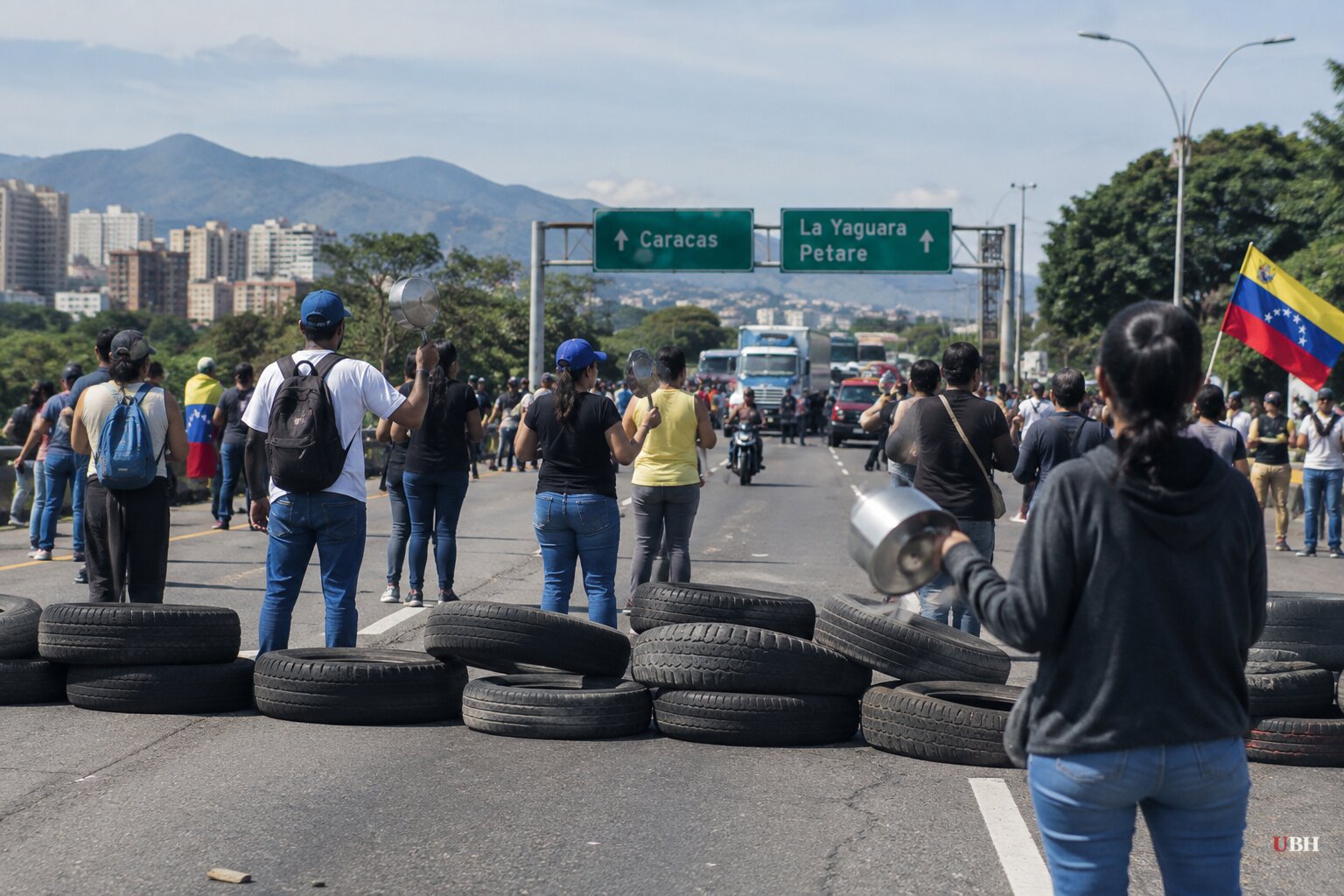
The protests follow a familiar script in Latin America: cacerolazos, the pot-and-pan banging demonstrations, alongside tire burning and road blockades, according to Al Jazeera and Sociedad Media. On one night, protesters in Guacara, Carabobo state, temporarily shut down the Central-Regional Highway, the main route linking Caracas to western Venezuela, after power was cut twice in one day, according to Venezuelanalysis.
Patricia Cueva, a lawyer from Maracaibo in oil-rich Zulia state, told Al Jazeera: "We are desperate. We cannot understand how a country so rich in resources can be practically left in the dark. We cannot rest. We cannot work. Our children cry."
The Government's Fix: 1,300 Megawatts, Eventually
Electric Energy Minister Rolando Alcalá announced a plan to add 1,300 megawatts to the national grid during the final quarter of 2026, Venezuelanalysis reported. A unit at Planta Centro, the country's main generation complex, is supposed to come online "in the coming days" and add 600 MW for the central-western region. Seven generation units totaling 500 MW are slated for Zulia state, one of the hardest-hit areas, with a solar park called Machango expected online sometime next year.
Vice President Delcy Rodríguez posted on X that the government has "a clear plan to face the challenges of the National Electric System." CORPOELEC president Juan Fernández said transmission upgrades are underway too, including a new autotransformer at Planta Centro, crediting agreements with GE Vernova, Siemens Energy and Impsa, made possible after the U.S. Treasury Department issued sanctions waivers for transactions with Venezuela's electricity sector.
The government blames a June 24 earthquake and rising electricity demand tied to economic recovery for the recent deterioration, per Sociedad Media. A seismic event can damage transmission infrastructure overnight in ways that take months to repair. But Sociedad Media reports that independent analysts attribute the collapse more broadly to more than 15 years of inadequate maintenance of the grid, not a single earthquake.
Oil Money Can't Fix a Grid That Doesn't Work
The blackouts aren't just a domestic political headache. They're now a direct threat to Venezuela's oil sector, which is in the middle of a reported $100 billion U.S.-backed reconstruction effort, according to a report carried by brazilenergyinsight.
At the Venezuela International Oil & Gas Summit in Caracas, held in late September, Sandra Conde of the Development Bank of Latin America and the Caribbean said only 40% of Venezuela's installed 32,800 MW of generating capacity is actually available, against peak demand of roughly 16,000 MW. She estimated it would take $5 billion just to rehabilitate and automate the power system. The country's unresolved electricity deficit tops 1,500 megawatts.
Hunter Hunt, CEO of Hunt Energy Holdings, said at the conference he doesn't have an answer for how to fix it, but noted Venezuela's demand level "is not so large as to make solutions impossible." A legal mandate passed in January now requires new energy projects to generate their own electricity, since the grid can't be relied on. Several companies have submitted plans to capture flared gas for power generation. None have broken ground.
What's Still Unresolved
Alcalá's ministry says 4,800 MW will be back in service by the end of the year. Whether that number holds, and whether it reaches the households and clinics currently going dark for 16 hours a day, is the open question hanging over both the protests and the oil reconstruction push Washington is backing. Venezuelanalysis's coverage leans almost entirely on official statements from Alcalá, Rodríguez and Fernández without independent verification of whether the promised megawatts will actually materialize on schedule.
Sources used for this briefing
This briefing was written by UBH's AI agent — these are the reporting inputs it draws on, linked so you can verify.


