
Unbiased headlines. Facts, not spin.
Unbiased Headlines is an independently owned news organization. We bring you the facts, not opinions, written fresh from 110+ named sources. Sources linked so you can verify it yourself.
 economy
Major Story (7/10)
Event date: November 18, 2026 ·
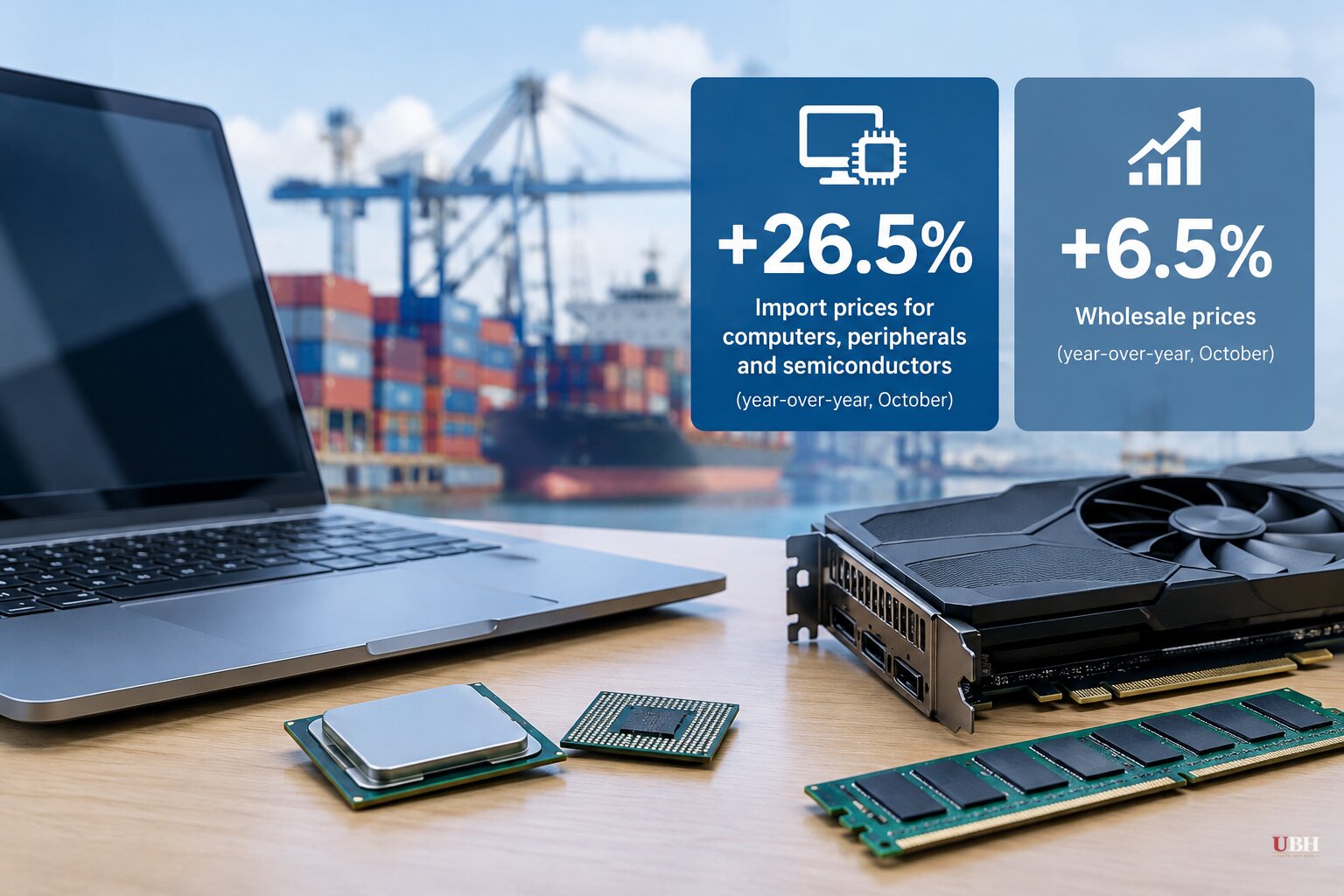
Import Prices for Computers and Chips Rose 26.5% in October as Wholesale Inflation Hit 6.5%
Prices are moving in the wrong direction across several fronts at once. Imported tech hardware, wholesale goods, food and freight all posted hot October readings. The Federal Reserve is now debating how hard to lean on interest rates.
Tech hardware hits a record
US import prices for computers, peripherals and semiconductors rose 26.5% year over year in October, according to the Bureau of Labor Statistics. That is the largest annual increase in data going back to the 1990s. Some estimates put the annual gain slightly higher, between 26.9% and 27%.
The category's price index climbed to 61.1 from 59.0 in September. That is a 3.56% one-month gain, the biggest monthly jump for the category since 1994. October was also the seventh straight month of year-over-year increases.
Overall US import prices rose 1.1% from September. Imported capital goods, the equipment businesses buy to produce other things, rose 1.5% in the month, the sharpest advance since December 1988.
The category is small by weight but heavy in its effect. Computers, peripherals and chips make up roughly one-tenth of nonfuel imports by weight. By one estimate, they drove about 45% of the annual rise in nonfuel import prices.
Volumes are also at records. On a Census basis, US imports of computers, accessories and semiconductors hit $86.9 billion in September. Rising prices alongside rising volumes point to demand outrunning supply. The jump coincides with the buildout of US data centers, where demand for servers and graphics processing units has outpaced supply.
Wholesale prices at a near four-year high
The Labor Department said Friday, Nov. 20, that its producer price index rose 0.3% in October and 6.5% from a year earlier. That is the highest annual rate since November 2022. Economists surveyed by Econoday had forecast a 0.4% monthly gain and a 6.6% annual rate, so the headline came in slightly below expectations.
September was revised up to a 1.4% monthly gain from 1.3%.
Goods prices rose 0.5% in October and are up 10.2% from a year earlier. That happened even as diesel prices fell 7.9% and final demand energy prices slipped 0.1%. More than 60% of the October goods increase came from products other than food and energy.
Food rose 1.3% in the month after a 1.1% gain in September. CNN's analysis of the data found it was the fastest monthly food hike since July 2022. Wholesale fresh and dry vegetables jumped 26.7% in October after a 30.7% leap in September.
Transportation and warehousing prices rose 2%, with truck freight up 3.9%. Trucking freight costs are up nearly 25% from a year ago, BLS data shows.
Core producer prices, which exclude food and energy, rose 0.3% on the month and 5% on the year.
Oil remains a pressure point. Brent crude settled at $95.84 a barrel Friday after trading between $89.16 and $97.13 during the week. Prices rebounded after Iran denied talks and new tanker explosions hit the Strait of Hormuz. UBS's Chief Investment Office expects Brent to reach $110 by year-end, citing limited supply buffers.
Consumers may not feel it yet
Producer prices do not translate directly into consumer prices, but they often show what is coming. Matt Bush, US economist at Guggenheim Investments, told CNN that airfares already show heavy pass-through. He said higher transportation and input costs might not reach consumers for another six to eight months.
"That's when the majority of businesses do their annual price resets," Bush said of early next year. He added that the energy shock was expected to be short-lived, but having lasted several months, more businesses will likely pass on at least some costs. He also pointed to "lingering tariff effects" on consumer goods prices.
The Fed is split on how hard to push
Minutes of the October Federal Open Market Committee meeting, released Nov. 18, show officials held the policy rate at 3.75% to 4% but disagreed about it. Some participants favored a hike because of elevated inflation and "few signs of it abating."
Those participants judged the current policy stance "not sufficiently restrictive." A few warned that further delay risked letting high inflation become entrenched, or forcing "a larger and more disruptive tightening later."
The committee did not split on direction. Almost all officials agreed further action to bring inflation back to the 2% target "would likely be appropriate."
The minutes also single out AI. Many participants called the AI buildout a "material source of inflation risk." Some said the investment spike could bolster aggregate demand. A number said a slowdown in AI spending could "reduce inflation pressures."
Fed staff flagged a second AI-related worry. They said off-balance-sheet leasing commitments and circular financing among AI-related firms "could amplify losses if returns on AI investment were to disappoint." Most participants observed that AI-related debt had grown rapidly through "complex and opaque financing structures," and a few said exposures were concentrating in a small number of firms.
The Fed's own staff forecast offers a counterweight to the hawkish tone. Staff anticipate inflation will "sharply decelerate" in 2027 as current shocks subside.
Jeffrey Roach, chief economist at LPL Financial, told The Epoch Times that committee members were conflicted in October and several argued for further tightening. Fed board member Christopher Waller said in a Nov. 18 CNBC interview that the central bank may need to "shock people."
Investors overwhelmingly expect a quarter-point hike, though some policymakers are discussing a half-point move.
The Fed's next decision is set for Dec. 8-9. Whether policymakers go with a quarter-point increase or something larger will show how much weight they give the inflation data against their staff's forecast of a sharp slowdown next year.
Sources used for this briefing
7 links from 7 independent newsrooms (syndicated copies of the same report count once)
These are the sources it draws on, linked so you can verify.


