
Unbiased headlines. Facts, not spin.
Unbiased Headlines is an independently owned news organization. We bring you the facts, not opinions, written fresh from 110+ named sources. Sources linked so you can verify it yourself.
 economy
Major Story (7/10)
Earth's Hottest Day Relative to Preindustrial Era: 2.12°C on Nov. 20, Preliminary Copernicus Data Show
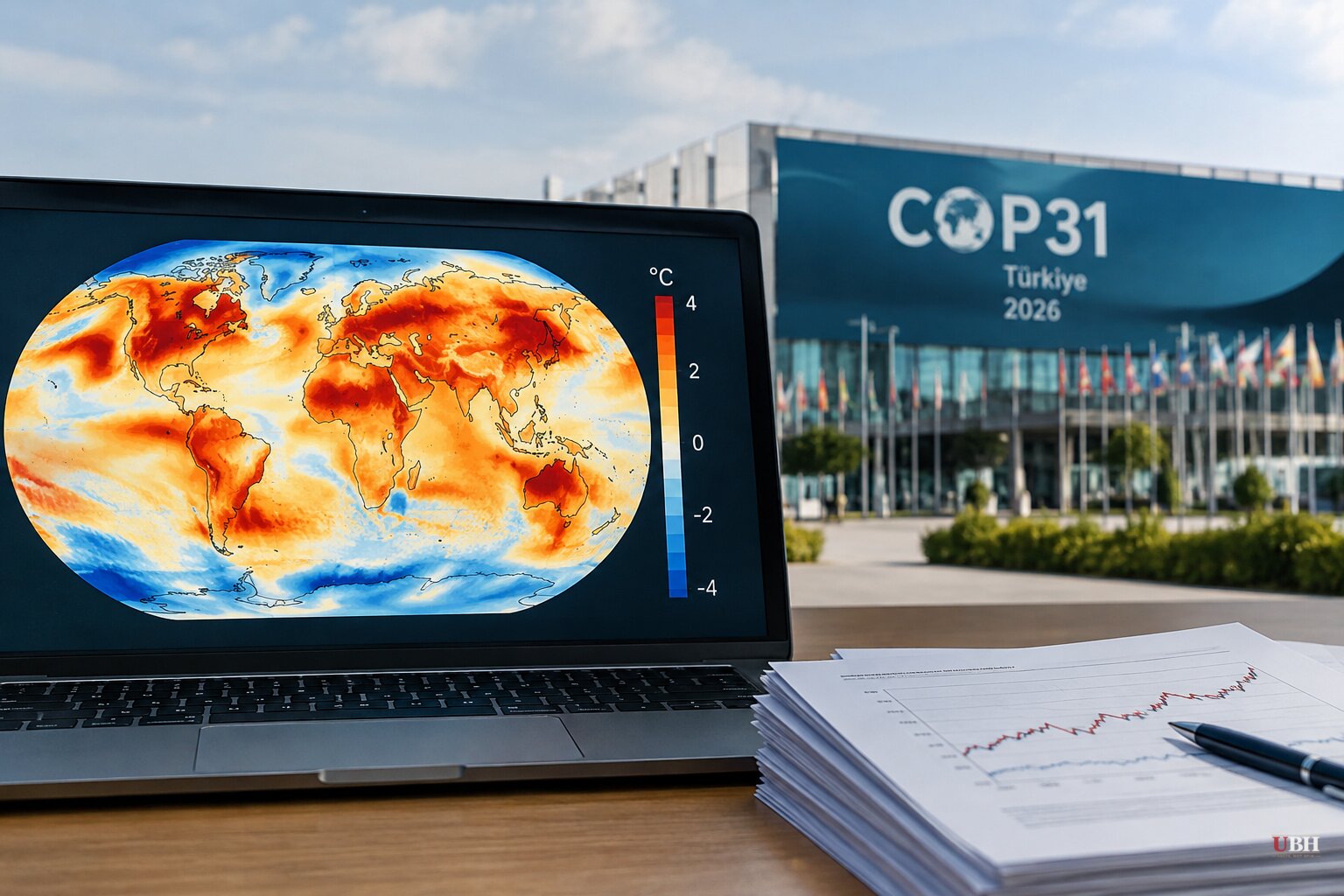
Earth recorded its largest daily temperature anomaly on Friday, Nov. 20, 2026. According to preliminary data from the EU's Copernicus Climate Change Service (C3S), the global average ran 2.12°C above the preindustrial average.
The previous record was 2.07°C, set on Nov. 17, 2023. Copernicus defines the preindustrial baseline as 1850 to 1900.
Both records came in November, and both came in years with a strong El Niño in place.
What the number measures
The global average surface air temperature on Nov. 20 was 14.44°C, according to Copernicus Climate Pulse. That is 1.22°C above the 1991–2020 average and the warmest Nov. 20 in the 87-year record.
The data come from ERA5, a Copernicus reanalysis that combines satellite, weather balloon, station and ocean observations with a weather model. The daily figures remain preliminary until Copernicus issues its monthly bulletin.
One day does not breach the Paris Agreement. The 2015 accord's goal of holding warming "well below" 2°C, and ideally 1.5°C, is judged on multi-year averages. By that measure, the United Nations says the world has warmed by nearly 1.4°C.
The El Niño behind the spike
An unusually powerful El Niño is adding heat on top of the long-term trend. NOAA's Climate Prediction Center said in its Nov. 12 discussion that El Niño continues to strengthen. It put the odds of a strong to very strong event through January–March 2027 above 79%.
NOAA put the chance of an event exceeding every El Niño since 1950 at about 60%. Its Niño 3.4 index, the standard gauge of strength, stood at +2.5°C, with sea surface anomalies in parts of the eastern equatorial Pacific topping 4.0°C.
Copernicus's own October data are more extreme. It put the Niño 3.4 region at 29.94°C, an anomaly of +3.21°C and the highest of any month on record. Those readings exceed the peaks of the 1982–83, 1997–98 and 2015–16 events.
The World Meteorological Organization expects the El Niño to peak in December 2026 and persist through at least February 2027. Some scientists say, based on tree-ring and coral evidence, that it could be the strongest in 1,000 years.
El Niño is a natural cycle. The sources agree it does not explain the baseline rise, which the climate scientists cited attribute to greenhouse gas emissions.
What comes next for temperatures
Zachary Labe, a scientist at the nonprofit Climate Central, said he expects more days above 2°C "over the next couple of months (possibly through March 2027)." He added that he still expects such days to be "more a rarity than the norm."
October 2026 was the warmest October in the ERA5 record at 1.75°C above preindustrial. It beat October 2023 by 0.05°C. August, September and October each topped 1.5°C.
The rolling 12-month average from November 2025 through October 2026 sits at 1.51°C. Copernicus's statistical model gives 2026 a better than 99% chance of finishing above 1.5°C for the calendar year. It puts the odds at roughly 80% that 2026 ends as the second-warmest year and about 20% that it ties or beats 2024.
Scientific American reported that heat from El Niño takes time to reach global temperatures. The magazine said 2027 will likely be the biggest heat year and "almost certainly" the hottest on record.
The talks and the skeptics
The COP31 summit in Antalya, Turkey, ended today, Sunday, Nov. 22, without an overarching agreement. The U.S. did not send an official delegation.
The UN has said global temperatures are expected to reach 1.8°C above preindustrial, overshooting the 1.5°C target.
Not everyone accepts the framing. Responding to Scientific American's post on the record, Tom Nelson, a commentator on X, asked what the "preindustrial average" temperature was, when it was measured, and how anyone knows it "to a precision of 1/100 of a degree C." Another user argued that more humans die of cold than heat and that plants prefer warmer conditions.
Copernicus has not responded to those posts in the material published so far. The agency's stated method is the ERA5 reanalysis measured against its 1850–1900 baseline. Its raw figure of 14.44°C and the 1991–2020 comparison do not depend on the preindustrial estimate.
What to watch
Copernicus will confirm or revise the Nov. 20 figure when its monthly bulletin is issued. El Niño is forecast to peak in December, so the next several weeks will show whether another day tops 2.12°C.
Sources used for this briefing
7 links from 5 independent newsrooms (syndicated copies of the same report count once)
These are the sources it draws on, linked so you can verify.


