
Unbiased headlines. Facts, not spin.
Unbiased Headlines is an independently owned news organization. We bring you the facts, not opinions, written fresh from 110+ named sources. Sources linked so you can verify it yourself.
 economy
Notable (6/10)
Event date: November 9, 2026 ·
Small-Business Bankruptcy Filings Keep Climbing: Subchapter V Up 46% Through September, 24% in October
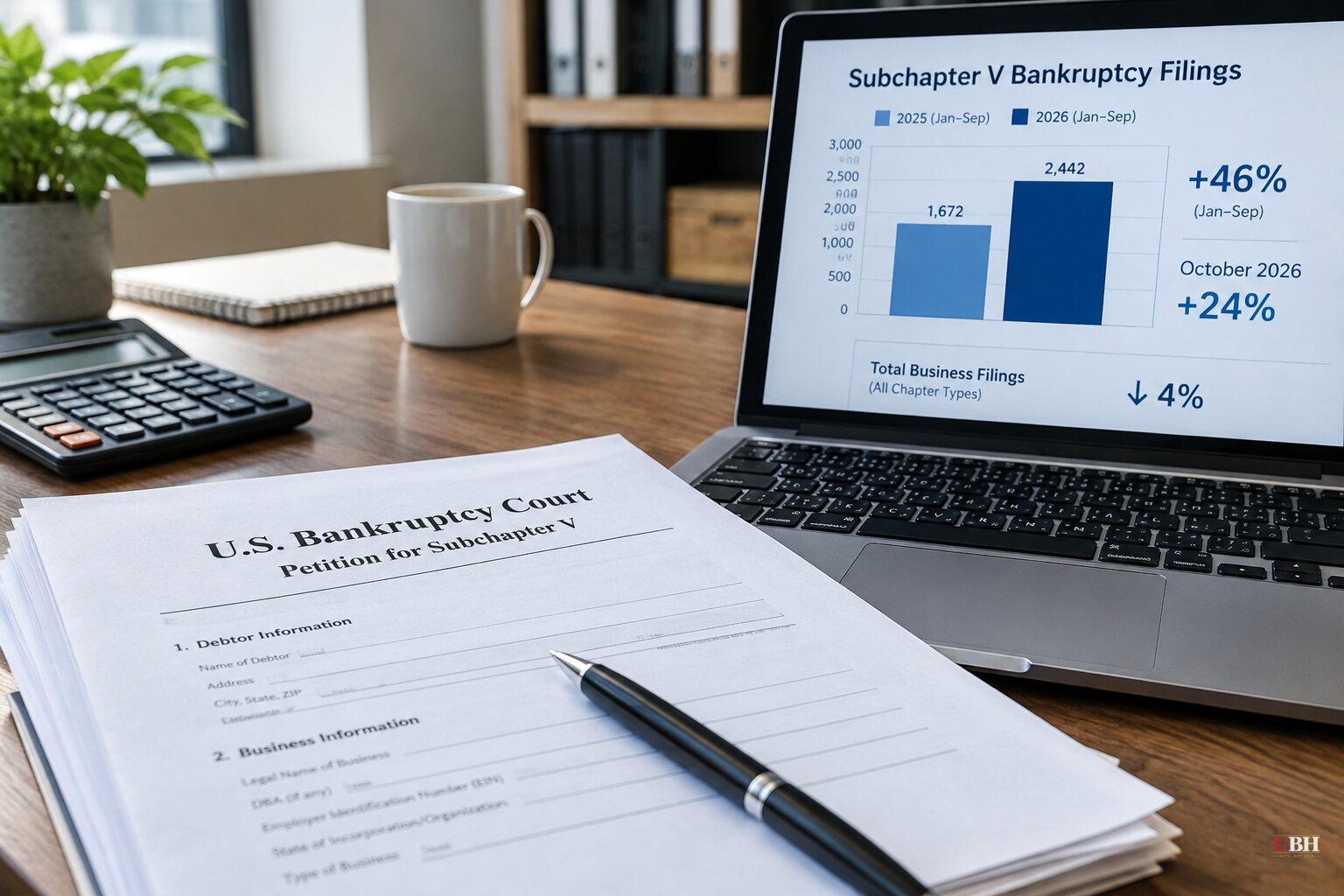
Small businesses are filing for bankruptcy protection at a faster clip than a year ago.
Small businesses chose Subchapter V, the streamlined Chapter 11 track Congress created in 2019, 2,442 times from January through September 2026. That compares with 1,672 in the same stretch of 2025, a 46% jump, according to data released Oct. 8 by Epiq AACER and the American Bankruptcy Institute (ABI).
What the monthly data show
September alone saw Subchapter V elections rise 38%, from 200 to 276. Commercial Chapter 11 filings fell 16% that month, from 769 to 648, and total commercial filings fell 7%.
Those declines come with an asterisk. The September 2025 comparison included 109 related filings tied to a single long-term care pharmacy services provider, which inflated the baseline. The year-to-date trend is the cleaner read, and it points up.
October followed the same split. ABI reported 54,028 total bankruptcy filings, a 2% increase from a year ago. Individual filings rose 2%. Business filings fell 4%. Subchapter V filings, the small-business slice, rose 24%.
Big corporate cases are not driving this. Subchapter V is open only to debtors engaged in business whose debts fall under a statutory cap, so large companies don't distort the count.
The pressures on owners
Inflation was 3.7% in September, the seventh straight month above 3%, according to Bureau of Labor Statistics data.
ABI Executive Director Amy Quackenboss said "elevated costs, tight credit conditions, and geopolitical risks continue to provide challenging economic headwinds for small businesses and families."
Michael Hunter, vice president of Epiq AACER, cited rising borrowing costs, higher household expenses, growing consumer delinquencies and a softer job market. He said he expects filings to keep rising into 2027. "While the broader economy continues to grow, household budgets remain strained by high energy prices and elevated interest rate borrowing costs," Hunter said.
The White House points to a different part of the ledger. Spokesman Matthew Middleton said the latest jobs report, which showed 165,000 added jobs, "is proof that President Trump's pro-growth economic agenda is working." The administration says the economy has added 861,000 jobs through October, versus 116,000 in all of 2025.
Both things can be true at once. Hiring can be strong while the smallest firms, with the least access to cheap credit, run out of room.
The debt-limit bill
The Bankruptcy Threshold Adjustment Act, H.R. 7730, would raise the Subchapter V debt ceiling. A Credible Law analysis says it would roughly double the limit, and another account puts the restored figure at $7.5 million. It passed both chambers without opposition and went to Trump on Nov. 5.
Quackenboss said the measure will help more small businesses and households deal with elevated costs and geopolitical risks.
The nine-month surge predates the bill, so a higher ceiling cannot explain it. What the bill does change is who qualifies from here forward. Larger small businesses that would have been shut out of the cheaper, faster track could get in.
Merchant cash advances
The stress shows up in how owners borrow, too. Merchant cash advances, which provide cash up front in exchange for a share of future receipts collected through daily remittances, are what NPR describes as the fastest-growing source of small-business funding in the country. The industry is largely unregulated.
NPR profiled Vahe Shahinian, a Glendale, California, ticketing and concert promoter. In 2019 a broker offered him a $750,000 line of credit, he says. The terms: take a third of the sum immediately and start repaying in daily installments of $3,600, with the rest available after 30 days.
Shahinian says he paid for 30 days, then 40, then 50. The line of credit never came, he says. He alleges fraud and has spent seven years in litigation. His suit could be among the first of its kind to go to trial, per NPR. His allegations are unproven, and the account above is his.
Credible Law notes that daily remittance obligations bear directly on how long a business can stay afloat when inflation and borrowing costs are elevated. A Small Business Administration rule is also in play, though the available details do not specify what it changes.
The open question is the Subchapter V ceiling. The bill reached Trump's desk on Nov. 5, and a signature would widen eligibility just as Epiq AACER's Hunter expects filings to keep climbing into 2027.
Sources used for this briefing
4 links from 4 independent newsrooms (syndicated copies of the same report count once)
These are the sources it draws on, linked so you can verify.


