
Unbiased headlines. Facts, not spin.
Unbiased Headlines is an independently owned news organization. We bring you the facts, not opinions, written fresh from 110+ named sources. Sources linked so you can verify it yourself.
 economy
Major Story (7/10)
Event date: November 20, 2026 ·
China's Gold Imports Hit Record $209 Billion, Narrowing a Trade Surplus That Still Tops $1 Trillion
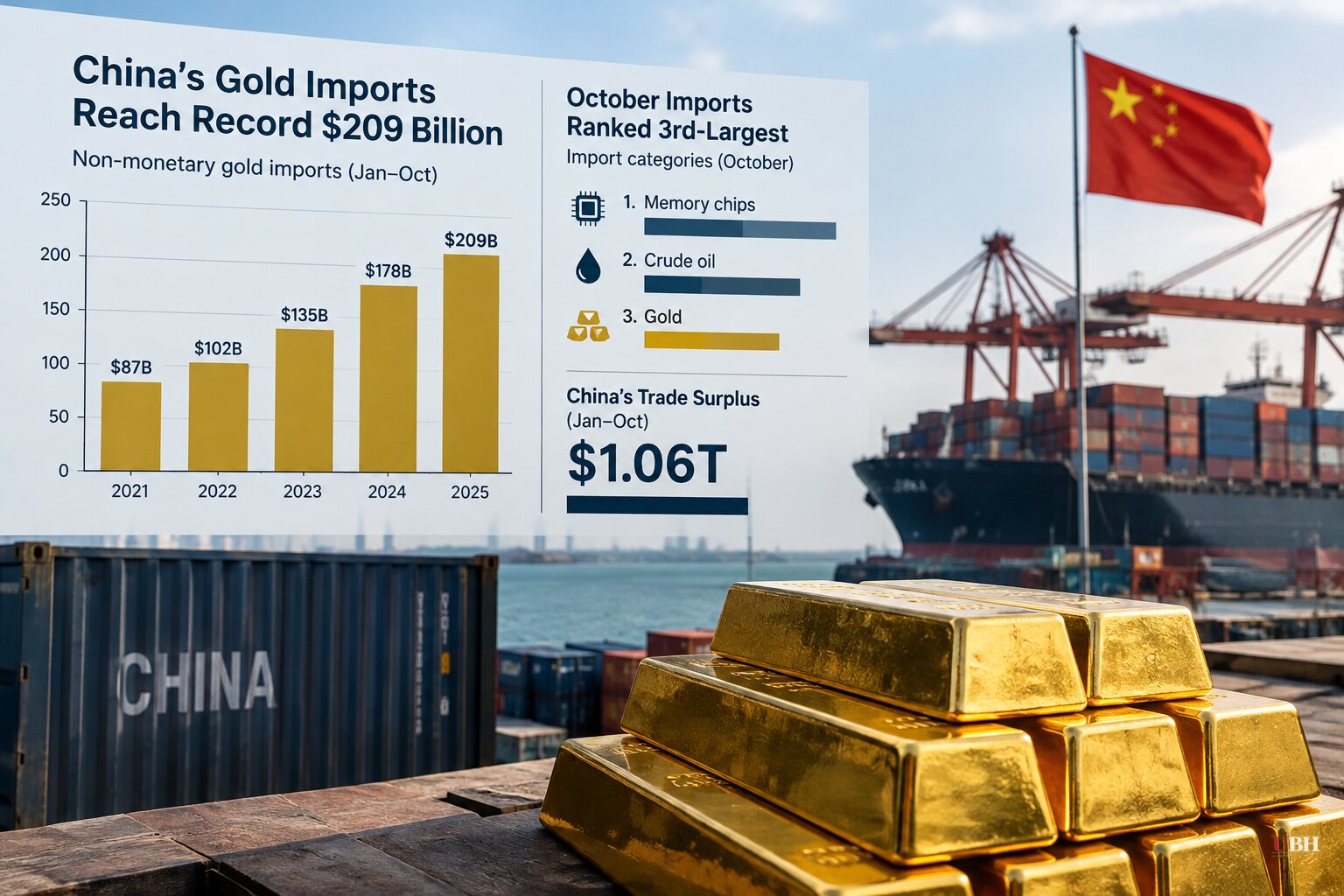
Since customs data on Nov. 10 showed China's trade surplus passing $1 trillion for a second straight year, a second set of figures, released Friday, Nov. 20, has added a missing piece: gold. China's imports of non-monetary bullion reached a record $209 billion in the first 10 months of 2026, Bloomberg's tally of the data shows, equal to nearly 8% of all imports over that stretch.
The October numbers
Chinese customs data show unwrought non-monetary gold imports of 155.85 tonnes in October, up 174.1% from a year earlier. Their value rose 183.5% to $20.73 billion.
That made gold the country's third-largest import by value for the month, behind only memory chips and crude oil.
A second customs line, semi-manufactured gold such as sheets, strips and wire, rose 151.7% in volume to 9.04 tonnes and 165.1% in value to $1.17 billion. Together the two categories were 7.13% of October's import bill, versus about 3.6% a year earlier.
Their combined $14.15 billion increase accounted for roughly 15.7% of the year-over-year rise in total imports. Switzerland was the top supplier, followed by Hong Kong and Australia.
What it does to the surplus
The overall surplus was $1.04 trillion for January through October. October's monthly surplus fell to $105.3 billion from $133.5 billion in September as imports rose 41.6% against exports up 35.2%.
Bloomberg's calculations show that without gold, the surplus would have crossed $1 trillion in September instead of a month later.
Brad Setser, a former U.S. Treasury official now at the Council on Foreign Relations, put the annual figure at about $1.5 trillion without gold accumulation, against roughly $1.3 trillion at the current pace.
Either way, 2026 is on track to beat last year's record $1.2 trillion surplus. Imports are up 29% over the 10 months.
Timing and the Davos pledge
Bloomberg notes that the surge began in January, when gold import volume and value more than doubled from December. That is the same month Vice Premier He Lifeng told a Davos crowd that China would become the world's marketplace, not just its factory.
No source says Beijing directed the gold purchases. The central bank issues import quotas to certain banks and has not disclosed the numbers. The People's Bank of China and the General Administration of Customs did not immediately respond to requests for comment.
Who is buying
The popular explanation is households fleeing a property slump. Chinese gold ETFs took in 6.3 tonnes in October, their fourth straight monthly inflow, lifting holdings to a record 310 tonnes. The World Gold Council cited weak equities, low government bond yields and the central bank's steady purchase announcements as drivers.
The customs data does not prove that story. As International Business Times pointed out, unwrought gold imports cover jewelry makers, investment demand and other commercial uses, not just retail buyers. Customs figures also exclude monetary gold held as official reserves.
The People's Bank of China added 25.82 tonnes in October, its largest monthly purchase in three years and a 24th straight month of additions. That took reserves to 2,435 tonnes. Those purchases do not show up in the goods trade balance.
The jewelry side is weak. World Gold Council data show jewelry is now under one-third of Chinese gold demand, and first-half jewelry consumption was the weakest in 20 years. Wholesale demand in October was 24% lower than a year earlier, the council said, mainly because of the jewelry slump.
Price, not just volume
The buying came as prices slid. The LBMA gold price fell 6.3% in dollar terms in October, leaving gold down 7.1% for the year in dollars and 9.4% in yuan. The council attributed the yuan figure partly to the currency's sharp rise against the dollar.
The council said a rotation out of equities and gold futures into bonds could be behind October's weakness. It said Chinese gold ETF flows turned modestly negative in early November as stock-market stabilization measures drew investors away.
The trade-friction backdrop
On the export side, analysts have warned about the dependence on foreign buyers. Joe Peissel, lead macroeconomist at Trivium China, said the risk of additional tariffs and trade barriers "will remain elevated in 2027." Alicia García-Herrero, chief economist for Asia Pacific at Natixis, said overcapacity, excess savings and weak domestic demand are forcing China to ship goods abroad, and that the situation is not sustainable.
European Union leaders have called for more trade curbs after agreeing with Beijing to limit Chinese hybrid vehicle exports to the bloc. Beijing and Washington formally extended their trade truce by two months, just before it was due to expire. China said any expansion of U.S. farm purchases depends on implementation of agreed reciprocal tariff cuts.
The surplus is falling short of its own record pace only because China is paying for gold, not because it is buying more of what American and European exporters sell. Whether Beijing counts a bullion stockpile as rebalancing is a question the PBOC and customs authorities have not yet answered. The truce extension runs two months, so the next test of U.S.-China trade terms arrives with the surplus still above $1 trillion.
Sources used for this briefing
7 links from 7 independent newsrooms (syndicated copies of the same report count once)
These are the sources it draws on, linked so you can verify.


