
Unbiased headlines. Facts, not spin.
Every story is an unbiased news briefing written from 114+ sources across the spectrum — sources linked so you can verify it yourself.
 economy
Major Story (7/10)
Event date: October 5, 2026
economy
Major Story (7/10)
Event date: October 5, 2026
Newsom Signs Law Requiring Pre-1965 Companies to Disclose Slavery-Era Financial Ties
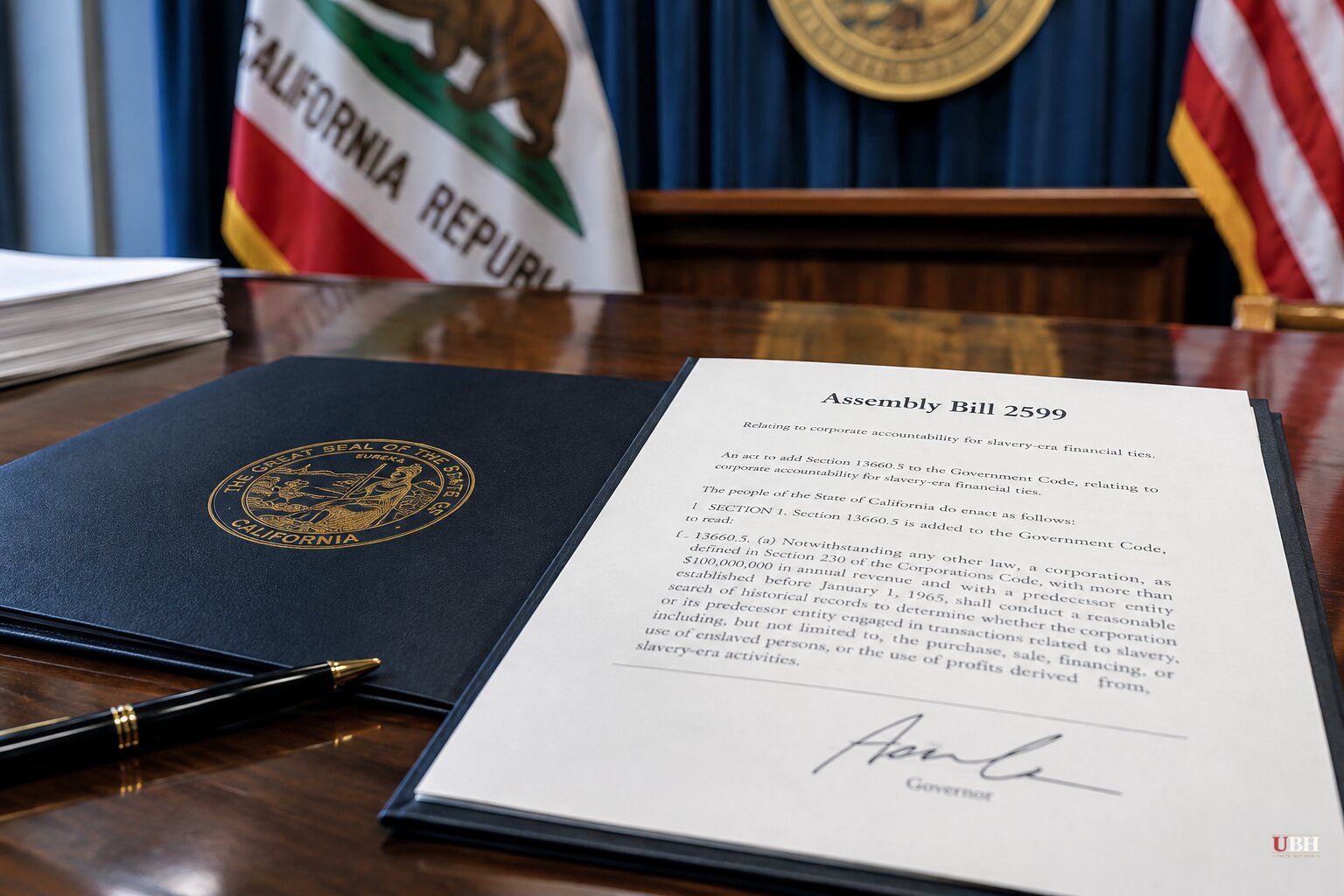
California just became the first state to force major corporations to dig through their own history books and confess, under oath, whether they profited from slavery.
Gov. Gavin Newsom signed Assembly Bill 2599, the Truth in Disclosure Act, on Wednesday, Sept. 30, according to CalMatters and multiple other outlets. The bill, authored by Democratic Assemblymember Isaac Bryan of Culver City, cleared the Legislature on a party-line vote, with 60 Democrats in support, according to the Daily Wire.
Who Has to Comply
The law applies to companies doing business in California with more than $100 million in annual worldwide gross receipts that existed, or had a predecessor entity that existed, on or before Dec. 31, 1964. Once the Legislature appropriates funding, covered companies must search their own records and those of related entities for evidence of transactions tied to chattel slavery going back to 1849, including buying or selling enslaved people, using them as loan collateral, insuring them, or financing those deals, according to the Alaska Story and CalMatters.
Companies then file a sworn affidavit, under penalty of perjury, detailing what they found. The findings go into a searchable public database built by California's Civil Rights Department. First affidavits are due Jan. 15, 2029, or later if the state hasn't built the platform yet, per Fox News Digital's reporting.
Newsom explained the mechanics during an Oct. 1 podcast interview with civil rights attorney Bryan Stevenson. "This is a bill that requires large companies that operated before 1965 to search their records for ties to slavery going back to 1849 and then we make it public," Newsom said. "These are insurance policies on enslaved people. Human beings used as collateral, quite literally as collateral for loans. Accountability, as Bryan said, starts with the truth."
Bryan told lawmakers in June the goal was exposing wealth built on unpaid labor. "For centuries, private corporations across the country benefited from chattel slavery," he said during a Senate Standing Committee hearing, according to Fox News Digital. "They benefited from the economic wealth transfer of free labor."
A Real Precedent, Not Hypothetical
CalMatters points to JP Morgan Chase as an example of the kind of disclosure the law could surface. In 2005, the bank issued a formal apology after acknowledging that two banks it had absorbed took approximately 13,000 enslaved people as loan collateral in Louisiana and seized ownership of about 1,250 of them when enslavers defaulted, according to the California Reparations Task Force report.
Supporters including the Alliance for Reparations, Reconciliation and Truth, backed by roughly 44 organizations such as the California Black Power Network and Equal Justice Society, say the database will let researchers and the public trace how slavery-era wealth connects to companies still operating today. ARRT called it a step toward "private repair," distinct from government reparations.
The Opposition's Case
Several insurance companies fought the bill, arguing they already disclosed slavery-related ties under a narrower 2000 California law that produced a public report, according to CalMatters. Their objection is straightforward: they've already done this, and a second mandate is redundant compliance cost for businesses that have to dig through century-old archives and predecessor-company histories just to prove a negative.
There's also a genuine legal question raised by the Alaska Story: whether compelling companies to produce and publish specific government-dictated statements runs into the Supreme Court's 2018 ruling in National Institute of Family and Life Advocates v. Becerra, which struck down a California law forcing crisis pregnancy centers to post certain disclosures. Whether AB 2599 survives a similar challenge hasn't been tested in court, and no lawsuit has been filed as of this writing.
Critics also worry this is a stepping stone. The Daily Wire noted California's 2023 reparations task force report recommended over 100 policy changes, and CalMatters reported economists estimated the state owes Black residents at least $800 billion for harms in policing, housing and health. Separately, the free-market Pacific Research Institute has estimated a full reparations program could cost $2.8 trillion and shrink the state's economy by 11% while requiring substantial tax hikes, a projection built on the task force's broader proposals, not on AB 2599 itself. The disclosure law creates no payment mechanism and mandates no checks to anyone.
Newsom has stopped short of endorsing direct cash payments. "Dealing with that legacy is about much more than cash payments," he told Fox News Digital in 2023.
What Happens Next
Implementation depends entirely on the Legislature appropriating money to build the Civil Rights Department's public database, something that hasn't happened yet. Until it does, there's no functioning platform and no enforceable filing deadline beyond the Jan. 15, 2029 backstop. Whether any company challenges the law on compelled-speech grounds, and whether lawmakers follow this disclosure mandate with an actual reparations payment bill, remain open questions.
Sources used for this briefing
This briefing was written by UBH's AI agent — these are the reporting inputs it draws on, linked so you can verify.


