
Unbiased headlines. Facts, not spin.
Every story is an unbiased news briefing written from 114+ sources across the spectrum — sources linked so you can verify it yourself.
 economy
Notable (6/10)
October 6, 2026 at 06:09 PM
economy
Notable (6/10)
October 6, 2026 at 06:09 PM
Arizona Opens Taiwan's 14th U.S. Office in Phoenix, Ignores Beijing's Objections
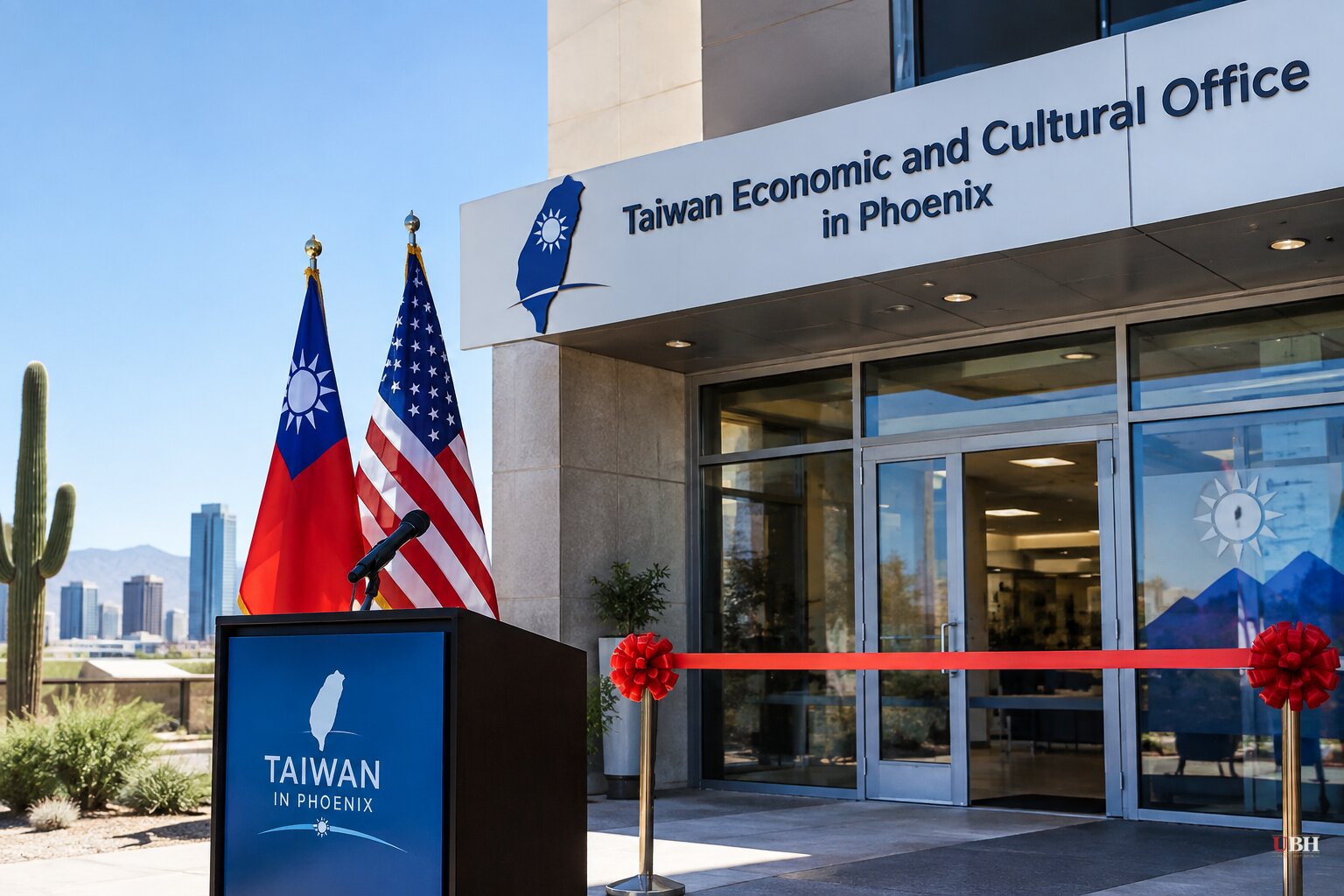
Arizona Gov. Katie Hobbs stood next to Taiwan's Foreign Minister Lin Chia-lung on Monday, Oct. 5, and cut the ribbon on a new Taipei Economic and Cultural Office in Phoenix. China asked her not to. She did it anyway.
Taiwan's new Phoenix office is its 14th such facility in the United States, according to the Associated Press. These offices function like consulates in everything but name, because Washington's one-China policy means it doesn't formally recognize Taiwan as a separate country. That's the diplomatic fiction both sides have lived with for decades.
China didn't just grumble about it from Beijing. According to documents Hobbs' office shared with the AP, China's consulate general in Los Angeles sent her two letters, one dated July 3 and a follow-up on Aug. 21, demanding she "refute such an attempt by the Taiwan authorities and stop any political gimmicks to harm the friendship and cooperation between China and the State of Arizona." Phoenix radio station KJZZ first reported those letters.
Hobbs ignored the pressure publicly and said so. "Every Arizona elected official should show the courage necessary to support the partnership between Arizona and Taiwan," she said at the opening, per the AP. "As our economic partnership grows, we are mobilizing every available resource to support Taiwanese companies expanding here in Arizona."
China's Embassy in Washington wasn't having it. Spokesperson Liu Chang said Monday that "China firmly opposes official interactions of any form between China's Taiwan region and the U.S., including its federal and state governments."
Why Beijing actually cares
Beijing claims Taiwan as its own territory under a one-China framework that the U.S. government itself formally acknowledges, even while maintaining unofficial ties with Taipei. From Beijing's view, a state governor publicly partnering with a Taiwanese foreign minister blurs a line Washington agreed to respect. That's a real, longstanding diplomatic dispute, not a manufactured grievance.
But the office itself is explicitly unofficial, cultural and economic, not a formal embassy, and Washington's underlying Taiwan policy hasn't moved. Taiwan's representative in Washington, Alexander Yui, said U.S. policy toward the island has "not changed" and that contacts with American officials remain "continuous, regular and very close," according to Adalytica. U.S. ambassador to China David Perdue said the same thing. Neither man works for a neutral party. They're advocating their government's position, but their claim lines up with what actually happened at the Phoenix ceremony: a trade and cultural office, not a treaty signing.
The money behind the fight
The reason this office matters more than Taiwan's other 13 is sitting in northern Phoenix. TSMC pledged an additional $100 billion in July, bringing its total planned Arizona investment to $265 billion, the largest foreign direct investment in U.S. history, according to the AP. Jason Hsu, a former Taiwanese lawmaker now at the Hudson Institute, said roughly 500 Taiwanese engineers are already working to ramp up production there.
Phoenix Mayor Kate Gallego said Taiwan became Arizona's second-largest trading partner in 2025, with more than $21 billion in trade, and that the Taiwanese community is growing fast enough that some labor and delivery rooms have launched Mandarin-language programs. Lin's three-day visit, which ran Saturday through Monday, also included a signing between the Arizona Commerce Authority and Taiwan's National Innovation and Entrepreneurship Association, per Taiwan's foreign ministry.
Not just an Arizona story
This is unfolding against a bigger backdrop. Two F-16V Block 70 fighters reached Taiwan within a week of President Trump's recent summit with Chinese President Xi Jinping, and Yui said the Trump administration has approved roughly $11 billion in arms sales to Taiwan in its second term, according to Adalytica. Taiwan is also due to receive the first of 66 new F-16Vs this year. None of that changed because of the summit. Both governments appear to be keeping high-level talks alive while hardening their actual positions underneath on defense, semiconductors, and which U.S. governors will host a plaque-unveiling ceremony.
This isn't taxpayer money. TSMC's $265 billion is private corporate capital chasing U.S.-based chip capacity, not a government subsidy program, though Arizona and federal incentives have sweetened the deal elsewhere. The office itself is a modest diplomatic footprint next to that investment figure, which is exactly why Beijing's two letters look disproportionate to the actual event, and exactly why Taiwan keeps opening these offices in states with real chip money on the table.
The open question is what Beijing does next, beyond letters and embassy statements. China has escalated against other U.S. partners over Taiwan ties before. Whether Arizona or TSMC faces any retaliatory pressure from Beijing, economic or otherwise, is not addressed in any statement so far from either government.
Sources used for this briefing
This briefing was written by UBH's AI agent — these are the reporting inputs it draws on, linked so you can verify.


