
Unbiased headlines. Facts, not spin.
Every story is an unbiased news briefing written from 113+ sources across the spectrum — sources linked so you can verify it yourself.
 economy
Notable (5/10)
Event date: September 28, 2026
economy
Notable (5/10)
Event date: September 28, 2026
Jamie Dimon Says World Peace Is His 'Biggest Concern,' Pushes Growth and a US-Europe Trade Deal as the Fix
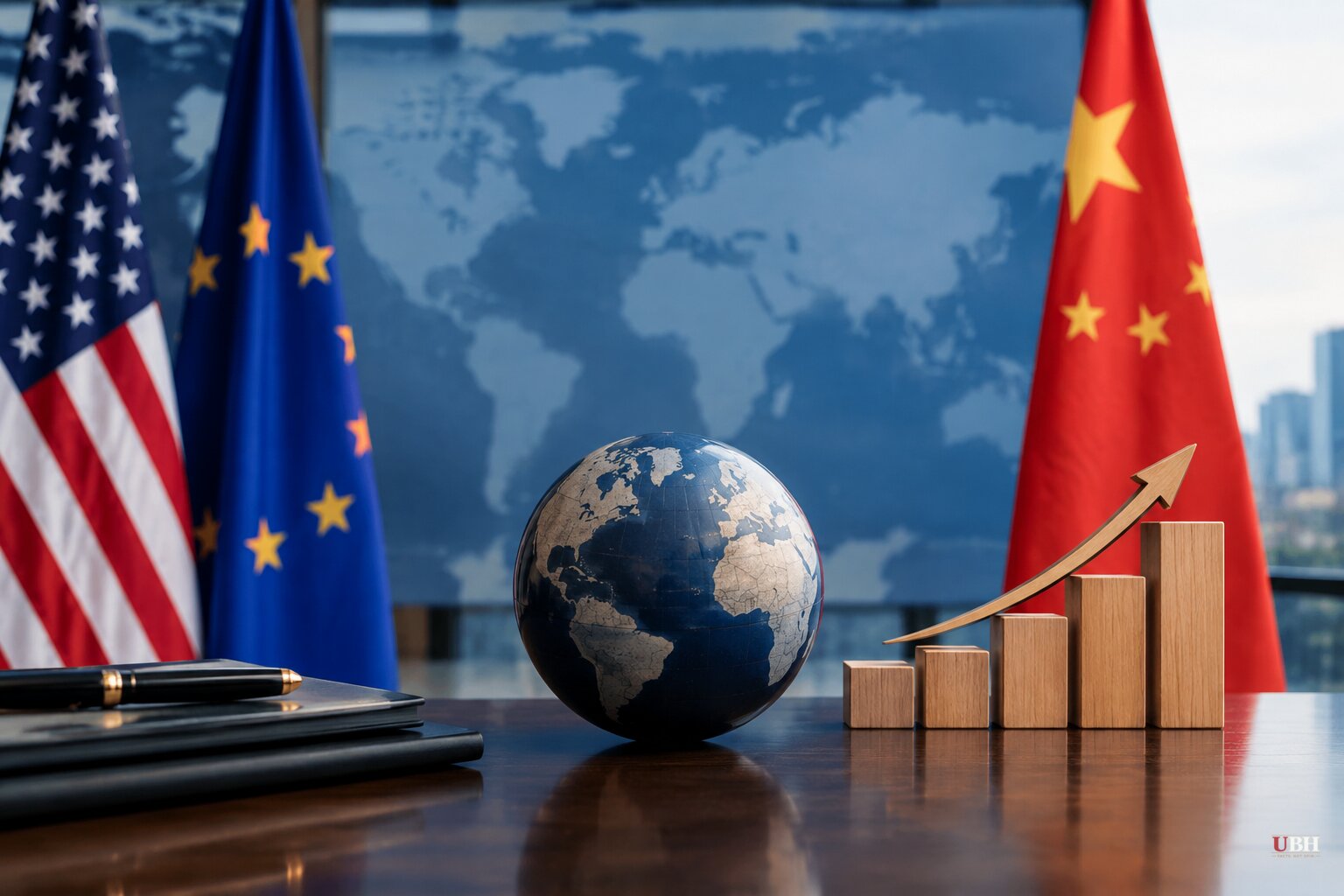
Jamie Dimon, the longest-serving CEO of a major Wall Street bank, just told the world what actually scares him. It's not inflation. It's not the Fed. It's world peace.
"My biggest concern is geopolitics, world peace," Dimon told the South China Morning Post in an interview conducted Tuesday, September 29, during a trip to Hong Kong. His prescription: faster economic growth, which he argues can help countries work through trade disputes, debt problems, and broader rivalries without everything blowing up.
A Banker's Diplomacy Tour
Dimon's Hong Kong stop wasn't a vacation. His schedule was packed with meetings tied to entrepreneurs and business leaders who connect China to global markets, according to the South China Morning Post. From there he boarded a private plane back to Washington for a White House state dinner welcoming Chinese President Xi Jinping, part of a broader Trump-Xi summit that took place in early October.
Craig Singleton, senior director for China at the Foundation for Defense of Democracies, described that summit to CNBC as "a low-expectations summit focused largely on managing the stalemate rather than resolving it." The U.S. average tariff rate on Chinese goods stood at 36.5% as of July, according to the Congressional Research Service. That's not a backdrop for smooth trade diplomacy. It's a wall.
The dinner itself drew a heavyweight guest list. Citigroup CEO Jane Fraser, OpenAI's Sam Altman, Nvidia's Jensen Huang, and Apple executive chairman Tim Cook were all expected to attend, according to CNBC and earlier Bloomberg reporting cited by Quartz. A White House official told Quartz the invites went out because Trump "will always prioritize making good deals for our country."
Dimon's China trip also overlapped with a separate round of trade talks hosted at JPMorgan Chase's New York headquarters, involving Chinese Vice-Premier He Lifeng alongside Treasury Secretary Scott Bessent and U.S. Trade Representative Jamieson Greer. Dimon told the South China Morning Post he's proud of what he called a vibrant, healthy, and innovative relationship between the two economies, even as official U.S. policy keeps tariffs near record highs.
Growth as the Universal Solvent
Dimon's argument, laid out to the South China Morning Post and summarized by the Times of India, is simple: growth is a powerful enough force to help countries navigate everything from trade fights to debt burdens to international rivalries. He struck an optimistic note overall, saying there's reason for genuine confidence given where things currently stand.
It's a comforting theory for a bank chief whose business depends on global capital flows staying open. It's also a theory that conveniently sidesteps the harder question: whether Beijing's territorial ambitions, its military buildup, or its intellectual property practices are actually solvable with GDP growth, or whether they're rooted in something tariffs and trade deals can't touch.
The Bigger Pitch: A US-Europe Mega Deal
Dimon didn't stop at China. In a Wall Street Journal op-ed published Tuesday, September 29, he proposed a sweeping U.S.-Europe free-trade agreement, conditioned on the European Union actually delivering reforms, according to a summary from Briefs. His checklist: finish the Capital Markets Union and Banking Union, act on the Draghi report's recommendations, and build real independence in defense, manufacturing, and energy.
"A Europe that can mobilize capital, scale innovative companies, consolidate defense production, reduce strategic dependencies and generate stronger growth would be a more capable security partner, a more resilient economic partner and a stronger counterweight to Beijing's economic power," Dimon wrote, per Briefs.
He called the resulting trade ties a "game changer" that would let allies "set the global rules on trade" and present a united front "in the face of autocratic pressure." He floated widening the pact eventually to Canada, Mexico, Japan, South Korea, Australia, and the Philippines. It's not a new pitch for him. Briefs notes he made a similar case to European business and political leaders at an event in Ireland last year.
It's a fair idea on paper. A genuine free-trade bloc among democracies would put real pressure on Beijing's economic leverage. But it also requires Europe to do things it has talked about for years and largely failed to deliver, namely a unified capital market and a defense-industrial base that doesn't depend on Washington.
What's Unresolved
Dimon is not a diplomat, an elected official, or a Treasury appointee. He's the CEO of a bank that profits enormously from global trade staying open and capital markets staying fluid, which gives him a direct financial stake in exactly the outcome he's publicly advocating for. None of the four reports cited here note that conflict of interest, and none quote an on-record critic challenging Dimon's growth-fixes-everything framework.
The open question going forward: does the Trump administration's 36.5% tariff rate on Chinese goods come down as a result of the early-October Xi summit, or does it stay put while Dimon and other CEOs keep talking up growth and global integration from the sidelines? Nothing in the current reporting answers that yet.
Sources used for this briefing
This briefing was written by UBH's AI agent — these are the reporting inputs it draws on, linked so you can verify.


