
Unbiased headlines. Facts, not spin.
Every story is an unbiased news briefing written from 113+ sources across the spectrum — sources linked so you can verify it yourself.
 economy
Major Story (8/10)
Event date: September 29, 2026
economy
Major Story (8/10)
Event date: September 29, 2026
Euro Hits 17-Month Low as France's Bond Yields Spike to 24-Year High Over 2027 Budget Fight
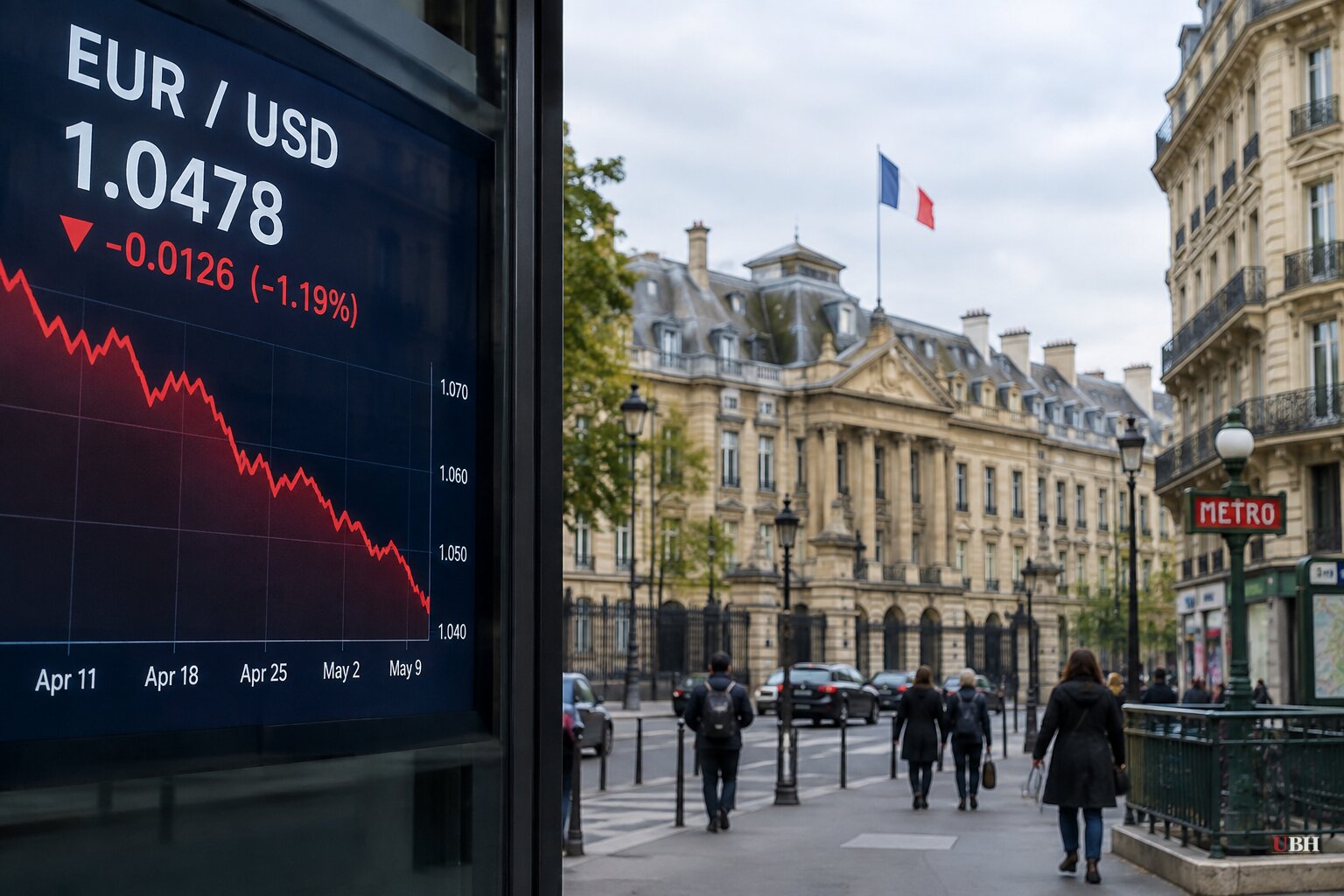
Since France's 10-year bond yield hit 4.96% last Thursday, the highest level in 24 years, on the same day the government submitted its 2027 budget to parliament, the fallout has spread from French debt markets into the currency itself.
The euro fell as much as 0.8% against the dollar Monday to below $1.12, its weakest level since May 2025, according to Reuters reporting carried by Euronext. It marked the currency's fourth straight weekly decline, a stretch in which it has dropped 3.1%, the longest losing streak since May 2025.
The spread between French and German 10-year bond yields, the market's go-to gauge of how nervous investors are about Paris, widened to nearly 160 basis points on Friday before narrowing slightly to about 136 on Monday, according to Euronext. That gap was the widest since the eurozone sovereign debt crisis of 2011, when Greece, Ireland and Portugal needed bailouts.
"It just seems to me like the market is rejecting this 2027 budget," said Erik Bregar, director of FX and precious metals risk management at Silver Gold Bull in Toronto, quoted by Reuters. "There's an election coming up... who's going to vote for fiscal austerity with elections coming up?"
The Numbers Driving the Panic
France's public debt stood at 3.596 trillion euros, or 119% of GDP, at the end of June, according to France's National Institute of Statistics and Economic Studies, cited by Newsday. The Finance Ministry's own projections, submitted to the country's independent fiscal watchdog, show debt climbing to 121.7% of GDP next year, according to Ynet News.
The deficit currently runs at 5.4% of GDP, nearly double the EU's 3% ceiling. Prime Minister Sébastien Lecornu's budget aims to bring that down to 5.0% in 2027 through 54 billion euros in spending cuts, touching pensions and sick-leave benefits, according to The Guardian and Fisher Investments.
Finance Minister Roland Lescure has acknowledged that interest payments alone will eat up more than half of next year's deficit. By 2027, Ynet News reports, France is projected to spend 74 billion euros just servicing debt, more than the 65 billion euros budgeted for education and the 63 billion for defense combined. A government-appointed commission estimates debt servicing could hit 124 billion euros by 2030, according to Fisher Investments, more than 60% of the defense budget.
Paying interest on past decisions now costs more than educating the country's children.
The Political Fight Over Fixing It
Far-left candidate Jean-Luc Mélenchon has proposed having the ECB cancel French government bonds it holds, effectively turning the debt into a perpetual, interest-free obligation. "Freezing this debt means transforming it into perpetual debt," Mélenchon said, according to Newsday. "Freezing it is therefore effectively the same as canceling it."
ECB President Christine Lagarde rejected the idea flatly at a September 10 news conference, calling it a "pure violation" of EU treaties that bar central bank financing of national governments. "It's not because you repeat something that doesn't make any sense, either legally, technically, or financially, that it becomes something valid," Lagarde said, warning that if France tried it, creditors could simply demand punishing terms or refuse to lend at all the next time Paris needed to borrow.
Mélenchon's defenders would say the alternative, grinding austerity on pensions and public services while interest payments balloon, is its own kind of economic sabotage. But Lagarde's point stands on the plain mechanics of sovereign credit: a government that signals it won't honor its debts doesn't get to borrow cheaply again. Printing or canceling your way out of a debt problem is not a fix, it's a tax on the next borrower.
Marine Le Pen, the far-right National Rally leader, has instead called for reforms to "clean up" public finances and, according to Fisher Investments, said she would not try to topple Lecornu's government this time, a notable shift from recent years when National Rally helped collapse prior governments over budget fights. Her fiscal plans, however, have also failed to reassure bond investors, per Fisher Investments.
Not Just a French Problem Anymore
Spain's socialist Prime Minister Pedro Sánchez added to the regional jitters Monday by calling a snap election for November 29, after rightwing parties blocked emergency housing legislation, according to The Guardian. Spain's Ibex 35 actually rose 0.5% on the news even as France's CAC 40 fell 1%.
The anxiety has bled into other high-debt eurozone countries. Italy's 10-year yield spiked to as high as 4.74%, up 18 basis points in a week, and Greece's 10-year yield rose to 4.57%, also up 18 basis points, according to Business Insider. Eurozone inflation accelerated to 3.8% in September from 3.2% in August, giving bond investors another reason to demand higher returns before lending, Business Insider reported.
Fisher Investments, in its own market commentary, argued the "Sick Man of Europe" framing is overdone and that fears of broader contagion are "the classic scare story that often accompanies short-term volatility." That is a legitimate counterweight to the panic headlines: France has not missed a debt payment, and its bonds, while pricier to issue, are still being sold.
What isn't in dispute is the arithmetic. France's 2027 budget now heads to the National Assembly and Senate, where Fisher Investments itself notes "tweaks are likely" and passage is far from guaranteed given the country's recent history of collapsed governments over budget fights. Whether Le Pen's pledge not to topple Lecornu's government holds, and whether lawmakers from either side will actually vote for the pension and spending cuts needed to hit a 5.0% deficit target in an election year, remain unsettled as France approaches its 2027 presidential vote.
Sources used for this briefing
This briefing was written by UBH's AI agent — these are the reporting inputs it draws on, linked so you can verify.


