
Unbiased headlines. Facts, not spin.
Every story is an unbiased news briefing written from 113+ sources across the spectrum — sources linked so you can verify it yourself.
 economy
Notable (6/10)
Event date: October 2, 2026
economy
Notable (6/10)
Event date: October 2, 2026
School Bus Diesel Costs Spike to Record Highs as Districts Cut Routes and Drain Reserves
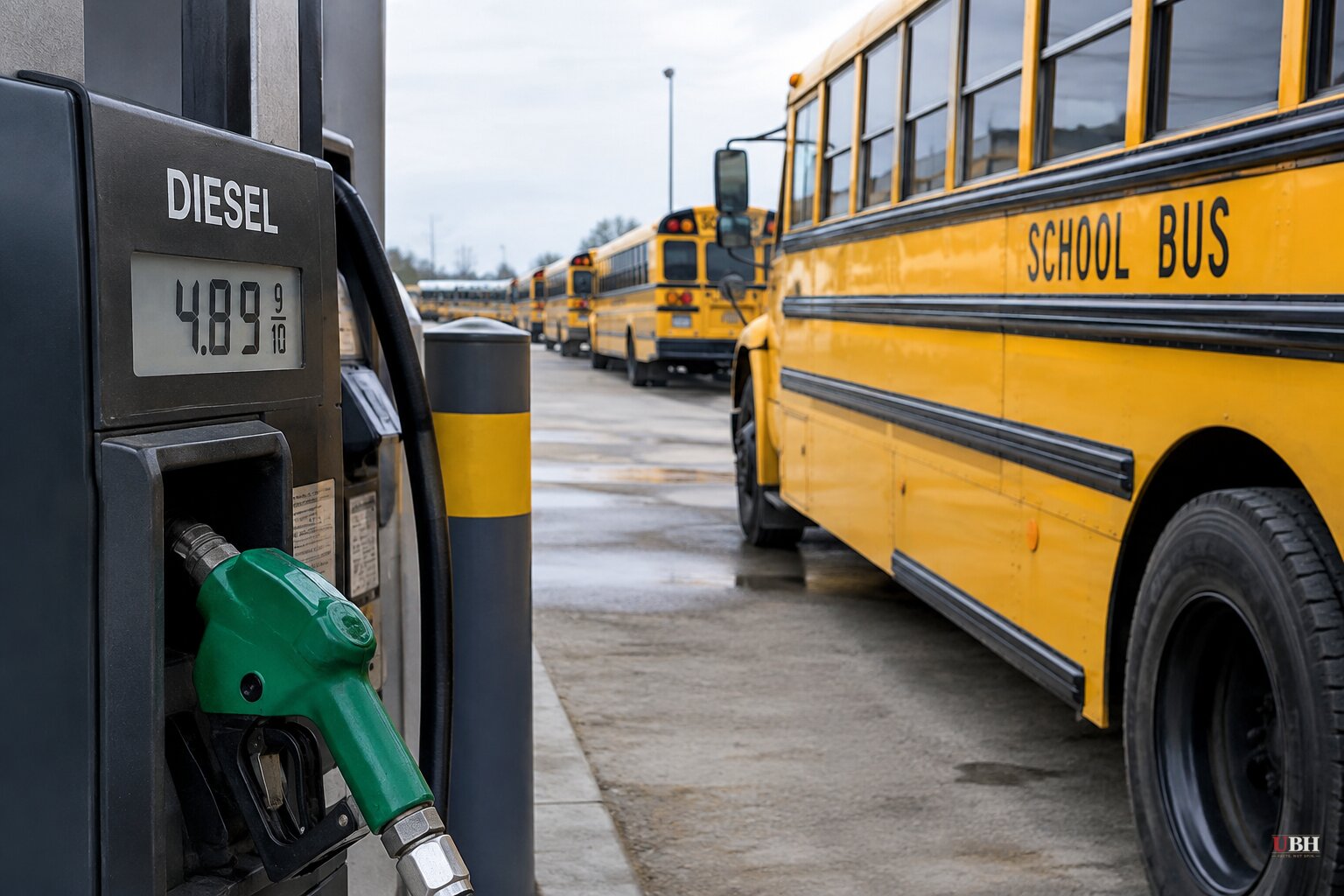
Fill-ups that used to cost $260 now cost $450
Milwaukee Public Schools runs about 650 buses every weekday. David Fifarek, the district's senior director of business and transportation services, says the cost to fill one standard bus has jumped from roughly $260 to more than $450 since diesel prices spiked.
The district locks in three-year contracts with private bus companies built around a fuel-price benchmark tied to the consumer price index. Last year's benchmark was $4.14 a gallon. Diesel has blown past that, triggering surcharges the district didn't plan for.
"If everything remains as where we're at right now, we're anticipating a $3.4 to $4 million cost factor that we didn't anticipate because prices for diesel have never hit this high," Fifarek told WUWM. Milwaukee has already eliminated 150 bus routes this school year, saving about $25,000 per route, and consolidated stops. The district is also leaning harder on 50 electric buses already in its fleet, with 100 more coming over the next two years.
Illinois alone spent $1.86 billion on busing
The Illinois State Board of Education reported spending $1.86 billion on student transportation in the 2025-26 school year, with contracted transportation services making up $1.24 billion of that. Back in 2021, total transportation spending in the state was $1.25 billion, meaning costs have climbed $610 million in five years, according to The Center Square.
Illinois reimburses districts for driver salaries, fuel, oil, tires and vehicle depreciation through its Pupil Transportation Claim and Reimbursement System, but the Fiscal Year 2027 allocation of $809.37 million is essentially flat from the prior year. AAA fuel data cited by The Center Square shows diesel in Illinois up roughly 67 cents a gallon since mid-May.
Noelle Ellerson Ng, chief advocacy and governance officer at the American Association of School Administrators, helped run a May survey of district officials. About a quarter reported running 11 to 20 percent over their transportation budget, and more than half were over budget by some amount. Districts responded first by consolidating bus routes, tightening route efficiency and cracking down on idling before turning to other revenue sources, she said.
The war is the trigger, but not the whole story
Multiple sources tie the diesel spike directly to the U.S.-Iran war, which the American Association of School Administrators says began in late February. The Independent reported Donald Trump "launched a war against Iran, choking off the world's oil supply," and that Iran's closure of the Strait of Hormuz is a direct factor in diesel costs now near a record $6.53 a gallon nationally, up from $3.74 a year earlier.
Patrick De Haan, head of petroleum analysis at GasBuddy, told The Independent the diesel crunch "comes down to one thing: how hard it is right now to turn oil into diesel, and how many people around the world are fighting over getting it." He also pointed to diesel export bans from Russia and China as compounding factors, not just the Strait closure. Trump said last Wednesday he was considering copying those export restrictions himself to bring down domestic prices ahead of November's midterms, according to The Independent.
If the administration follows through on an export restriction and prices ease, it would suggest the spike is a manageable supply-chain problem rather than a structural one. As of now, no such policy has been enacted, and oil markets remain jumpy: Reuters reported Brent crude climbed above $103 a barrel in Monday trading after Yemen's Houthi movement said it struck Saudi Aramco facilities in Riyadh and Khurais, a reminder the regional conflict isn't contained to Iran alone.
The broader price tag, and the pushback
The Institute on Taxation and Economic Policy, in an analysis cited by People's World, estimated the total added cost of higher gas and diesel prices tied to the war topped $103 billion nationally by late September, on pace to approach $180 billion by year's end. ITEP put the extra cost to the average household at $750 so far, rising toward $1,300 by December. Local and state governments have paid an estimated $1.98 billion extra for fuel this year, per the same analysis, projected to hit $3.35 billion by year's end, a cost that ultimately lands on taxpayers.
Those are modeled projections from a single research organization, not audited government totals, and should be read as estimates rather than final figures. Garrison Public Schools in North Dakota budgeted $100,000 for diesel this year, up from $80,000 last year and $65,000 the year before, Superintendent Nick Klemisch told The Independent. "We rob Peter to pay Paul, basically," he said. "We may have to not purchase a piece of equipment for the classroom."
Some districts bet on alternative fuel early
Not every district is bleeding. In Boulder, Colorado, most buses run on propane and unleaded fuel with some electric buses mixed in. Assistant transportation director David Self told NPR the district's diesel expenditure is actually down 12 percent from last year. Jefferson County, Colorado, with nearly 400 buses covering more than 20,000 miles a day, hasn't been as lucky. Transportation director Nathan Reimer told NPR the district's fuel spend is "staggeringly higher than even last year" and he's now studying smarter routing.
Peter Mannella of the National Association of Pupil Transportation warned the squeeze could eventually hit extracurriculars directly: "Do we take the team to the football game, or do we let mom and dad do that? Do we have field trips to museums?" A survey of 188 school officials found 40 percent had already consolidated routes, 27 percent cracked down on idling, and 20 percent had cut back field trips.
Whether diesel prices ease depends largely on how the Iran conflict develops and whether Trump moves forward with an export restriction of his own. Until then, districts are stuck deciding what gets cut first: bus routes, equipment, or field trips.
Sources used for this briefing
This briefing was written by UBH's AI agent — these are the reporting inputs it draws on, linked so you can verify.


