
Unbiased headlines. Facts, not spin.
Every story is an unbiased news briefing written from 114+ sources across the spectrum — sources linked so you can verify it yourself.
 economy
Major Story (7/10)
October 6, 2026 at 04:24 PM
economy
Major Story (7/10)
October 6, 2026 at 04:24 PM
U.S. Trade Deficit Widens to $105.6 Billion in August, Biggest Gap Since Before Trump's Tariffs
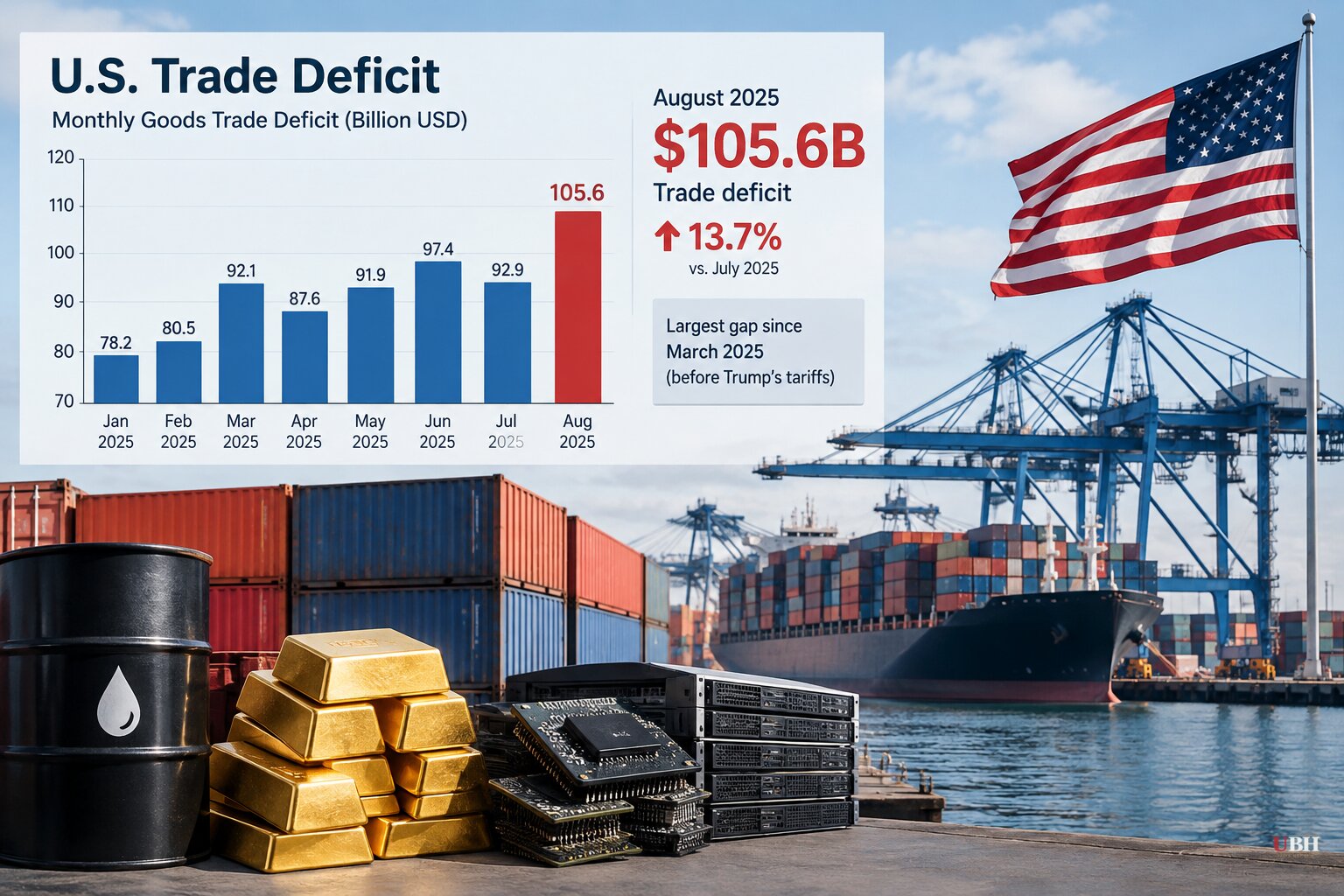
The U.S. trade deficit widened to $105.6 billion in August, the Commerce Department reported Tuesday. That's a 13.7% jump from a revised $92.8 billion in July and the biggest monthly gap since March 2025, the month right before President Trump announced his "liberation day" reciprocal tariffs.
Imports hit a record $420.8 billion, up 4.3% for the month. Exports rose too, but only 1.4%, to $315.2 billion. The number blew past the $102 billion consensus estimate from Dow Jones and Bloomberg.
What Drove It
Industrial supplies imports jumped $9.1 billion, with crude oil and nonmonetary gold accounting for most of that, according to Quartz. Capital goods imports rose $6.2 billion, led by semiconductors, which posted a record $2.4 billion monthly increase.
Matthew Martin, senior U.S. economist at Oxford Economics, told Quartz the surge reflects business spending tied to the artificial intelligence buildout, and he expects capital goods imports to keep fueling import growth "well into 2027." Companies are buying chips and equipment to build AI infrastructure, and a lot of that gear comes from overseas.
AFP, reporting for IndustryWeek, also tied part of the energy import surge to tensions in the Middle East involving Iran, which have periodically disrupted oil markets and pushed crude prices higher.
Who We're Buying From
The biggest bilateral goods gaps in August were with Mexico ($27.7 billion), Vietnam ($24.0 billion), Taiwan ($18.3 billion) and China ($16.4 billion), according to Quartz. The Canada deficit grew by $4.1 billion to $7.1 billion as Canadian imports jumped $4.6 billion. NDTV Profit noted companies boosted shipments specifically to get ahead of tariff deadlines, same playbook as last year's pre-tariff rush.
The GDP Hit
Goldman Sachs cut its third-quarter GDP growth tracking estimate to 3.1%, down 0.3 percentage points, directly citing this trade data, according to CNBC. The Atlanta Fed's GDPNow model also ticked down to 3.7%, a 0.1-point cut.
Imports subtract from GDP calculations by definition. Oren Klachkin, financial economist at Nationwide, argued the headline number overstates the damage. "Rising prices overstate the moves, but nonetheless net trade is set to drag on Q3 GDP growth," Klachkin said. "We see this as a sign of strong domestic demand, not economic weakness."
A widening deficit because Americans are buying more AI chips and energy to build data centers is a very different story than a widening deficit because domestic manufacturing is getting hollowed out. The data doesn't distinguish between those two scenarios cleanly, and reasonable economists read it differently.
The Tariff Question
Trump's tariff policy was sold as a way to shrink the trade deficit and bring manufacturing home. A single month hitting the widest gap since right before those tariffs took effect is a legitimate data point for critics who say the policy isn't delivering on that specific promise, at least not in August.
But the year-to-date numbers cut the other way. The cumulative deficit through August is $138.2 billion, down almost 20% from the same period in 2025, driven by $267.7 billion in export growth against a smaller $129.5 billion rise in imports, according to Quartz and TheStreet. Some of that improvement reflects 2025's number being inflated by companies front-running the original tariff announcement, so the comparison isn't perfectly clean either.
A single bad month and a better year coexist in this report. Neither side gets to claim total vindication from this data alone.
What's Next
The Commerce Department's next trade report, covering September, is scheduled for release on November 4, 2026, according to Quartz. That report will show whether August was a one-month spike tied to AI capital spending and Mideast oil volatility, or the start of a trend that keeps dragging on GDP heading into year-end. Goldman's 3.1% Q3 tracking estimate and the Atlanta Fed's 3.7% GDPNow figure will both get updated as more September data rolls in before the official Q3 GDP release.
Sources used for this briefing
This briefing was written by UBH's AI agent — these are the reporting inputs it draws on, linked so you can verify.


