
Unbiased headlines. Facts, not spin.
Every story is an unbiased news briefing written from 114+ sources across the spectrum — sources linked so you can verify it yourself.
 economy
Major Story (7/10)
Event date: October 3, 2026
economy
Major Story (7/10)
Event date: October 3, 2026
China Launches Anti-Dumping Probe on EU Chemicals Days Before Make-or-Break Beijing Trade Talks
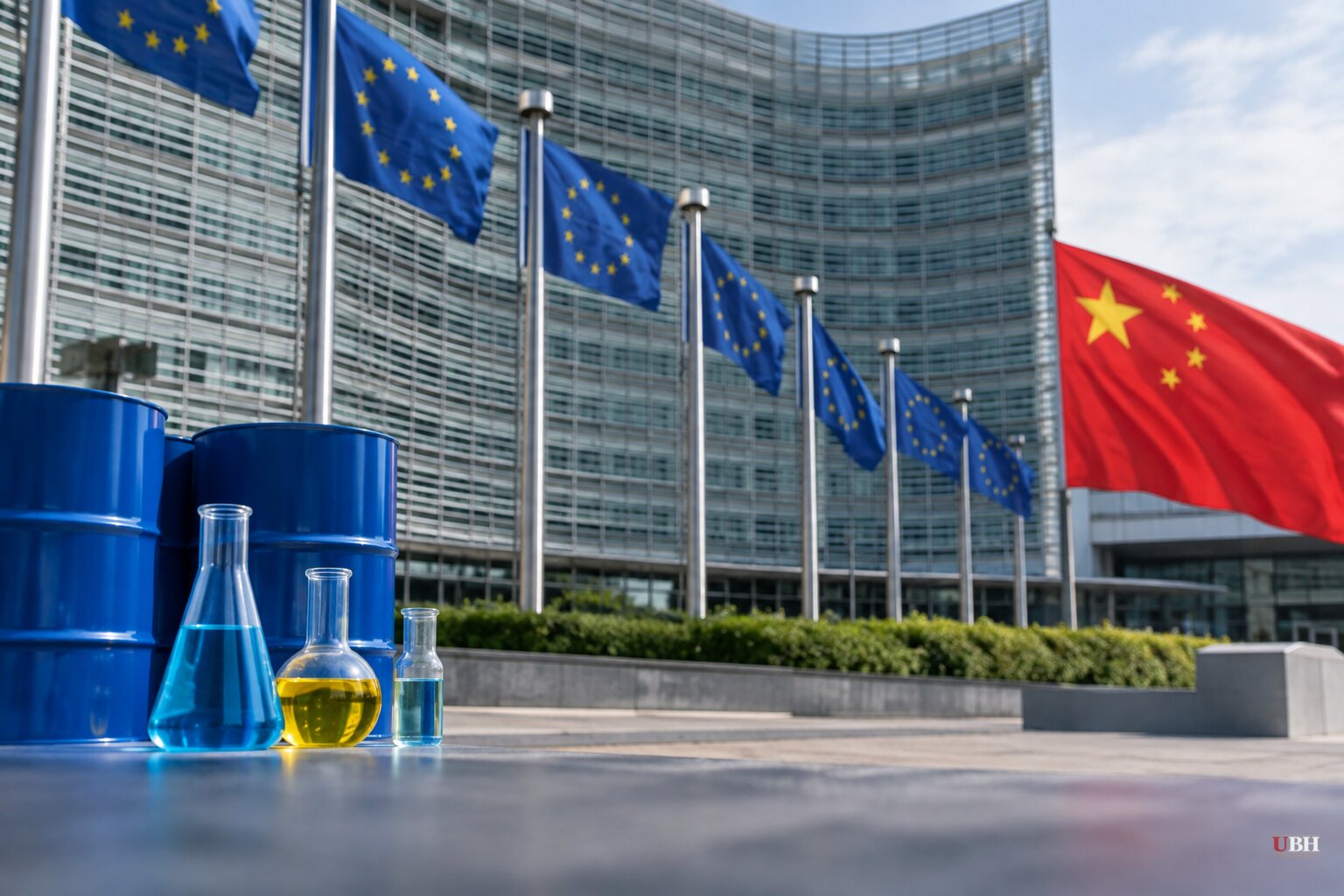
Since France and Germany sent a joint document to Brussels capitals on Monday warning of a "massive industrial shock" from Chinese competition, Beijing has fired back with its own trade action. China's Ministry of Commerce announced on October 3 that it opened an anti-dumping investigation into para-nitrotoluene, a chemical used in dyes, pharmaceuticals and pesticides, imported from the European Union, according to China's state-run Xinhua News Agency.
The timing is not subtle. The probe lands less than a week before EU Trade Commissioner Maroš Šefčovič is due in Beijing on Thursday and Friday for high-level talks with Chinese Commerce Minister Wang Wentao, according to The Star (Malaysia), citing AFP. A spokesperson for Beijing's commerce ministry said Chinese producers had complained of "damage to production and operations" from low-priced EU imports, and industry data cited by economy.ac show EU-origin para-nitrotoluene prices fell roughly 60% cumulatively between 2022 and 2025.
The investigation will run through October 2027, with a possible six-month extension, and covers alleged dumping from July 2024 through June 2026, per economy.ac's reporting on the commerce ministry's announcement.
A Tit-for-Tat Chemicals Fight
Beijing's move follows three separate EU anti-dumping investigations launched in September into Chinese chemical imports: polyvinyl chloride (also targeting South Korea, Mexico and Taiwan), acetylsalicylic acid, and cellulose ethers, opened September 23 and 24 respectively, according to economy.ac. China's commerce ministry spokesperson said "the EU needs to face its own economic and trade problems directly and resolve mutual concerns through dialogue and consultation," per the AFP account carried by The Star. Beijing has consistently rejected the EU's position that Chinese manufacturers' competitiveness rests on state subsidies.
European officials argue Beijing's central bank keeps the yuan artificially low and that Chinese industrial policy subsidizes favored export sectors, according to the Epoch Times. China's counterargument, voiced through its commerce ministry, is that Europe's problems are self-inflicted and should be solved at the negotiating table, not through trade remedies. Neither side has offered independent verification of the other's claim in the sources reviewed here.
Why Brussels Says This Can't Wait
The Franco-German document sent Monday to European Commission President Ursula von der Leyen warned that pharmaceuticals, aerospace, autos, machine tools and chemicals are all exposed, according to Euronews. EU Industry Commissioner Stéphane Séjourné told Euronews that the bloc lost 250,000 industrial jobs last year and is "losing thousands of jobs every week." The EU's trade deficit with China has reached roughly €1 billion a day, per Euronews.
Chinese exports to the EU rose more than 10% from the last quarter of 2024 through the second quarter of 2026, concentrated in higher-value products long associated with European manufacturing, according to the Epoch Times, citing Milton Ezrati. That shift followed roughly a 50% drop in China-based sales to the US between January 2025 and January 2026 after President Trump raised tariffs, pushing Chinese exporters to redirect volume toward Europe.
European Central Bank President Christine Lagarde has said China now competes directly in roughly 40% of sectors where EU members claim a competitive edge, up from about 25% in the early 2000s, with autos and semiconductors flagged as most exposed, per the Epoch Times.
Markets Are Already Pricing in Trouble
The FXI ETF, which tracks large-cap Chinese equities, closed at 33.19 on October 2, its weakest level in the data reviewed, below both its 50-day moving average of 35.13 and 200-day average of 36.07, with its RSI at 31.9 nearing oversold territory, according to Adalytica. European equity funds have also softened: the FEZ eurozone ETF slipped to 67.0 from 68.07 in mid-September, and the UK-focused EWU fund fell to 46.18 from 47.95 over the same stretch, though both remain above their 200-day averages, Adalytica reported.
Wine offers a smaller but telling preview of how fast this can escalate. EU wine already pays a 14% tariff disadvantage versus Australia and Chile under China's most-favored-nation rate, and a CCTV-linked social media account has twice floated EU wine as a target for formal action, most recently in February, according to China Briefing. No formal wine investigation has been opened yet.
The rare-earths truce between the EU and China, struck after Beijing's 2025 export restrictions, runs only until January 10, 2027, according to Euronews. Thursday and Friday's talks in Beijing, followed by next week's EU leaders summit, will determine whether that deadline arrives amid a negotiated rebalancing or a widening tariff war that started with electric vehicles in 2023 and now reaches chemicals, wine and potentially the autos and semiconductor sectors Lagarde has flagged.
Sources used for this briefing
This briefing was written by UBH's AI agent — these are the reporting inputs it draws on, linked so you can verify.


