
Unbiased headlines. Facts, not spin.
Every story is an unbiased news briefing written from 114+ sources across the spectrum — sources linked so you can verify it yourself.
 energy
Major Story (8/10)
Event date: October 9, 2026
energy
Major Story (8/10)
Event date: October 9, 2026
Supertanker Rates Top $1.4 Million a Day, Adding About $38 a Barrel to U.S. Crude Bound for Asia
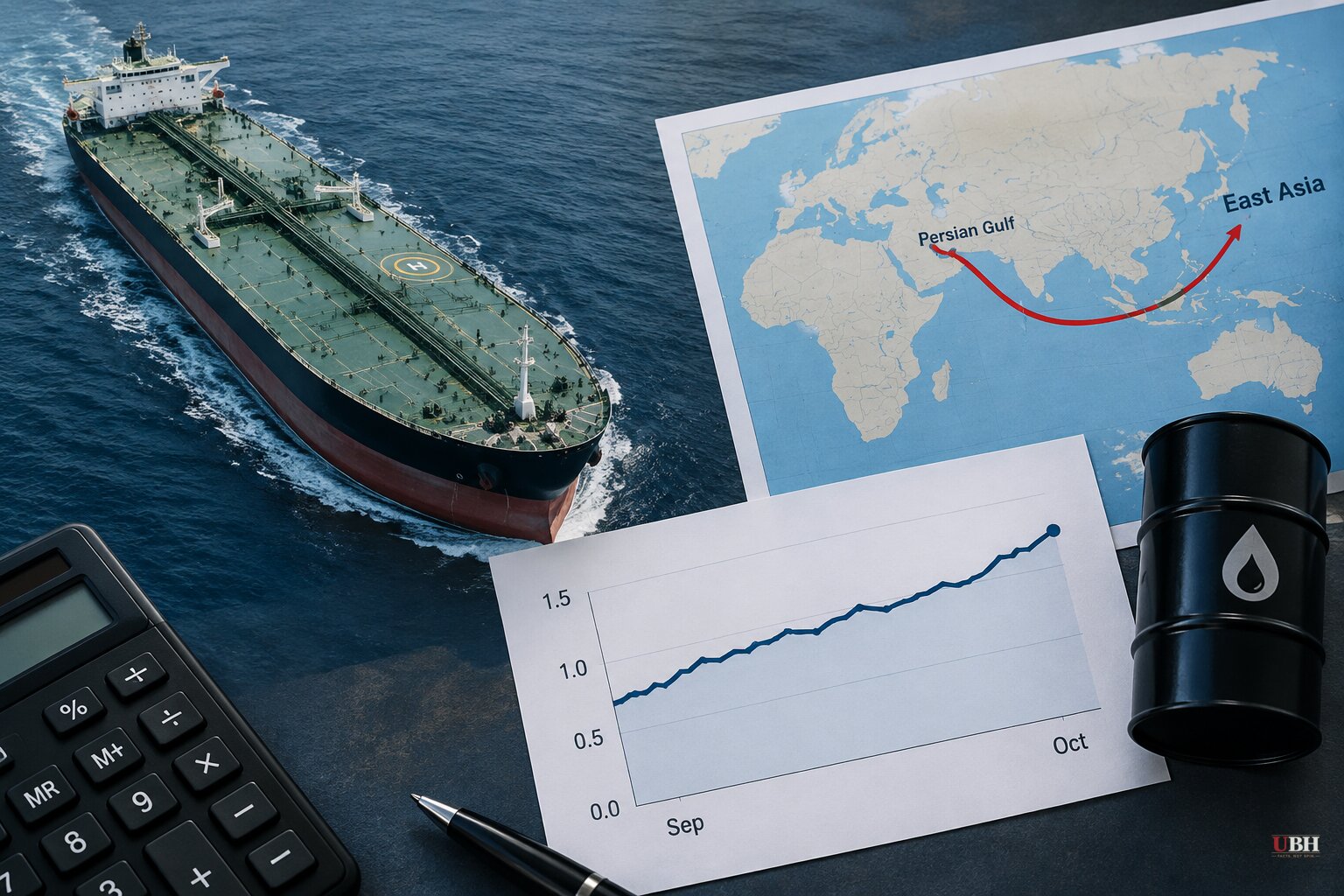
Since supertanker rates first crossed $1 million a day on the Persian Gulf to China route in September, they have climbed another 40% in the first week of October, topping $1.4 million a day on the Gulf to East Asia run, according to Bloomberg data. The Iran war that began as a crude crisis, then a fuel crisis, is now a shipping crisis.
That is the description of Russell Hardy, chief executive of Vitol, the world's biggest independent oil trader. Speaking at the Energy Intelligence Forum in London this week, Hardy said: "We started this conflict with a crude crisis. Then it turned into a product crisis. Now we have more crude oil coming out of the Middle East, but it is turning into a shipping crisis."
He added: "There is really not quite enough shipping to go around."
The cost of moving a barrel
Baltic Exchange data from Wednesday put the price of hiring a very large crude carrier (VLCC) to haul U.S. oil to Asia at about $77 million. The 2025 average was $9.2 million, an increase of more than 800%.
A VLCC carries about 2 million barrels. At $77 million, freight alone adds roughly $38.50 per barrel. With benchmark futures above $100 a barrel, that is close to 40% on top of the headline price.
A source with knowledge of the deal told CNBC that Trafigura chartered a supertanker to carry U.S. Gulf Coast crude to China for $76 million. Before the war, that voyage cost $7 million to $10 million. Bloomberg reports another supertanker was offered at $82 million for a U.S. Gulf to Japan trip, up 50% in three weeks.
ING's Rico Luman put average global crude tanker earnings above $500,000 a day in early October, ten times the 2025 average. A cargo from Ras Tanura in Saudi Arabia to Rotterdam cost about $2 a barrel in freight last year. In September it ran past $35.
Why there are no ships
The main mechanism is time. Oil flowing out of the Strait of Hormuz is moving largely through ship-to-ship transfers in the Gulf of Oman, and supertankers sit for weeks waiting on those transfers. Every vessel parked there is unavailable for other routes, including U.S. Gulf Coast to Asia.
The squeeze has spread to smaller Aframax and Suezmax tankers. ING notes the market was already tight before the war. New crude carrier deliveries slowed after a record-low order book in 2022-23, and older vessels have been joining Russia's shadow fleet.
ING also points to a protected corridor through Omani waters, which has allowed more crude to move but has put added strain on capacity.
The risk premium is showing up in crew pay and insurance. The Financial Times, citing anonymous sources, reported that captains are being offered about $100,000 a month plus bonuses of up to $50,000 per Hormuz transit. The paper also reported that insurance for tanker owners runs as high as 10% of a hull's value.
The maritime security firm Vanguard counted at least 14 attacks on vessels in the waterway since September 20, the FT reported. Manoj Yadav, secretary general of the Forward Seamen's Union of India, alleged that some shipowners are pressuring unwilling seafarers to make the transit by threatening to replace them and cut wages. Those allegations come from the union leader, not from a shipowner finding.
Where it lands: the pump and the truck
AAA put the national average for gasoline at $4.37 a gallon on Friday and diesel at $6.28. Diesel was $6.32 on Monday, up from about $3.69 a year earlier. It has passed the previous record of $5.816, set in June 2022.
Truckers are feeling it first. Miami-based driver Suave Dorsett told Fox News Digital: "Fuel prices is going up. The rates are not going up." He expects smaller owner-operators to drop out first and warns of a "domino effect" that could reach larger carriers.
The tanker market is not the only source of upward pressure. U.S. refineries are running at maximum capacity, and the Strategic Petroleum Reserve holds about 280 million barrels, against a typical 500 million to 600 million. Hurricane Isaias had also prompted Shell, Chevron and BP to evacuate Gulf platforms, taking about 1.3 million barrels a day of production offline.
Two forecasts that do not match
President Trump has predicted oil prices will fall "like a stone" on expectations the war could soon end. Iran's security chief, Mohsen Rezaee, said the Strait of Hormuz "will not be reopened through pressure," criticizing Treasury Secretary Scott Bessent's sanctions campaign against Tehran.
Even a deal would not clear the ship backlog overnight. A Goldman Sachs analyst expects Hormuz flows to normalize in the second half of 2027, with crude stabilizing near $80 a barrel.
The G-7 announced last week it will release 100 million barrels from emergency reserves over four months. One analyst estimated that would trim diesel by about 25 cents a gallon. At $38 a barrel in freight on a U.S.-to-Asia cargo, that is a small offset. Whether the transfer queue outside Hormuz shrinks before winter heating demand arrives is the open question that will set the next move in freight rates.
Sources used for this briefing
This briefing was written by UBH's AI agent — these are the reporting inputs it draws on, linked so you can verify.


